Chinese E-cigarette Exports to Philippines Increase Significantly in November

Industry Insight by Mincy
Jan.03.2024
Chinese E-cigarette Exports to Philippines Increase Significantly in November
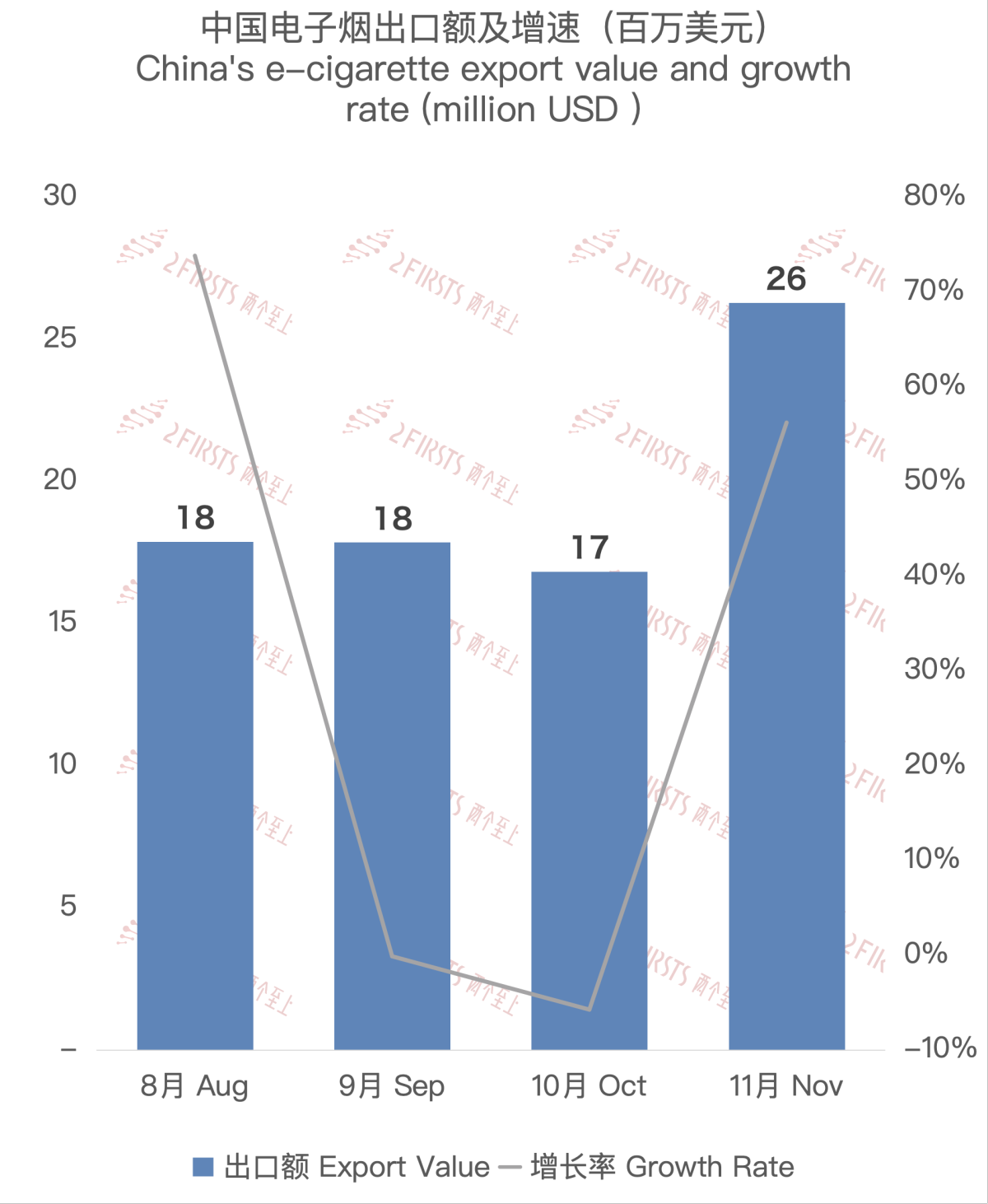
China's e-cigarette exports to the Philippines in November 2023 reached $26.29 million, with a YoY growth of 249.28%.

According to updated trade data from the General Administration of Customs of the People's Republic of China, 2FIRSTS has analyzed the e-cigarette export figures from China to the Philippines in November 2023. Here are the details:
Chinese E-cigarette Exports to Philippines Increase Significantly in November
Image source: 2FIRSTS (Mincy mapping)


Exports reached approximately $26.29 million, marking a month-on-month growth of 56.22% and a year-on-year growth of 249.28%.
Chinese E-cigarette Exports to Philippines Increase Significantly in November
Image source: 2FIRSTS (Graphics by Mincy)


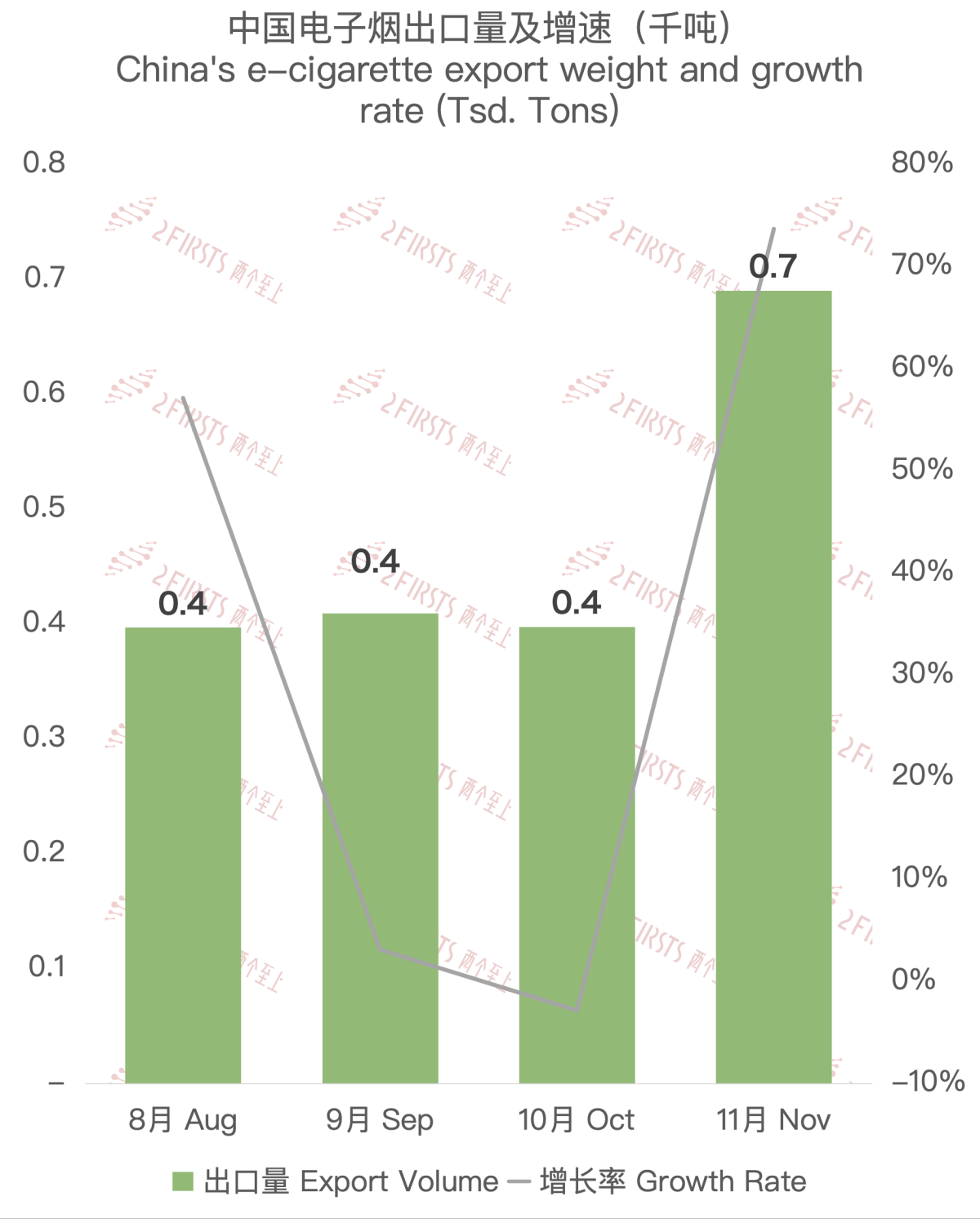
The export volume reached approximately 690 tons, with a month-on-month growth rate of 73.66% and a year-on-year growth rate of 300.87%.
Chinese E-cigarette Exports to Philippines Increase Significantly in November
Source of the image: 2FIRSTS (Designed by Mincy)


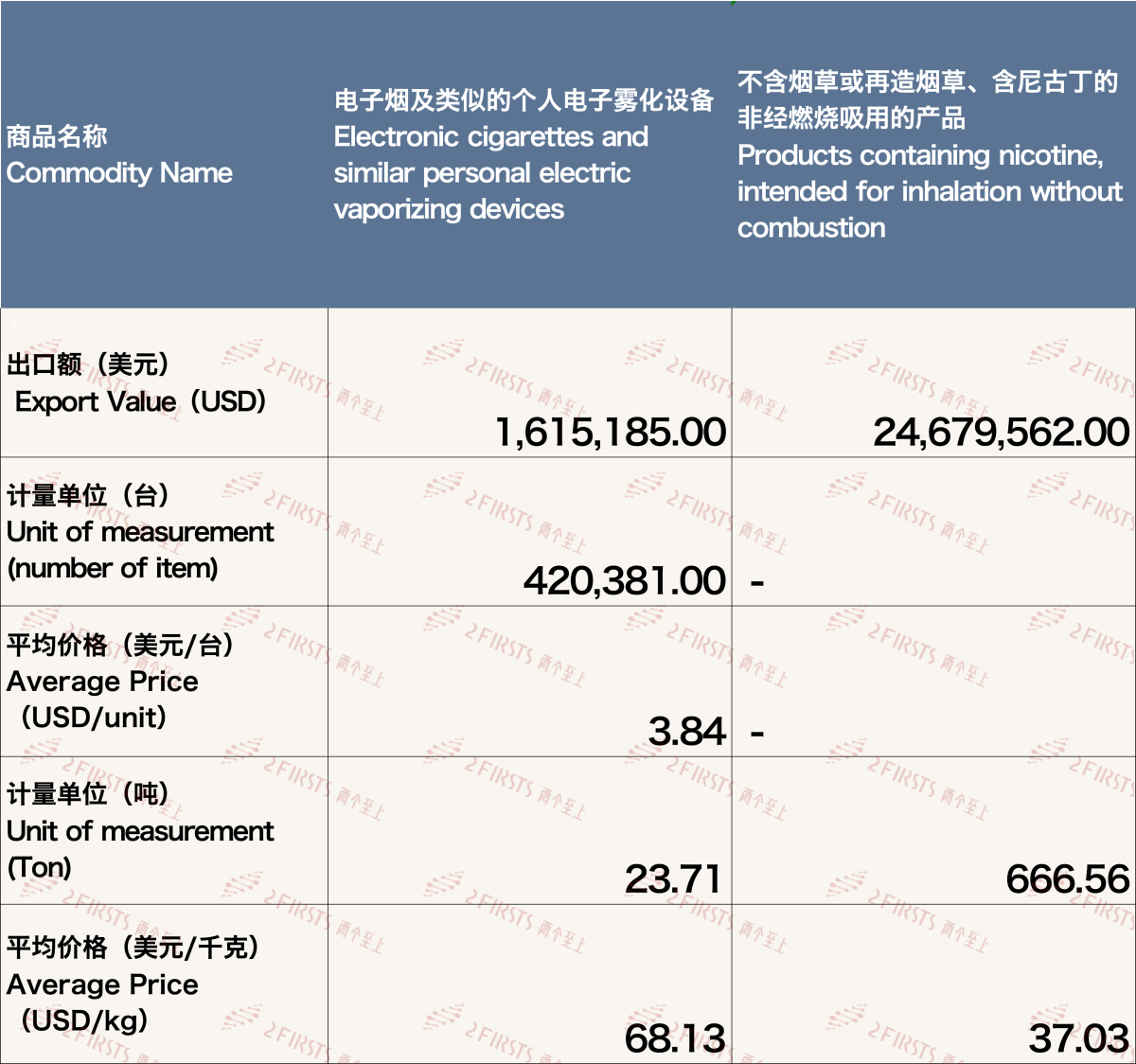
The export unit price decreased by 10.04% on a monthly basis and 12.87% on a year-on-year basis, reaching $38.09 per kilogram. Meanwhile, the average price of "e-cigarettes and similar personal electronic vaporizers" was $3.84 per unit.

Chinese E-cigarette Exports to Philippines Increase Significantly in November
Image source: 2FIRSTS (created by Mincy)


Among them, "e-cigarettes and similar personal electronic vaporizer devices" accounted for 6.14% of the export product category, while "non-combustible products containing nicotine, excluding tobacco or reconstituted tobacco" accounted for 93.86%.

Chinese E-cigarette Exports to Philippines Increase Significantly in November
Image source: 2FIRSTS (Mincy artwork)


We welcome news tips, article submissions, interview requests, or comments on this piece.

Please contact us at info@2firsts.com, or reach out to Alan Zhao, CEO of 2Firsts, on LinkedIn


Notice

1.  This article is intended solely for professional research purposes related to industry, technology, and policy. Any references to brands or products are made purely for objective description and do not constitute any form of endorsement, recommendation, or promotion by 2Firsts.

2.  The use of nicotine-containing products — including, but not limited to, cigarettes, e-cigarettes, nicotine pouchand heated tobacco products — carries significant health risks. Users are responsible for complying with all applicable laws and regulations in their respective jurisdictions.

3.  This article is not intended to serve as the basis for any investment decisions or financial advice. 2Firsts assumes no direct or indirect liability for any inaccuracies or errors in the content.

4.  Access to this article is strictly prohibited for individuals below the legal age in their jurisdiction.


Copyright


This article is either an original work created by 2Firsts or a reproduction from third-party sources with proper attribution. All copyrights and usage rights belong to 2Firsts or the original content provider. Unauthorized reproduction, distribution, or any other form of unauthorized use by any individual or organization is strictly prohibited. Violators will be held legally accountable.

For copyright-related inquiries, please contact: info@2firsts.com


AI Assistance Disclaimer


This article may have been enhanced using AI tools to improve translation and editorial efficiency. However, due to technical limitations, inaccuracies may occur. Readers are encouraged to refer to the cited sources for the most accurate information.

We welcome any corrections or feedback. Please contact us at: info@2firsts.com

Bringing Tax and Insurance Into Nicotine Regulation: Insights From a Tobacco Harm-Reduction Report
A smoke-free nicotine policy report argues that tobacco harm reduction should move beyond product bans and health warnings into tax policy, insurance pricing and risk-based regulation. While some projections remain open to debate, the report highlights a wider challenge: nicotine products, technologies and consumer behavior have changed sharply over the past decade, and regulatory systems may need new tools to better align tobacco control with harm-reduction goals.
Jun.08
EU Launches Online Feedback as TPD Revision Enters New Milestone
The European Commission has opened an online call for evidence on revising EU tobacco products and advertising rules, marking a new phase in the TPD/TAD review. Policy options may cover novel products, flavours, packaging, digital marketing and advertising. A 2Firsts review of 855 early submissions shows rapid engagement and recurring debate over differentiated regulation, harm reduction, youth protection, illicit trade and economic impact.
Special Report
May.21
Charlie’s Plans Q3 2026 Pilot of America’s First Age-Gated Flavored Disposable Vape
U.S. vape company Charlie’s Holdings announced plans to pilot its age-gated flavored disposable vape products in hundreds of retail stores during the third quarter of 2026. The company said the products will utilize AI- and blockchain-powered age-verification technology designed to address FDA concerns over youth access and potentially create a new compliance pathway for flavored vape products.
Jun.15
 RFK Jr. Spokesman Resigns Over FDA Authorization of Fruit-Flavored Vapes
RFK Jr. Spokesman Resigns Over FDA Authorization of Fruit-Flavored Vapes
Richard Danker, a senior public affairs official in Health Secretary Robert F. Kennedy Jr.’s team, resigned from his role at HHS over the FDA’s recent authorization of fruit-flavored vaping products. In a resignation letter addressed to President Donald Trump, Danker argued that the products could expose minors to nicotine addiction, lung damage, and increased cancer risks, while also conflicting with recent HHS guidance on youth risks associated with flavored nicotine products.
News
May.15
The new regulations on nicotine in Argentina are creating caution, expectations, and doubts about the market, according to a local reference in harm reduction for smoking.
The new Argentine framework for tobacco and nicotine marks a shift from prohibition towards registration, traceability, and health surveillance. Juan Facundo Teme told 2Firsts that adult consumers and some of the commercial sector are cautiously optimistic, although concerns remain about flavors, registration costs, and market access.
May.11
Multi-State Coalition Urges F1 to End Nicotine Sponsorships, Citing Zyn and Velo
Hawaii Attorney General Anne Lopez is co-leading a coalition of 19 states and jurisdictions urging the Fédération Internationale de l’Automobile (FIA) and Formula 1 to end sponsorships involving tobacco and nicotine products, including nicotine pouch brands such as Zyn and Velo.
News
Jun.09