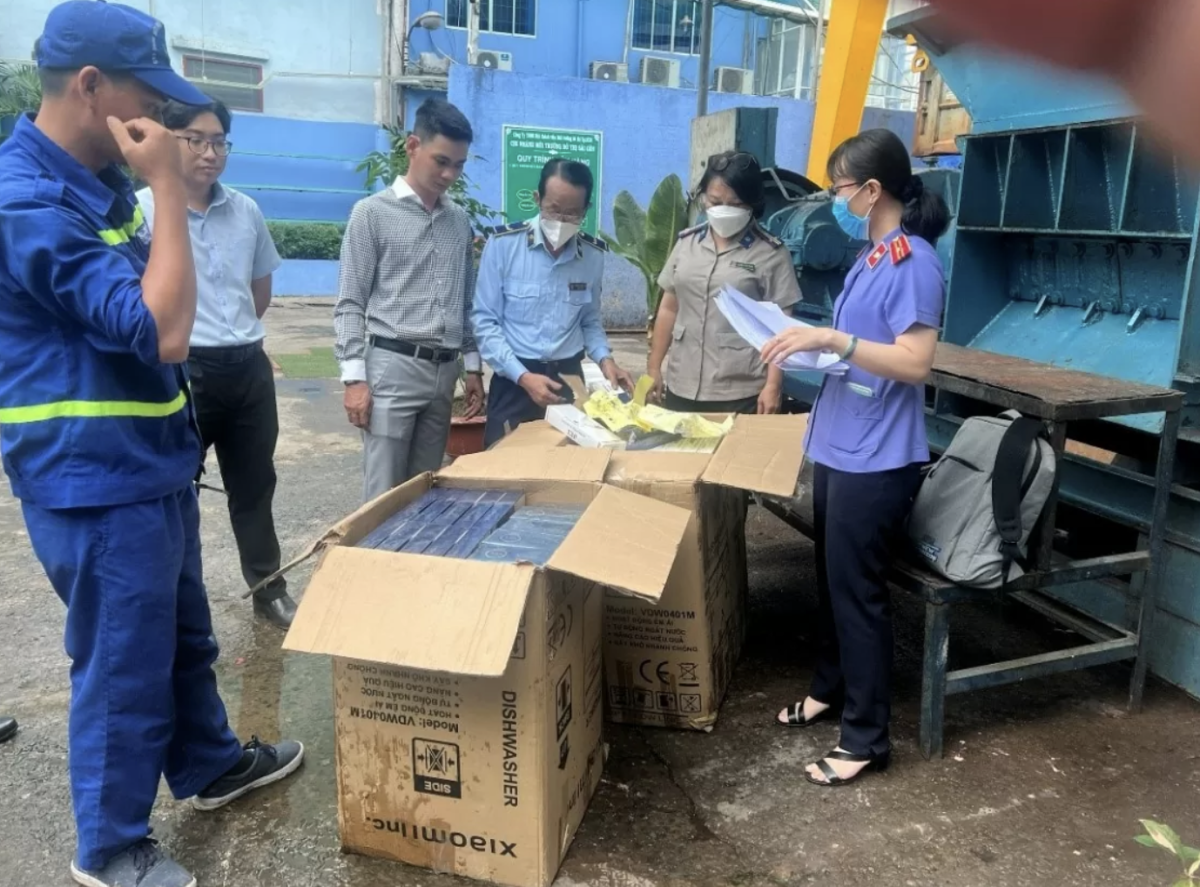
Destruction of Illegal Imported Tobacco Products in Ho Chi Minh City

Aug.07.2024
Destruction of Illegal Imported Tobacco Products in Ho Chi Minh City
Authorities in Ho Chi Minh City collaborated with multiple agencies to destroy 20,810 packs of smuggled tobacco products.

According to the Ho Chi Minh City Market Management Department's report on August 7, in the first seven months of 2024, representatives from Vietnam Environment Joint Stock Company, Ho Chi Minh City Urban Environment Company, Ho Chi Minh City Urban Environment Limited Liability Company branch, and Dai Phuc Solid Waste Treatment and Cemetery Joint Stock Company, along with representatives from City Department 389, Vietnam Tobacco Association, Cần Giờ, Tân Phú District, and the administrative authorities of District 3 and Market Management Department No. 18, carried out activities to destroy illegally imported smuggled tobacco products.


The destroyed tobacco products included 20,810 packs of various brands, including 555, Jet, Hero, Esse Change, Esse Menthol, Esse Lights, Marlboro, Zouk, Raison Ice Cafe, Caraven Demi, Caraven Classic, Saigon Sliver, and others.


The disposal method involves placing tobacco products into a professional shredder for grinding, and then directly incinerating them in a high-temperature furnace to ensure compliance with environmental technology requirements.


This destruction of smuggled tobacco products was carried out under strict supervision from City Permanent Institution No. 389, Market Management Bureau, Vietnam Tobacco Association, and relevant units responsible for handling administrative violations and recent enforcement decisions.


The Ho Chi Minh City Market Management Bureau stated that this is one of the regular activities of the bureau, as part of the 389 Steering Committee, to actively strengthen cooperation with other forces to combat counterfeit and low-quality products, especially foreign tobacco products smuggled from the southwestern border and then resold locally.


We welcome news tips, article submissions, interview requests, or comments on this piece.

Please contact us at info@2firsts.com, or reach out to Alan Zhao, CEO of 2Firsts, on LinkedIn


Notice

1.  This article is intended solely for professional research purposes related to industry, technology, and policy. Any references to brands or products are made purely for objective description and do not constitute any form of endorsement, recommendation, or promotion by 2Firsts.

2.  The use of nicotine-containing products — including, but not limited to, cigarettes, e-cigarettes, nicotine pouchand heated tobacco products — carries significant health risks. Users are responsible for complying with all applicable laws and regulations in their respective jurisdictions.

3.  This article is not intended to serve as the basis for any investment decisions or financial advice. 2Firsts assumes no direct or indirect liability for any inaccuracies or errors in the content.

4.  Access to this article is strictly prohibited for individuals below the legal age in their jurisdiction.


Copyright


This article is either an original work created by 2Firsts or a reproduction from third-party sources with proper attribution. All copyrights and usage rights belong to 2Firsts or the original content provider. Unauthorized reproduction, distribution, or any other form of unauthorized use by any individual or organization is strictly prohibited. Violators will be held legally accountable.

For copyright-related inquiries, please contact: info@2firsts.com


AI Assistance Disclaimer


This article may have been enhanced using AI tools to improve translation and editorial efficiency. However, due to technical limitations, inaccuracies may occur. Readers are encouraged to refer to the cited sources for the most accurate information.

We welcome any corrections or feedback. Please contact us at: info@2firsts.com

The new regulations on nicotine in Argentina are creating caution, expectations, and doubts about the market, according to a local reference in harm reduction for smoking.
The new Argentine framework for tobacco and nicotine marks a shift from prohibition towards registration, traceability, and health surveillance. Juan Facundo Teme told 2Firsts that adult consumers and some of the commercial sector are cautiously optimistic, although concerns remain about flavors, registration costs, and market access.
May.11
Imperial Brands Launches 2ml+10ml blu MAX 6000 Vape System
mperial Brands has launched blu MAX 6000 in the UK, positioning the product as a higher-puff vape kit with longer-lasting use and replaceable pod+refill options. The device uses a 2ml+10ml click-on box format, with starter kits priced at £10.99 (approximately $14) and replacement pod+refill packs priced at £7.99 (approximately $10).
Market
May.19
Acting CTP Director Says FDA Cut Premarket Tobacco Application Backlog by About 70% Over the Past Year
FDA Center for Tobacco Products Acting Director Bret Koplow said at the American Tobacco and Nicotine Forum that the agency has reduced its premarket tobacco application backlog by about 70% over the past year and eliminated the acceptance queue. He said FDA has reviewed about 27 million applications, but only a small number have been authorized, mainly because most submissions lacked the scientific data needed to demonstrate public health benefits.
Apr.23 by 2FIRSTS.ai
Revised Tobacco Business Act to Take Effect in South Korea, Banning Online Sales of Liquid Vapes
South Korea’s Ministry of Health and Welfare will implement a partial revision of the Tobacco Business Act on April 24. The scope will expand from products made with “tobacco leaves” to all products manufactured with natural or synthetic nicotine. Synthetic nicotine liquid e-cigarettes, which had previously been treated as industrial products and were freely sold and advertised online, will from April 24 be subject to the same regulations as ordinary tobacco products.
Apr.23 by 2FIRSTS.ai
Belgium Approves Vape Flavor Ban, Allowing Only Tobacco-Flavored and Unflavored Products From September 2028
Belgium’s federal government on Thursday approved a ban on flavored vapes, allowing only tobacco-flavored and unflavored e-cigarettes on the market from September 2028. Health Minister Frank Vandenbroucke said the measure is aimed at protecting the health of children and young people and preventing a new generation from becoming dependent on tobacco.
May.06 by 2FIRSTS.ai
State Registries Are Reshaping U.S. Vape Market Access 2Firsts Interview with U.S. Vapor Manufacturers Association President Allison Boughner
As the U.S. vapor market faces FDA authorizations, import seizures and growing state-level restrictions, AVM President Allison Boughner told 2Firsts that state product registries and white-list systems are having the most immediate impact. She said distributors are placing greater weight on documentation, product origin and supply-chain transparency.
Special Report
May.26