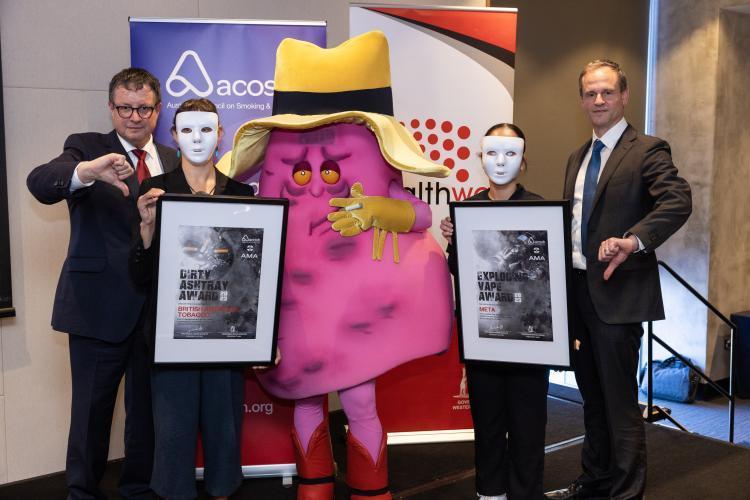
British American Tobacco (BAT) and the American social media company Meta were both awarded at a ceremony held in Perth, Australia, on August 29. BAT received the "Dirty Ashtray Award" while Meta won the inaugural "Exploding e-cigarette" award. These annual awards are presented by the Australian Medical Association (AMA) and the Australian Council on Smoking and Health (ACOSH) to highlight industries and organizations that undermine tobacco and e-cigarette control strategies in Australia.
The British American Tobacco Company is a proponent of Responsible Vaping Australia (RVA), having received recognition for supporting and funding a campaign aimed at undermining Australia's public health policies regarding e-cigarettes.
Meta, the owner of Facebook, Instagram, Threads, and WhatsApp, has won an award for its failure to enforce its policy of banning the promotion of tobacco or nicotine products on its platforms.
Laura Hunter, CEO of the Australian Council on Smoking and Health (ACOSH), has stated that RVA is a front for British American Tobacco (BAT), as the company aims to sell e-cigarettes in the retail market.
Tobacco giant British American Tobacco pretended to be concerned about the rise of the black market for e-cigarettes and the increasing number of teenagers using e-cigarettes, using the cover of RVA. The company lobbied the government and enlisted various community departments and organizations, who may be unaware that the large tobacco company is the mastermind behind their lobbying efforts. Consequently, they have rightly earned the 2023 Ashtray Award.
The inaugural "Explosive E-cigarette Awards" revealed individuals who endorse and spread information about the tobacco industry. Meta holds unparalleled influence in the virtual world, with a significant impact.
Meta's website proudly displays a policy that clearly promises to prohibit e-cigarette advertising or promotions on its platform. However, a quick glance reveals that this promise has not been enforced.
Mrs. Hunter stated that the Meta platform is being utilized to facilitate the use and sale of e-cigarettes, making it easier for an increasingly younger audience to be exposed to these products.
The President of the American Medical Association, Professor Robeson, has announced that the government has implemented significant measures to ban nicotine e-cigarette products and restrict their usage to only those prescribed by doctors.
The presence of filthy ashtrays and explosive e-cigarette incidents underscores the need to address the unregulated advertising of nicotine products on social media and prevent tobacco industry participants from funding political and lobbying groups.
Professor Robson said, "In order to safeguard the health of all Australians, our colleagues in the health and tobacco control departments are in favor of the government's introduction of new tobacco and e-cigarette reforms.
Over a hundred representatives from the Australian Public Health Alliance, dedicated to reducing smoking and e-cigarette consumption, attended a breakfast meeting. Among them was Minister for Health and Aged Care, Mark Butler, who discussed the next steps in government tobacco control legislation.
References
The Dirty Ashtray and Exploding Vape awards were recently given to big tobacco companies and social media platforms.
Disclaimer
This article is provided solely for professional research, industry discussion, and informational purposes. Any references to brands, companies, products, technologies, or policies are made for factual reporting and analytical purposes only, and do not constitute endorsement, recommendation, promotion, or advertising by 2Firsts.
Nicotine-containing products, including but not limited to cigarettes, e-cigarettes, heated tobacco products, and nicotine pouches, carry significant health risks. Readers are responsible for complying with all applicable laws and regulations in their respective jurisdictions, including age restrictions and access limitations.
The information contained in this article should not be regarded as investment, legal, medical, regulatory, or commercial advice. While 2Firsts strives to ensure the accuracy and reliability of its content, it does not assume liability for any direct or indirect loss arising from errors, omissions, inaccuracies, or reliance on the information contained herein.
This article is not intended for individuals below the legal age for accessing tobacco or nicotine-related information in their jurisdiction.
Copyright Notice
This article is either original content produced by 2Firsts or content reproduced, translated, summarized, or adapted from third-party sources with attribution where applicable. The intellectual property rights of the original content remain with 2Firsts or the respective original rights holders.
No individual or organization may copy, reproduce, distribute, republish, modify, translate, or otherwise use this content without prior authorization. Any unauthorized use may result in legal action.
For copyright-related inquiries, corrections, or removal requests, please contact: info@2firsts.com.
AI-Assisted Translation and Editing Notice
Portions of this article may have been translated, edited, or reviewed with the assistance of artificial intelligence tools to improve efficiency and readability. Due to the limitations of AI-assisted translation and editing, discrepancies, omissions, or inaccuracies may exist when compared with the original source.
Where applicable, readers are advised to refer to the original source for the most complete and accurate information. If you identify any errors or believe that any content infringes upon your rights, please contact us at info@2firsts.com, and we will review and address the matter promptly.