ECigIntelligence Interview: Stricter Regulation on NGPs, Especially in Nicotine Pouches

2Firsts Events by 2FIRSTS, edited by Sophia
Sep.20.2024
ECigIntelligence Interview: Stricter Regulation on NGPs, Especially in Nicotine Pouches
At InterTabac, Pablo, the legal analysis director from ECigIntelligence, stated in a conversation with 2Firsts that the global trend towards reducing tobacco harm reduction is strengthening, leading to increasingly strict regulation of NGPs. He pointed out that brands need to be prepared to face this pressure, especially in the field of nicotine pouches.

On September 19th, the InterTabac officially opened in Germany. As the official media partner, 2Firsts arrived at the event and had a discussion with Pablo Cano Trilla, the Head of Legal Analysis from ECigIntelligence.


TobaccoIntelligence is a professional tobacco consulting company based in Spain, with a sister company focused on the e-cigarette industry called ECigIntelligence. Both are independent brands operated by the same parent company, Tamarind Intelligence. At the industry conference during this expo, Pablo represented ECigIntelligence and delivered a speech titled "Legal Challenges, Prospects and Future Projections in the Evolving Nicotine and Novel Tobacco Sectors."


After the speech, Pablo discussed with 2Firsts that globally, there is a growing trend of reducing harm from tobacco, leading to increasingly strict regulations on new tobacco products. He pointed out that brands need to be prepared to face this pressure, especially in the area of nicotine pouches. 


He emphasized that the most likely scenario is that nicotine pouches are not going to be banned, but this is not something that should be discarded.


ECigIntelligence Interview: Stricter Regulation on NGPs, Especially in Nicotine Pouches
Pablo speaks at a lecture | Image source: 2Firsts


NGPs face strict regulation, nicotine pouches may be banned


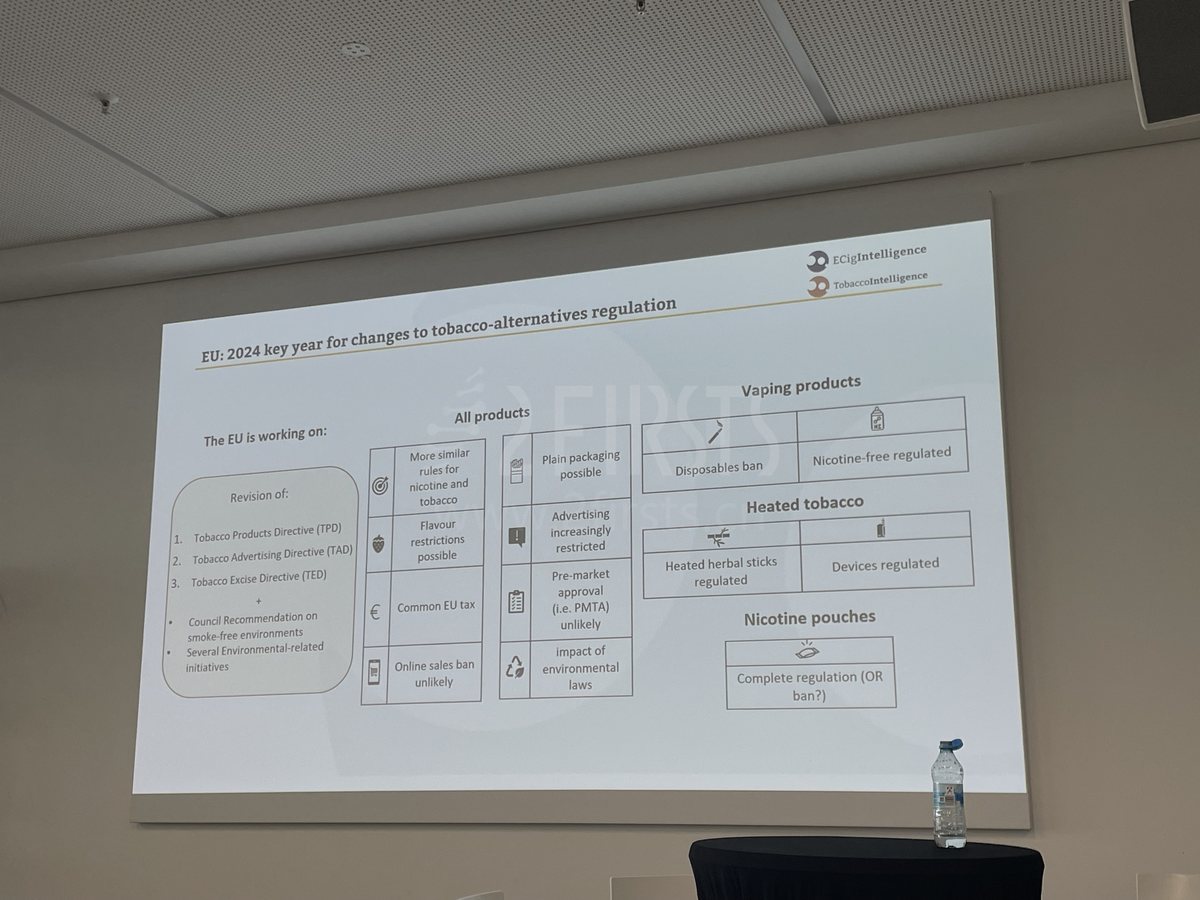
As the head of legal analysis at a professional tobacco consulting company, Pablo states that 2024 will be a crucial turning point for EU regulation of new tobacco products, particularly in the regulation of emerging products such as nicotine pouches. Pablo anticipates that the revised Tobacco Products Directive (TPD) will introduce more uniform rules, covering pre-market approval, advertising restrictions, and environmental regulations for products like nicotine pouches.


He emphasized that nicotine pouches have become a new target for regulation. Whether they will be banned or not remains uncertain. Nicotine pouch manufacturers and sellers need to closely monitor policy changes to ensure their products meet new regulatory requirements and adapt to the constantly evolving market environment.


Furthermore, Pablo told 2Firsts that European policymakers are paying particular attention to the regulation of e-vapor products (EVP), with a decreasing demand for disposable e-cigarettes in the European market (especially in the UK, Germany, and France) and a shift towards refillable products becoming the new mainstream. He mentioned that policies such as flavor bans for disposable products not only affect the European market but may also have a ripple effect on other regions, such as Brazil in Latin America.
 

ECigIntelligence Interview: Stricter Regulation on NGPs, Especially in Nicotine Pouches
Pablo's speech content │ Image source: 2Firsts


Taste preferences for nicotine pouches vary between Europe and US, with potential in the Latin America


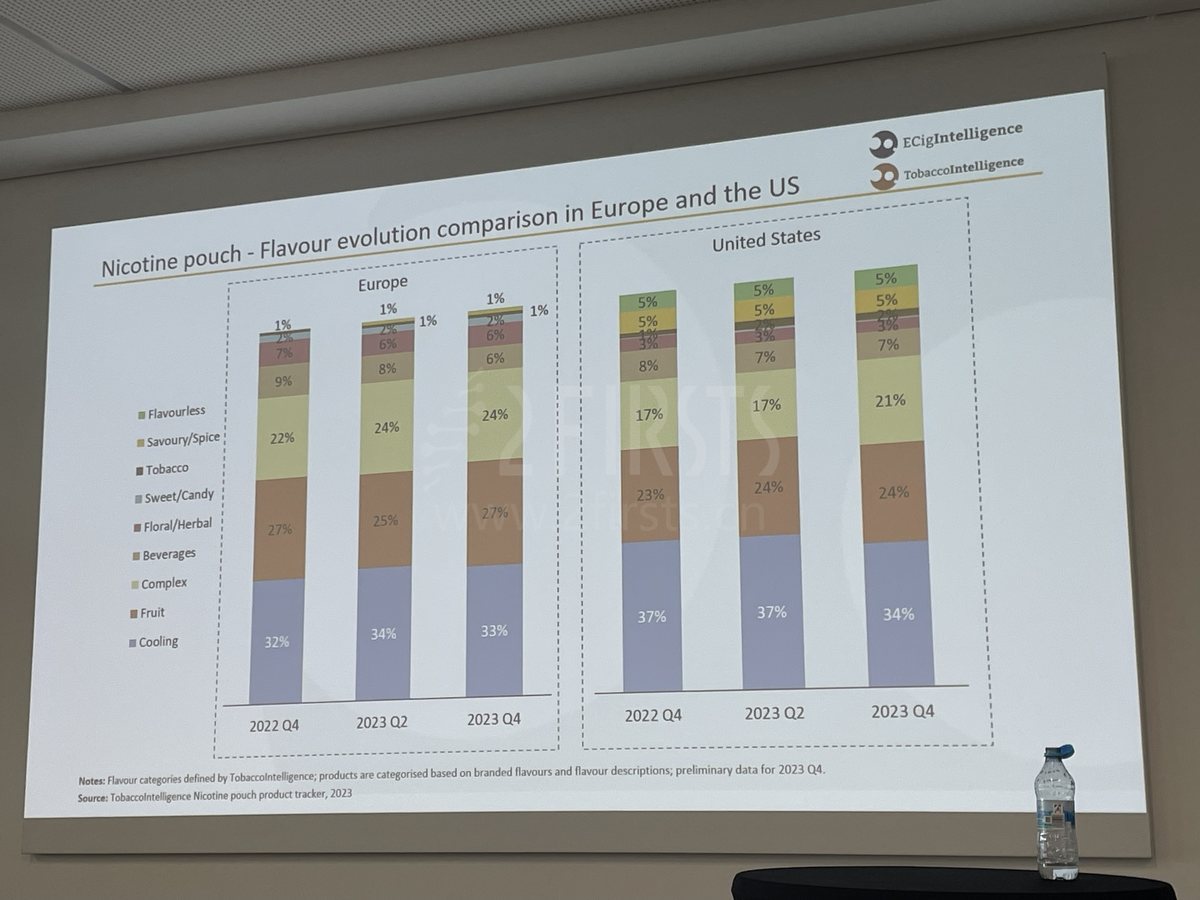
Pablo mentioned to 2Firsts that there are certain differences between the European and American markets in terms of nicotine pouch flavor preferences.


For example, in the fourth quarter of 2023, he pointed out that consumers in Europe and America both prefer nicotine pouch products with a cool sensation flavor.


In Europe, consumers have a greater preference for nicotine pouches in "fruit" and "mixed" flavors. In the fourth quarter of 2023, the market share of "fruit" nicotine pouches reached 27%, while "mixed" flavors reached 24%.


In the emerging e-cigarette market, Pablo believes that Latin America has tremendous market potential. Despite Southeast Asia being a hot spot in the industry, increasingly strict regulations have made its market prospects less clear. Additionally, the launch of proprietary brand products by China Tobacco (CNTC) at the trade show demonstrates China's significant position in the global tobacco industry, warranting industry attention.
 

ECigIntelligence Interview: Stricter Regulation on NGPs, Especially in Nicotine Pouches
Pablo's speech content │ Image source: 2Firsts


Prediction: HTP, EVP, and OND facing different opportunities


Pablo predicts that HNB tobacco products (HTP), e-cigarette vapor products (EVP), and nicotine pouches (OND) will face different growth opportunities in 2025.


He believes that HNB products will experience rapid growth, especially in markets such as the Middle East and North America, as well as in European countries such as Italy, and Spain.


According to forecasts from Pablo, e-cigarette vapor products have huge market potential in Latin America. Nicotine pouches have become very popular in European and American markets, especially the brand represented by ZYN has achieved significant success in the US market.


We welcome news tips, article submissions, interview requests, or comments on this piece.

Please contact us at info@2firsts.com, or reach out to Alan Zhao, CEO of 2Firsts, on LinkedIn


Notice

1.  This article is intended solely for professional research purposes related to industry, technology, and policy. Any references to brands or products are made purely for objective description and do not constitute any form of endorsement, recommendation, or promotion by 2Firsts.

2.  The use of nicotine-containing products — including, but not limited to, cigarettes, e-cigarettes, nicotine pouchand heated tobacco products — carries significant health risks. Users are responsible for complying with all applicable laws and regulations in their respective jurisdictions.

3.  This article is not intended to serve as the basis for any investment decisions or financial advice. 2Firsts assumes no direct or indirect liability for any inaccuracies or errors in the content.

4.  Access to this article is strictly prohibited for individuals below the legal age in their jurisdiction.


Copyright


This article is either an original work created by 2Firsts or a reproduction from third-party sources with proper attribution. All copyrights and usage rights belong to 2Firsts or the original content provider. Unauthorized reproduction, distribution, or any other form of unauthorized use by any individual or organization is strictly prohibited. Violators will be held legally accountable.

For copyright-related inquiries, please contact: info@2firsts.com


AI Assistance Disclaimer


This article may have been enhanced using AI tools to improve translation and editorial efficiency. However, due to technical limitations, inaccuracies may occur. Readers are encouraged to refer to the cited sources for the most accurate information.

We welcome any corrections or feedback. Please contact us at: info@2firsts.com

German Tobacco Tax Revenue Falls 10.8% Through August as Tax-Paid Cigarette Volume Drops 12.6%
Germany collected €9.789 billion in total tobacco tax revenue from January through August 2026, down 10.8% from a year earlier, according to the Federal Ministry of Finance. Germany's tobacco tax base covers not only cigarettes and fine-cut tobacco but also heated tobacco and vaping liquids taxed as tobacco substitutes. The German Association of the Tobacco Industry and Novel Products, or BVTE, citing federal statistical data, said tax-paid cigarette volume fell 12.6% to 40.6 billion sticks. BVTE is using the latest figures to argue against further tax increases planned from 2027 through 2030, while Germany's parliament is scheduled to hold a first reading of the bill on September 24.
Sep.23
Special Report|Japan Tobacco Buys CLEW: Can Its 160,000-Store Cigarette Network Help It Vie for U.S. Nicotine Pouch Share Against PMI and BAT?
Japan Tobacco Inc. (JT) announced on November 12, 2026, that it had acquired the U.S. assets of nicotine pouch brand CLEW from Nevcore Innovations Inc., including trademarks, intellectual property, product formulations and a Premarket Tobacco Product Application (PMTA). CLEW, currently distributed through selected outlets in 13 U.S. states, will immediately join the JTI LIGGETT portfolio. The transaction follows JT's approximately $2.4 billion acquisition of U.S. cigarette maker Vector Group in 2024. JTI LIGGETT says its existing cigarette brands reach more than 160,000 U.S. retail stores. During the 2026 NACS Show in October, JTI LIGGETT booth staff told 2Firsts that the company had not yet launched nicotine pouches in the United States. Although Nevcore previously announced FDA acceptance of CLEW's PMTA, the brand is absent from the agency's current list of authorized nicotine pouch products. JT has not disclosed a retail expansion plan for CLEW.
Business
Nov.12
UK Extends Age-18 Rules to Zero-Nicotine Vapes and Nicotine Pouches From Oct. 29, Bans Vending Machines and Promotional Giveaways
Key provisions of the UK's Tobacco and Vapes Act 2026 will take effect on Oct. 29, extending an age-18 sales restriction to all vaping and non-medicinal nicotine products. In England, Wales and Northern Ireland, the change brings zero-nicotine vapes within statutory age-of-sale rules and also covers products including nicotine pouches, strips and pearls. The law will also prohibit proxy purchasing for under-18s, consumer-facing vending machines, promotional giveaways and substantial discounts intended to promote vaping and nicotine products.
Regulations
Oct.10
RLX Technology Dropped From FTSE All-World as International Business Reaches 68.5% of Q2 Revenue
RLX Technology (NYSE: RLX) has been removed from the FTSE All-World Index, effective September 21. FTSE Russell records show RLX was already part of its global equity index universe by 2022, when its American depositary receipts were classified as China Large Cap securities. Trading volume rose to about 44.77 million shares on September 18, roughly 23 times the previous session's volume. RLX reported RMB1.0105 billion in second-quarter revenue, up 14.8% year over year, with international operations contributing 68.5%. The company also acquired a 51% stake in one of Western Europe's largest distributors of next-generation smoke-free and FMCG products in July.
Sep.22
Germany's Four-Year Tobacco Tax Plan Heads to Parliament as BAT, JTI and PMI Push for Changes
Germany's parliament is scheduled to hold a first reading of amendments to the Tobacco Tax Act on September 24. The government plans annual tax increases from 2027 through 2030 covering cigarettes, heated tobacco, vaping liquids and other categories. It expects the reform to generate €756 million in additional revenue in 2027, rising to €3.589 billion in additional annual revenue by 2030. Ahead of the parliamentary debate, the German Association of the Tobacco Industry and Novel Products, or BVTE, launched the "Tabaksteuer mit Augenmaß" campaign backed by BAT, JTI, Philip Morris, Reemtsma and wholesale and retail groups.
Sep.23
EU Vape, Heated Tobacco and Nicotine Pouch Tax Reform Reaches Ministerial Talks: Sweden Opposes Proposed 2032 Minimum of 50% of Retail Price or €50/kg for Nicotine Pouches
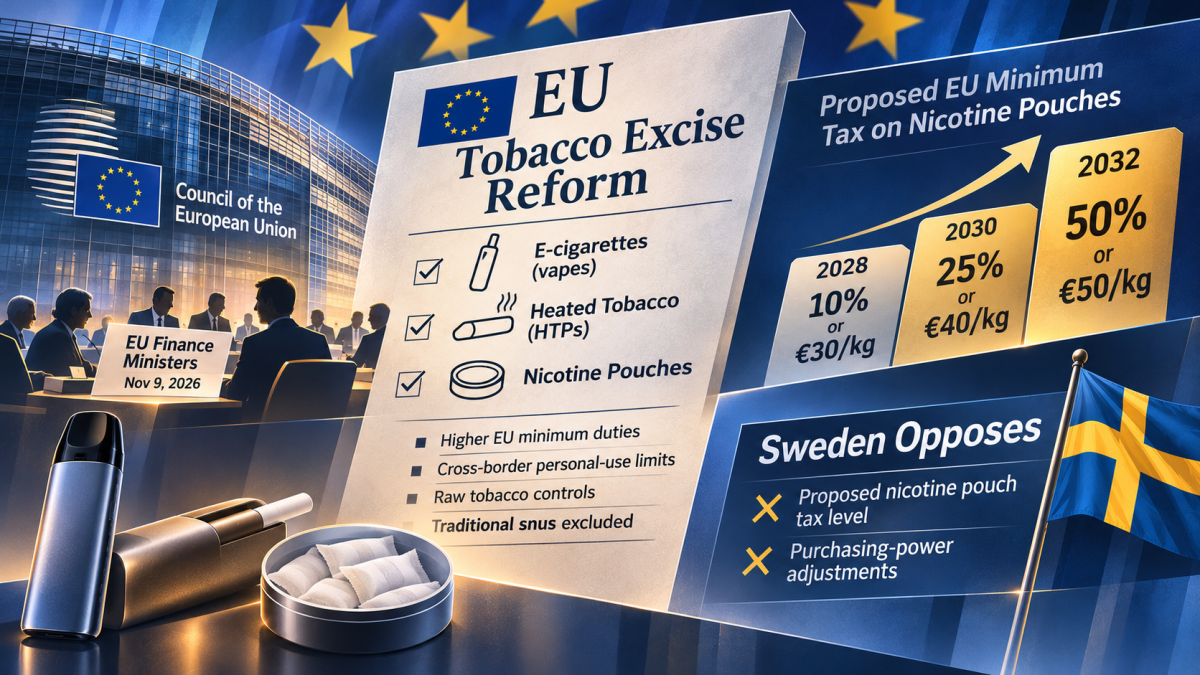
EU finance ministers are scheduled to discuss tobacco excise reform on November 9, 2026, seeking agreement on higher minimum duties for conventional tobacco and a common EU minimum tax framework covering e-cigarettes, heated tobacco and nicotine pouches. A November 5 Council document identifies nicotine pouch taxation as the main outstanding issue. The Irish Council presidency proposes phased increases, reaching 50% of retail selling price or €50 per kilogram in 2032. Sweden has formally said it cannot support the current compromise, objecting to both the proposed nicotine pouch tax burden and the adjustment of minimum rates based on national purchasing power. The package also addresses cross-border personal-use reference quantities, raw tobacco controls and the continued exclusion of traditional tobacco snus.
Regulations
Nov.10