2Firsts Observation | Element Vape Launches “Made in USA” Section as Product Pages Show “Assembled in USA” and “Made in USA” Labels

Jan.20
2Firsts Observation | Element Vape Launches “Made in USA” Section as Product Pages Show “Assembled in USA” and “Made in USA” Labels
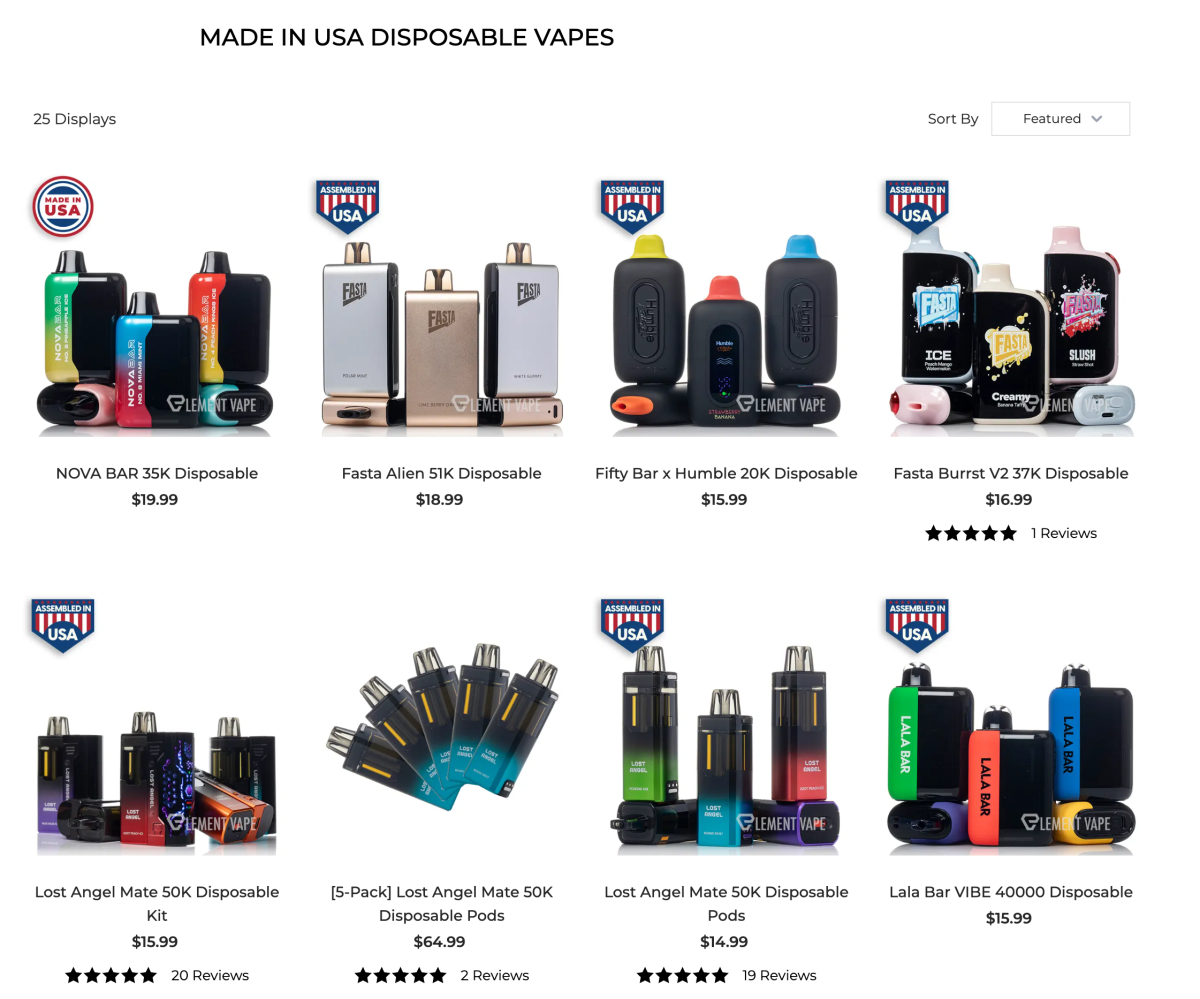
Element Vape, a U.S. online vaping retailer, uses origin labels such as “Made in USA” and “Assembled in USA” across disposable vape product pages and a dedicated collection page, grouping items under “Made in USA Disposable Vapes,” but the platform does not disclose on its public pages the applicable standards or evidentiary basis for these different claims.

Update (Jan. 21):


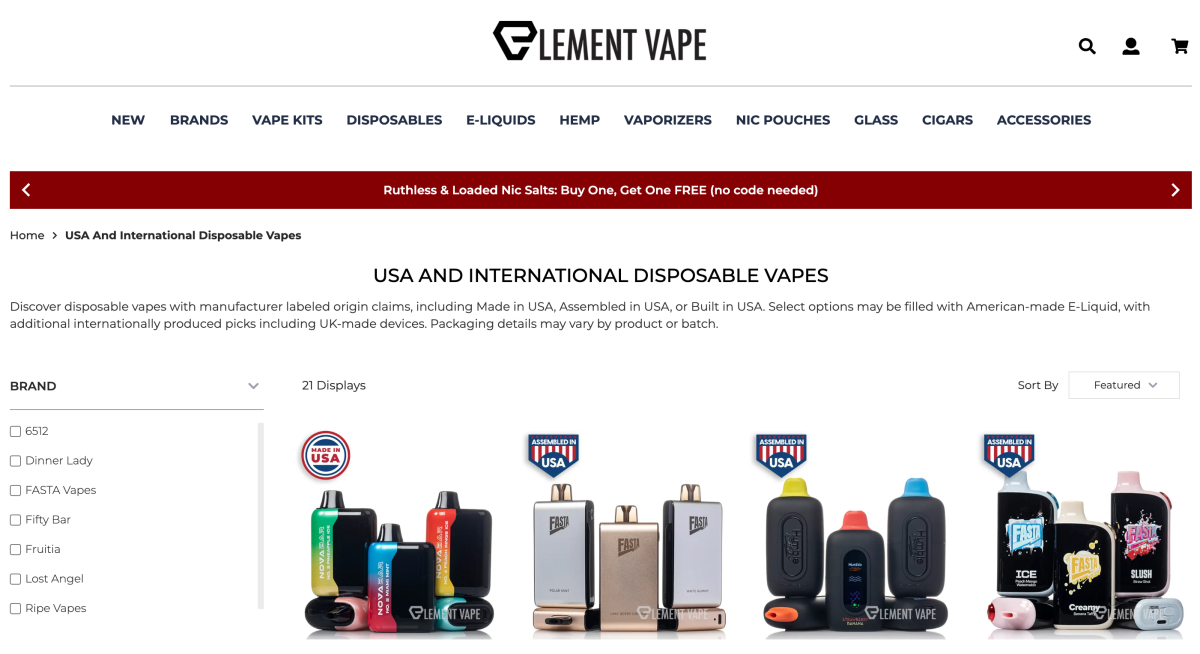
On Jan. 21, 2Firsts revisited U.S. online vape retailer Element Vape’s former “Made in USA Disposable Vapes” section and found that it had been renamed “USA AND INTERNATIONAL DISPOSABLE VAPES.”


At the same time, the number of products listed in the section fell to 21 from 25 on Jan. 20, while the page continued to display multiple labeling claims, including “MADE IN USA,” “ASSEMBLED in USA,” and “MADE IN UK.”
 

2Firsts Observation | Element Vape Launches “Made in USA” Section as Product Pages Show “Assembled in USA” and “Made in USA” Labels
Element Vape “USA AND INTERNATIONAL DISPOSABLE VAPES” product section | Source: Element Vape screenshot, Jan. 21

Key Takeaways


  • Multiple labels on the same platform: Some disposable products are labeled “Made in USA,” while others use claims such as “Assembled in USA.”
  • Collection page reinforces the “U.S.-made” selling point: The site features a “Made in USA Disposable Vapes” section and highlights descriptions such as “prefilled with America-made E-Liquids.”
  • No publicly stated definitions: In the searchable on-page text, there is no unified explanation of the boundary between terms such as “Made” and “Assembled,” the location of key processes, or the share of components sourced from different places.
  • Compliance context matters: Under the U.S. regulatory framework for origin claims, “Made in USA” is generally treated as a stronger claim, and whether a qualified statement is needed depends on the degree of U.S. manufacturing and the supporting evidence.


2Firsts, January 20, 2026 


2Firsts observed that U.S. online vape retailer Element Vape uses multiple “U.S.-related” origin labels across disposable vape product detail pages and a dedicated collection page, including “Made in USA” and “Assembled in USA,” but does not disclose on its public pages the specific definitions or applicable standards behind these different wordings.


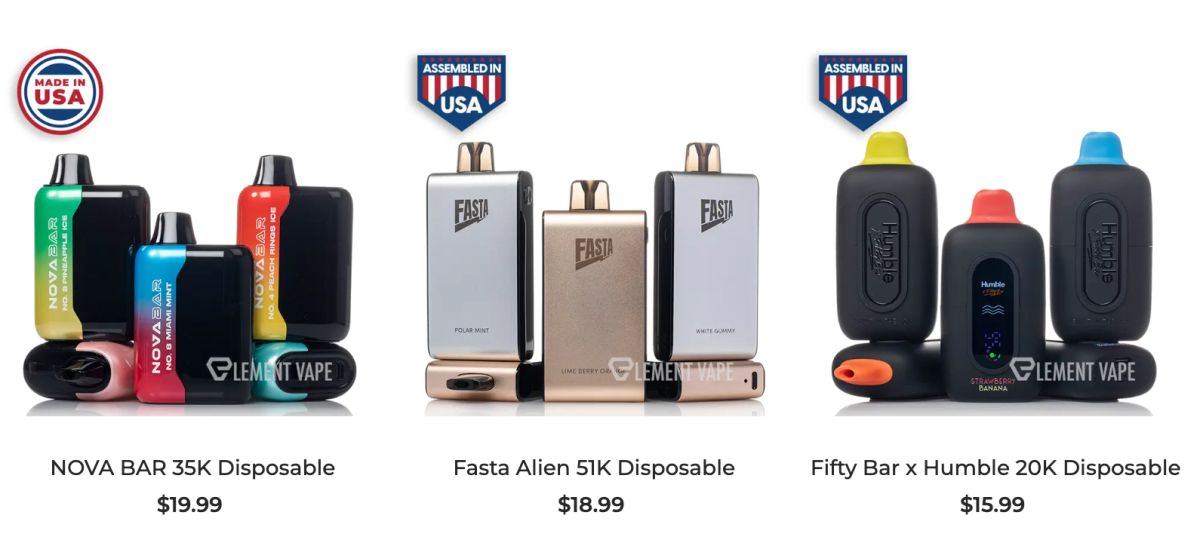
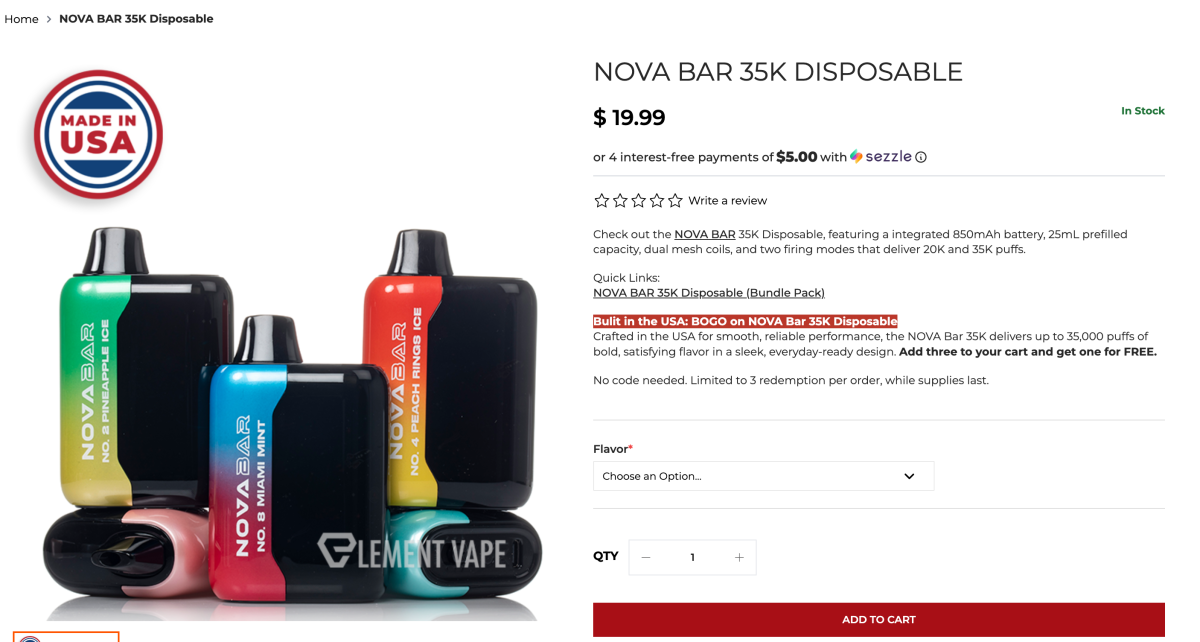
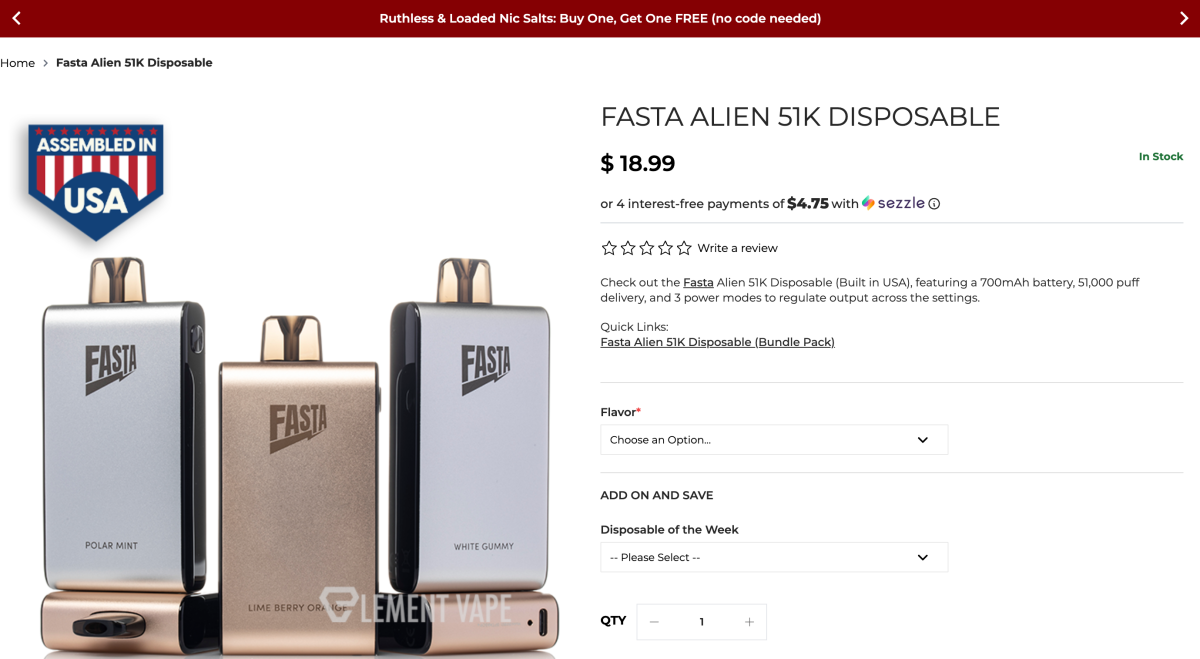
At the product-page level, the platform uses different phrasing for different items. For example, the selling-points section for the Fifty Bar 6500 disposable is labeled “Made in USA,” while the product pages for NOVA Bar 35K and Fasta Alien 51K use “Assembled in USA.” The Fasta Alien 51K page also includes language such as “USA-Based Flavor Lab,” but does not provide further detail related to supply chains or manufacturing steps.
 

2Firsts Observation | Element Vape Launches “Made in USA” Section as Product Pages Show “Assembled in USA” and “Made in USA” Labels
The platform uses different wording across products: “Made in USA” or “Assembled in USA” | Source: Element Vape


On the collection-page level, Element Vape has set up a “Made in USA Disposable Vapes” section. The section lists 25 disposable vape products, of which 12 are explicitly labeled “MADE IN USA,” seven are labeled “ASSEMBLED in USA,” and two are labeled “MADE IN UK.” The lineup indicates that, while the section is titled “Made in USA,” the origin/manufacturing claims shown on product pages are not uniform, spanning “U.S.-made,” “assembled in the U.S.,” and a smaller number of “U.K.-made” claims.


However, after reviewing the relevant collection page and representative product pages, 2Firsts did not find a unified explanation from the platform regarding the boundary between “Made in USA” and “Assembled in USA,” the evidentiary requirements, or the supply-chain conditions supporting each claim.
 

2Firsts Observation | Element Vape Launches “Made in USA” Section as Product Pages Show “Assembled in USA” and “Made in USA” Labels
Disposable vapes labeled “Made in USA” | Source: Element Vape


2Firsts Observation | Element Vape Launches “Made in USA” Section as Product Pages Show “Assembled in USA” and “Made in USA” Labels
Disposable vapes labeled “Assembled in USA” | Source: Element Vape


In the U.S. regulatory context, “Made in USA” is considered a relatively strong origin/manufacturing claim, with a clearly defined threshold.


2Firsts notes that the U.S. Federal Trade Commission’s (FTC) Made in USA Labeling Rule incorporates the “all or virtually all” standard into labeling requirements: if a product is not “all or virtually all” made in the United States, marketers may not use an unqualified “Made in USA” label; otherwise, they may face civil penalties. The scope of enforcement also covers such claims appearing in catalogs and online channels, including e-commerce pages.
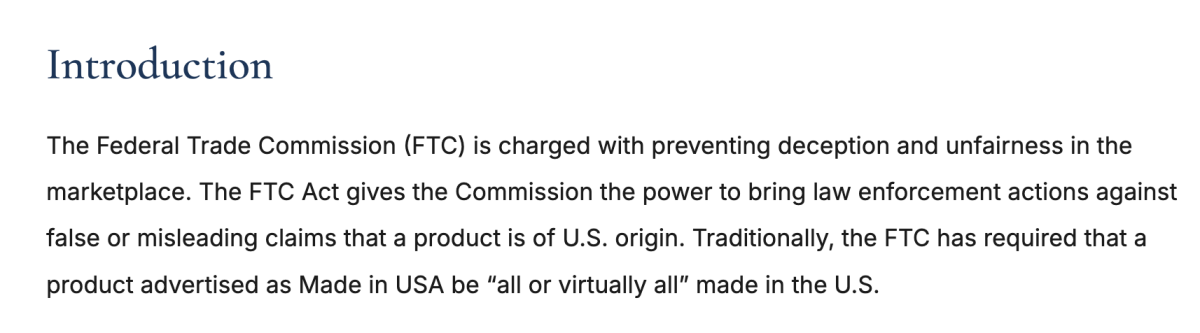
 

2Firsts Observation | Element Vape Launches “Made in USA” Section as Product Pages Show “Assembled in USA” and “Made in USA” Labels
Screenshot of the FTC page “Complying with the Made in USA Standard” | Source: FTC


From a market perspective, the U.S. disposable vape supply chain has long been globalized, and it is not uncommon for retailers to differentiate products using wording such as “U.S.-made” or “U.S.-based processes.” But without a publicly stated explanation of how different terms are applied and what evidence supports them, it is difficult for outside observers to distinguish between “Made in USA” and “assembled or partially completed in the U.S.” based on marketing language alone.


Cover image source: Element Vape


We welcome news tips, article submissions, interview requests, or comments on this piece.

Please contact us at info@2firsts.com, or reach out to Alan Zhao, CEO of 2Firsts, on LinkedIn


Notice

1.  This article is intended solely for professional research purposes related to industry, technology, and policy. Any references to brands or products are made purely for objective description and do not constitute any form of endorsement, recommendation, or promotion by 2Firsts.

2.  The use of nicotine-containing products — including, but not limited to, cigarettes, e-cigarettes, nicotine pouchand heated tobacco products — carries significant health risks. Users are responsible for complying with all applicable laws and regulations in their respective jurisdictions.

3.  This article is not intended to serve as the basis for any investment decisions or financial advice. 2Firsts assumes no direct or indirect liability for any inaccuracies or errors in the content.

4.  Access to this article is strictly prohibited for individuals below the legal age in their jurisdiction.


Copyright


This article is either an original work created by 2Firsts or a reproduction from third-party sources with proper attribution. All copyrights and usage rights belong to 2Firsts or the original content provider. Unauthorized reproduction, distribution, or any other form of unauthorized use by any individual or organization is strictly prohibited. Violators will be held legally accountable.

For copyright-related inquiries, please contact: info@2firsts.com


AI Assistance Disclaimer


This article may have been enhanced using AI tools to improve translation and editorial efficiency. However, due to technical limitations, inaccuracies may occur. Readers are encouraged to refer to the cited sources for the most accurate information.

We welcome any corrections or feedback. Please contact us at: info@2firsts.com

Malaysia Police Plan Saliva Tests at Roadblocks to Detect Synthetic Drugs Mixed Into Vape Liquids
Malaysian police plan to use saliva test kits at roadblocks to detect drivers using synthetic liquid drugs marketed as “Piu Piu” and “Magic Mushroom,” substances that authorities say are mixed into vape liquids and inhaled through e-cigarette devices, raising road-safety concerns and adding pressure on vape regulation.
Jun.29
Australia’s Daily Smoking Rate Falls to Record Low of 5.8% as Nicotine Use Patterns Shift
According to the Australian Institute of Health and Welfare’s National Drug Strategy Household Survey, daily smoking among Australians aged 18 and over fell to a record low of 5.8% in 2025. Health Minister Mark Butler said Australia now has around 500,000 fewer daily smokers than three years ago and credited the government’s vaping reforms as part of broader progress. Among people aged 14 and over, daily smoking declined from 8.3% in 2022-23 to 5.6% in 2025. Daily vaping rates stabilised at 3.6%, while the government also moved to further restrict access to nicotine pouches through unapproved therapeutic import pathways.
Jul.21
UAE Sets Dh1-Per-ml Minimum Excise Price for Vape Liquids From Sept. 1 While Keeping 100% Tax Rate
The UAE Ministry of Finance will introduce a minimum excise price for e-liquids used in vaping and electronic smoking devices from September 1, 2026. The minimum excise price will be set at AED 1 per millilitre. The existing 100% excise tax rate will continue to apply to tobacco and electronic smoking products. The measure changes the minimum taxable base rather than the tax rate, with the UAE government saying it aims to establish unified tax standards, improve market compliance and prevent pricing loopholes.
Regulations
Aug.07 by 2Firsts Perspectives
ATF Cancels Webloc Contract, Raising Questions Over Commercial Location Data in Enforcement
The U.S. Bureau of Alcohol, Tobacco, Firearms and Explosives (ATF) has stopped using Webloc, a commercial phone-tracking tool, after lawmakers, a prosecutor and a judge raised legal and privacy concerns over warrantless use of ad-tech location data, a development that may affect data-use boundaries in U.S. enforcement against illicit tobacco, nicotine products and cross-border distribution networks.
Jun.29
From a 2017 Launch to 48% of South Korea’s Heated Tobacco Market, KT&G Looks Back on a Decade of lil
KT&G announced on Aug. 13, 2026, that it has opened “lil Archive,” a brand exhibition space in Seoul showcasing the evolution, technology platforms and future direction of its heated tobacco brand lil since its launch in 2017. KT&G said lil now spans three major platforms — lil SOLID, lil HYBRID and lil AIBLE — with more than 30 dedicated consumables, and held a 48% share of South Korea's heated tobacco market in the second quarter of 2026. The opening comes as lil enters its 10th year, with KT&G continuing to position the brand for expansion beyond its domestic market.
Aug.14
PMI Q2 Call: ZYN Growth, IQOS Pricing and a Diverging Global Tobacco Market
Philip Morris International’s second-quarter earnings call offered new detail on its smoke-free strategy. Management said it would increase U.S. investment behind nicotine pouch brand ZYN, keep IQOS focused on volume before stronger pricing, and use SENTIA, DELIA, LEVIA, VEEV and ZYN to manage tax and regulatory pressure across Japan and Europe. Analysts from Goldman Sachs, Morgan Stanley, UBS and other firms also pressed PMI on profitability, market share, cigarette resilience and the durability of its global transformation over coming quarters.
Jul.24