Every summer, it is the busiest time for the recruitment team of Simore.
This year has been especially busy, as we are not only accepting new hires but also welcoming past partners. The "new" refers to the nearly 200 university graduates who have recently joined our organization. The "old" pertains to the visits we have received from nearly ten university leaders who are part of our initiative to expand connections with businesses and promote job opportunities.
Since the outbreak of the COVID-19 epidemic, the task of "maintaining employment and ensuring job security" has been extremely challenging. Faced with the severe situation of the first-ever graduating class of over 10 million students in 2022, vocational schools, university graduates, and enterprises are taking active measures, hoping to provide more job opportunities and a more attractive future for these post-2000 generation individuals.
During this year's National People's Congress and Chinese People's Political Consultative Conference, Zhang Xinghai's proposal of "encouraging young people to work in factories instead of delivering takeout" became a trending topic on Weibo. With a shortage of skilled labor in the technology industry, new manufacturing enterprises in the Greater Bay Area, led by companies such as SMIC, are doing their utmost to retain younger workers born after 2000. They are providing a dual career development path for management and professional skills, as well as more opportunities for training, cross-site development, job experience, and high potential for promotion. Of course, these companies are also offering decent salaries and long-term, specialized job security.
In SMIC's 15 automated, digitized smart factories, the performance of post-2000s new intelligence makers is constantly challenging the perceptions of the SMIC recruitment team.
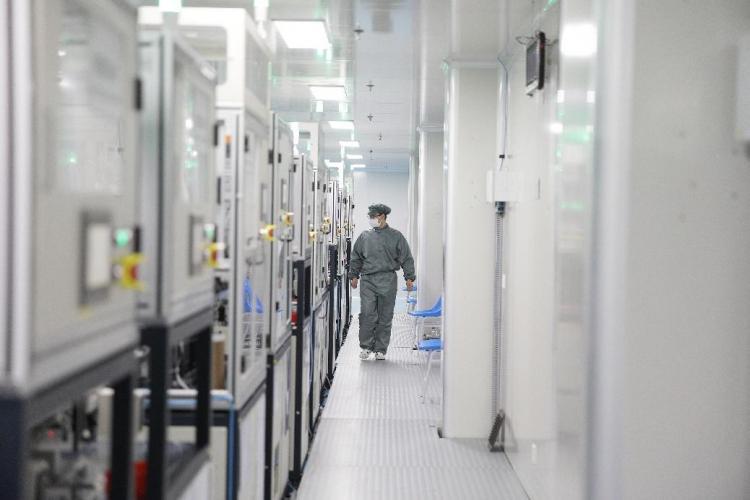
Simoer's new intelligent manufacturing production line.
Li Changzheng, who graduated from Guangxi Vocational and Technical College's Mechatronics Engineering program, has been with Simer for three years. His career plan is clear: to continuously improve his skills and become an electrical engineer as soon as possible. In just three years, he has made significant progress, becoming proficient in the equipment debugging and assembly work for automation line projects. He has even taken on the role of an "internship mentor" to share his expertise and has grown from a grassroots technician to an electrical technician.
Grassroots technicians are the first label for these post-2000 workers who enter the factory. Last July, Xie Wenqiang graduated from Guangzhou Mechanical and Electrical Technician College with a major in automotive inspection and maintenance. He joined SMOLE as a campus recruiter and became a production automation technician. After entering the company, he found a mentor who was very enthusiastic about teaching and provided hands-on guidance, making him feel a sense of belonging. Although he has only been with the company for a year, he can now independently solve common equipment failures. Engineers all praise Xie for his strong learning ability, quick adaptation, and comparable technical level to senior technicians.
Compared to Li Changzheng and Xie Wenqiang who focus on technical research, Duan Huimin is more willing to explore new directions. She graduated from Hunan University of Finance and Economics in 2019 and became an intern as a production reserve cadre through campus recruitment. In her first month of internship on the production line, she volunteered to take on the "stretching" work and efficiently helped dozens of employees complete production tasks every day. In 2020, she transitioned from "stretching" to become a marketing assistant and is now a trusted assistant to the project manager. She was also awarded the Outstanding Staff of 2021. She said her career plan is in project management and she plans to take the PMP certification next.
More and more post-2000s are continuing their journey in the field of technology. In January 2019, Huang Haimei joined the Engineering Equipment Department of Smore as a campus recruitment intern with the clear goal of becoming a manufacturing engineer. Over the past two years, she has worked hard and achieved the "Excellent Technician" award for two consecutive years. In April 2021, she was successfully promoted to IE Assistant Engineer. Her colleagues say that she is one of the few outstanding examples in the company who has been able to transition from a staff member to a full-time employee within two years.
According to a research report from 58 Hiring Research Institute, the post-95s generation prefer new second- and third-tier cities for employment, while the appeal of traditional first-tier cities has decreased. 54% of employed individuals lean towards careers as livestream hosts and internet celebrities, with less than 10% entering the manufacturing industry.
Compared to their peers, the post-2000 generation working on Sumaor's production line highly value opportunities to work in advanced manufacturing. They do not want to become mere industrial workers like cogs in a wheel. Instead, they aspire to be multifaceted talents, combining their future prospects with advanced technology. They aim to master all the skills involved in the production process and become the cornerstone of China's economy.
Smoore has stated that the company is committed to creating value for society and making all its employees happy. This commitment is reflected in their cultural activities and efforts to create a sense of togetherness within the company. Additionally, Smoore has been investing heavily in automation, information technology, and intelligent development in order to free up its front-line workers. Over the past two years, Smoore has established partnerships with 15 colleges and universities, providing training and support to over 1,000 skilled workers to help the company improve its manufacturing capabilities.
This article is an original piece written by 2FIRSTS Technology Co., Ltd in Shenzhen. The copyright and permission to use belong solely to the company and without authorization, no individual or organization may copy, reproduce, or use the content in any way that violates the company's copyright laws. Offenders will be held legally responsible, and the company reserves the right to pursue legal action against them.
Disclaimer
This article is provided solely for professional research, industry discussion, and informational purposes. Any references to brands, companies, products, technologies, or policies are made for factual reporting and analytical purposes only, and do not constitute endorsement, recommendation, promotion, or advertising by 2Firsts.
Nicotine-containing products, including but not limited to cigarettes, e-cigarettes, heated tobacco products, and nicotine pouches, carry significant health risks. Readers are responsible for complying with all applicable laws and regulations in their respective jurisdictions, including age restrictions and access limitations.
The information contained in this article should not be regarded as investment, legal, medical, regulatory, or commercial advice. While 2Firsts strives to ensure the accuracy and reliability of its content, it does not assume liability for any direct or indirect loss arising from errors, omissions, inaccuracies, or reliance on the information contained herein.
This article is not intended for individuals below the legal age for accessing tobacco or nicotine-related information in their jurisdiction.
Copyright Notice
This article is either original content produced by 2Firsts or content reproduced, translated, summarized, or adapted from third-party sources with attribution where applicable. The intellectual property rights of the original content remain with 2Firsts or the respective original rights holders.
No individual or organization may copy, reproduce, distribute, republish, modify, translate, or otherwise use this content without prior authorization. Any unauthorized use may result in legal action.
For copyright-related inquiries, corrections, or removal requests, please contact: info@2firsts.com.
AI-Assisted Translation and Editing Notice
Portions of this article may have been translated, edited, or reviewed with the assistance of artificial intelligence tools to improve efficiency and readability. Due to the limitations of AI-assisted translation and editing, discrepancies, omissions, or inaccuracies may exist when compared with the original source.
Where applicable, readers are advised to refer to the original source for the most complete and accurate information. If you identify any errors or believe that any content infringes upon your rights, please contact us at info@2firsts.com, and we will review and address the matter promptly.