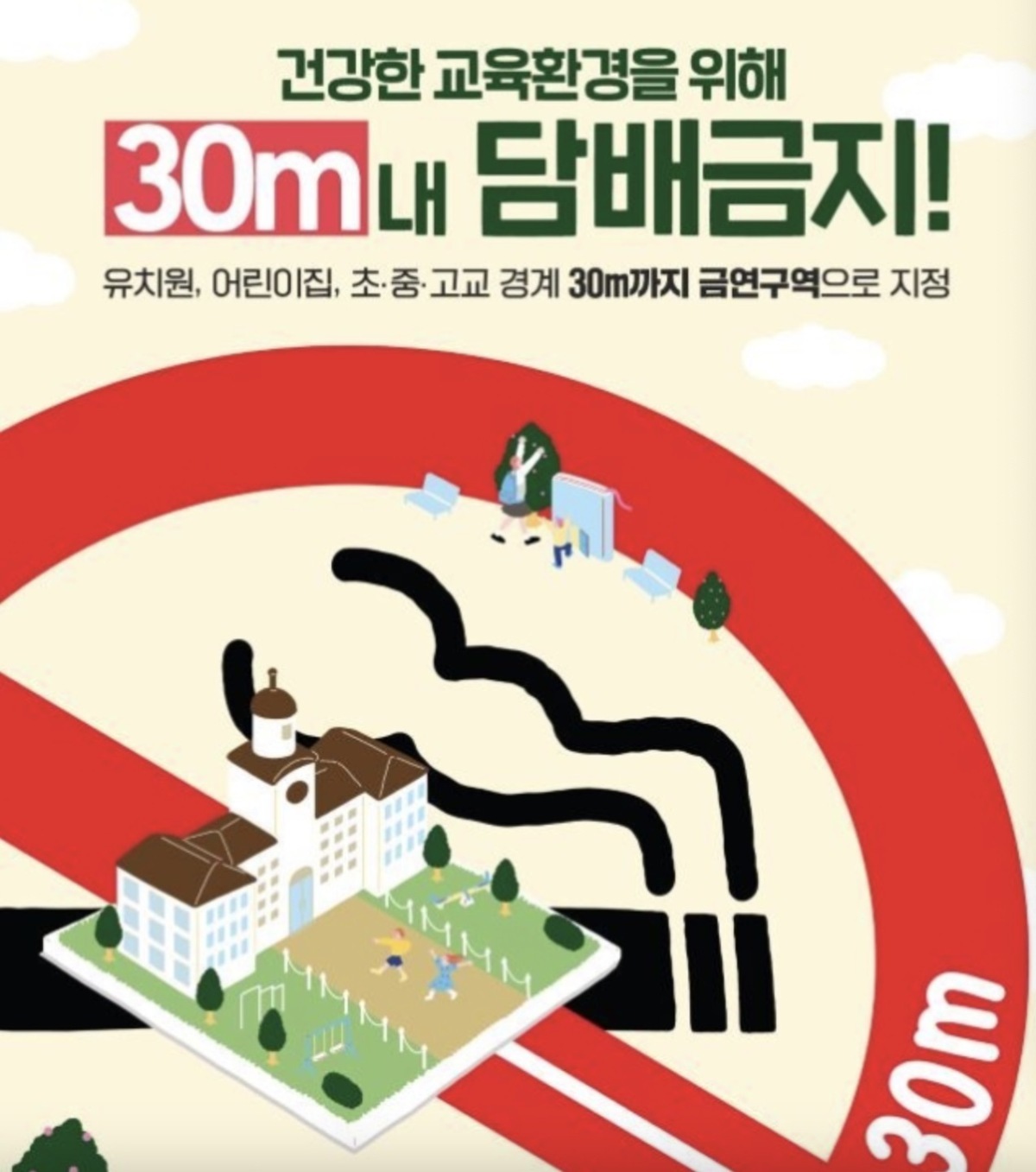
According to Naver news on August 5th, South Korea's Gyeonggi Province announced on the 5th that starting from the 17th, the non-smoking areas around kindergartens, elementary schools, middle schools, and high schools will be expanded to within 30 meters.
According to the revised National Health Promotion Act, a new regulation has been established that designates a 30-meter boundary around facilities from elementary schools to high schools as non-smoking areas.
In addition, the no-smoking area within 10 meters of the facilities of kindergartens and nurseries has been expanded to within 30 meters.
Smoking in these areas will result in a fine of 100,000 South Korean won.
In order to promote a smoke-free environment, the province is advancing initiatives such as providing technical support for smoke-free policies in health facilities, developing educational materials and campaigns, and building a network of support. For more information, individuals can contact the Smoke-Free Support Team of the Province.
The director of the Gyeonggi Province Health Department in South Korea, Liu Yingzhe, stated:
In order to provide a smoke-free environment for children and young people to receive education, we request the cooperation of the public.
We welcome news tips, article submissions, interview requests, or comments on this piece.
Please contact us at info@2firsts.com, or reach out to Alan Zhao, CEO of 2Firsts, on LinkedIn
Notice
1. This article is intended solely for professional research purposes related to industry, technology, and policy. Any references to brands or products are made purely for objective description and do not constitute any form of endorsement, recommendation, or promotion by 2Firsts.
2. The use of nicotine-containing products — including, but not limited to, cigarettes, e-cigarettes, nicotine pouchand heated tobacco products — carries significant health risks. Users are responsible for complying with all applicable laws and regulations in their respective jurisdictions.
3. This article is not intended to serve as the basis for any investment decisions or financial advice. 2Firsts assumes no direct or indirect liability for any inaccuracies or errors in the content.
4. Access to this article is strictly prohibited for individuals below the legal age in their jurisdiction.
Copyright
This article is either an original work created by 2Firsts or a reproduction from third-party sources with proper attribution. All copyrights and usage rights belong to 2Firsts or the original content provider. Unauthorized reproduction, distribution, or any other form of unauthorized use by any individual or organization is strictly prohibited. Violators will be held legally accountable.
For copyright-related inquiries, please contact: info@2firsts.com
AI Assistance Disclaimer
This article may have been enhanced using AI tools to improve translation and editorial efficiency. However, due to technical limitations, inaccuracies may occur. Readers are encouraged to refer to the cited sources for the most accurate information.
We welcome any corrections or feedback. Please contact us at: info@2firsts.com