FDA Orders JUUL Products Removed from US Market

Jun.24.2022
FDA Orders JUUL Products Removed from US Market
JUUL forced to remove all products from US market due to FDA marketing refusal order.

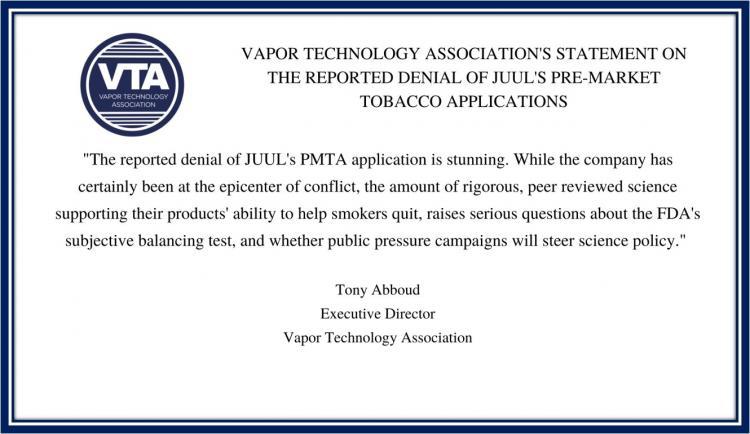
On June 23rd, the FDA issued a Marketing Denial Order to JUUL Labs Inc., requiring them to remove all JUUL products from the US market, including JUUL e-cigarettes and four types of JUUL pods. Following this order, Tony Abboud, the Executive Director of the Vapor Technology Association, made a statement regarding the matter. The full statement is as follows:


According to reports, the rejection of JUUL's PMTA application is shocking. While JUUL is certainly at the center of the controversy, the rigorous, peer-reviewed scientific data determining the effectiveness of JUUL products for smoking cessation has raised serious questions about the subjective balance test of the FDA and whether public pressure has guided policy development.


Related News:


JUUL has released a statement regarding the FDA's ban, stating that they may appeal the decision.


The FDA has issued a marketing denial order to JUUL, requiring all of its products to be taken off the market.


Disclaimer

This article is provided solely for professional research, industry discussion, and informational purposes. Any references to brands, companies, products, technologies, or policies are made for factual reporting and analytical purposes only, and do not constitute endorsement, recommendation, promotion, or advertising by 2Firsts.

Nicotine-containing products, including but not limited to cigarettes, e-cigarettes, heated tobacco products, and nicotine pouches, carry significant health risks. Readers are responsible for complying with all applicable laws and regulations in their respective jurisdictions, including age restrictions and access limitations.

The information contained in this article should not be regarded as investment, legal, medical, regulatory, or commercial advice. While 2Firsts strives to ensure the accuracy and reliability of its content, it does not assume liability for any direct or indirect loss arising from errors, omissions, inaccuracies, or reliance on the information contained herein.

This article is not intended for individuals below the legal age for accessing tobacco or nicotine-related information in their jurisdiction.


Copyright Notice

This article is either original content produced by 2Firsts or content reproduced, translated, summarized, or adapted from third-party sources with attribution where applicable. The intellectual property rights of the original content remain with 2Firsts or the respective original rights holders.

No individual or organization may copy, reproduce, distribute, republish, modify, translate, or otherwise use this content without prior authorization. Any unauthorized use may result in legal action.

For copyright-related inquiries, corrections, or removal requests, please contact: info@2firsts.com.


AI-Assisted Translation and Editing Notice

Portions of this article may have been translated, edited, or reviewed with the assistance of artificial intelligence tools to improve efficiency and readability. Due to the limitations of AI-assisted translation and editing, discrepancies, omissions, or inaccuracies may exist when compared with the original source.

Where applicable, readers are advised to refer to the original source for the most complete and accurate information. If you identify any errors or believe that any content infringes upon your rights, please contact us at info@2firsts.com, and we will review and address the matter promptly.


Tobacco Farming in the New Nicotine Era: Why Indian Farmers Struggle to Transition — Contributed by Samrat Chowdhery
In this contributed article to 2Firsts, Mumbai-based journalist and harm reduction advocate Samrat Chowdhery examines India’s tobacco transition from the perspective of agriculture, supply chains and regulation. As noted by 2Firsts, India offers a relevant case for understanding how new nicotine technologies may affect not only consumption, trade and policy, but also tobacco farming.
Special Report
May.29
BAT Restructuring to Affect 9,000 Roles as Tobacco Group Pushes Cost Cuts and AI
British American Tobacco (BAT) plans to cut about 5,500 jobs globally and shift around 3,500 roles to strategic partners by the end of 2026, affecting about 9,000 roles in total, as the company seeks to simplify operations, strengthen technology capabilities and deliver £600 million in annual savings by 2028.
BAT
Jun.29
Nevada Considers Nearly Doubling Tobacco Taxes, With $65 Million in New Revenue Expected From Expanded Nicotine Levies
Health groups in Nevada are urging lawmakers to nearly double the state cigarette tax and extend similar tax changes to other nicotine products, including e-cigarettes and nicotine pouches.
Jul.17
Supreme Vape Revenue Rises 15% Despite UK Disposable Vape Ban
UK consumer goods group Supreme said its vaping revenue rose 15% to £148.1 million in the year to March 31, 2026, despite the UK disposable vape ban taking effect during the period, while the company identified the Vaping Products Duty due in October as the next major industry milestone.
Regulations
Jul.03 by 2Firsts Perspectives
2Firsts Data | China’s Vape Exports Rise 3.1% in H1 2026 as 6-Methyl Nicotine-Related Products Surge 65.2%
China’s vape exports showed resilience in the first half of 2026 after a short-term shock from China’s export rebate adjustment. But customs data points to more than a simple recovery: the structure of growth is changing. Vaping devices and atomization hardware emerged as the strongest growth driver, while nicotine-containing vaping products remained broadly stable. Meanwhile, nicotine substitute-related products represented by 6-methyl nicotine expanded rapidly, becoming a new category to watch for both industry and regulators. After the U.S. market went through a cycle of shortages, replenishment and inventory rebuilding in 2025, China’s vape supply chain is entering a new phase of reallocation.
Special Report
Jul.20
China Tobacco Yunnan Patent Describes Cigar Flavor Granules With Encapsulation Rate Above 77%
According to public records from China’s National Intellectual Property Administration, a patent application filed by China Tobacco Yunnan Industrial Co., Ltd. for “cigar flavor granules” was published on May 12, 2026. The filing proposes purifying an ethanol extract of cigar tobacco leaves using LX-8 macroporous resin, followed by encapsulation with maltodextrin and sucrose fatty acid ester to improve smoking comfort, reduce dryness and enhance aroma release stability in reconstituted tobacco.
Jun.10