Finland Police Seize 1,000 Illegal Vapes Amid Regulatory Gaps

Nov.21.2024
Finland Police Seize 1,000 Illegal Vapes Amid Regulatory Gaps
Finnish police seize 1,150 illegal vapes with high nicotine content, exposing gaps in vape regulation and minor smuggling.

On November 20, the Finnish Police reported the seizure of 1,150 illegal e-cigarettes during a raid in Porvoo, a city in southwestern Finland.


The operation implicated two minors and one adult, who are suspected of smuggling the illegal products into the country. The case has been referred to prosecutorial authorities for review and potential prosecution in the coming days.


Marja Kiiski, senior police inspector at the Southwest Finland Police Department, raised concerns over the growing trade and use of illegal e-cigarettes. 


She emphasized the lack of oversight regarding the ingredients in these products, which are often imported from abroad. Recent confiscations revealed nicotine concentrations of 5%, exceeding Finland's legal limit of 2%, thereby classifying them as illegal. 


The sale of such e-cigarettes frequently occurs on social media and anonymous messaging platforms, exposing buyers to potential fraud or robbery during illicit transactions.


Finnish law outlines several offenses related to illegal e-cigarette trade. Chapter 46, Article 6a of the Penal Code defines the possession of illegally imported e-cigarettes as a minor offense of dealing with illegal goods. 


Under Article 109 of the Tobacco Act, purchasing e-cigarettes from abroad with the intent to sell them to minors constitutes a tobacco sales crime. Additionally, Chapter 46, Article 4 of the Penal Code considers ordering illegal e-cigarettes into Finland an act of smuggling.


We welcome news tips, article submissions, interview requests, or comments on this piece.

Please contact us at info@2firsts.com, or reach out to Alan Zhao, CEO of 2Firsts, on LinkedIn


Notice

1.  This article is intended solely for professional research purposes related to industry, technology, and policy. Any references to brands or products are made purely for objective description and do not constitute any form of endorsement, recommendation, or promotion by 2Firsts.

2.  The use of nicotine-containing products — including, but not limited to, cigarettes, e-cigarettes, nicotine pouchand heated tobacco products — carries significant health risks. Users are responsible for complying with all applicable laws and regulations in their respective jurisdictions.

3.  This article is not intended to serve as the basis for any investment decisions or financial advice. 2Firsts assumes no direct or indirect liability for any inaccuracies or errors in the content.

4.  Access to this article is strictly prohibited for individuals below the legal age in their jurisdiction.


Copyright


This article is either an original work created by 2Firsts or a reproduction from third-party sources with proper attribution. All copyrights and usage rights belong to 2Firsts or the original content provider. Unauthorized reproduction, distribution, or any other form of unauthorized use by any individual or organization is strictly prohibited. Violators will be held legally accountable.

For copyright-related inquiries, please contact: info@2firsts.com


AI Assistance Disclaimer


This article may have been enhanced using AI tools to improve translation and editorial efficiency. However, due to technical limitations, inaccuracies may occur. Readers are encouraged to refer to the cited sources for the most accurate information.

We welcome any corrections or feedback. Please contact us at: info@2firsts.com

Imperial Brands Plans Thousands of Job Cuts Across U.S. and Europe in Cost Restructuring
According to Reuters, citing Bloomberg News, British tobacco company Imperial Brands PLC plans to cut thousands of jobs across the United States and Europe as part of a cost reduction and organizational restructuring effort. The announcement drew market attention to the company’s shares. The move comes as global tobacco companies continue adjusting their operations amid slower cigarette market growth, changing consumer preferences and the transition toward next-generation nicotine products.
Aug.11
India Duty-Free Nicotine Pouch Sales Face Regulatory Test as ZYN, FOX Classification Remains Open
The Bombay High Court has ruled that airport duty-free shops are not exempt from India's domestic regulatory laws merely because they operate beyond the customs barrier, leaving in place a sales halt covering ZYN and FOX nicotine pouches at Mumbai's international airport. The court, however, did not determine that the products necessarily qualify as "drugs" under India's Drugs and Cosmetics Act. The retailers have four weeks to submit product information to the appropriate authorities, including CDSCO, which must complete its review within 30 days of receiving the submissions.
Sep.24
Altria’s USSTC Starts $250 Million Kentucky Expansion, Adding More Than 200 Jobs
U.S. Smokeless Tobacco Company, an Altria Group company, has broken ground on an approximately $250 million manufacturing expansion in Hopkinsville, Kentucky. The roughly 270,000-square-foot facility is expected to create more than 200 jobs and absorb processing, manufacturing and packaging operations currently split between Hopkinsville and Nashville, Tennessee. USSTC previously said production at its Nashville facility is expected to wind down by early 2028. The project forms part of Altria’s broader effort to modernize and consolidate its U.S. smokeless tobacco manufacturing network.
Sep.10
JUUL Purchasers Ask Ninth Circuit to Preserve Antitrust Classes in Case Over Altria’s $12.8 Billion Investment
Private antitrust litigation stemming from Altria's 2018 $12.8 billion investment for a 35% economic interest in JUUL is advancing before the U.S. Court of Appeals for the Ninth Circuit. Direct purchasers, indirect purchasers and indirect resellers of JUUL products filed answering briefs this week seeking to preserve class certifications granted by a California federal court in February. Altria and JUUL argue that individual consumers and large distributors differ too much in purchasing terms to remain in a single direct-purchaser class, while a separate dispute concerns whether California antitrust law can apply to indirect purchasers across 27 jurisdictions. A September trial has been put on hold during the appeal.
Sep.23
Kantar Study Finds More Than 93% of Vape Products in Ukraine Fail Regulatory Requirements
According to Interfax-Ukraine, a study conducted by market research firm Kantar Ukraine at the request of major tobacco companies found that more than 93% of vape products in Ukraine did not fully comply with regulatory requirements. The research examined product categories, brand distribution and consumer purchasing channels, showing that pod systems and disposable vapes represent major segments of the market, while offline retail remains the dominant purchasing channel. The findings highlight ongoing compliance challenges in Ukraine’s vape market.
Aug.26
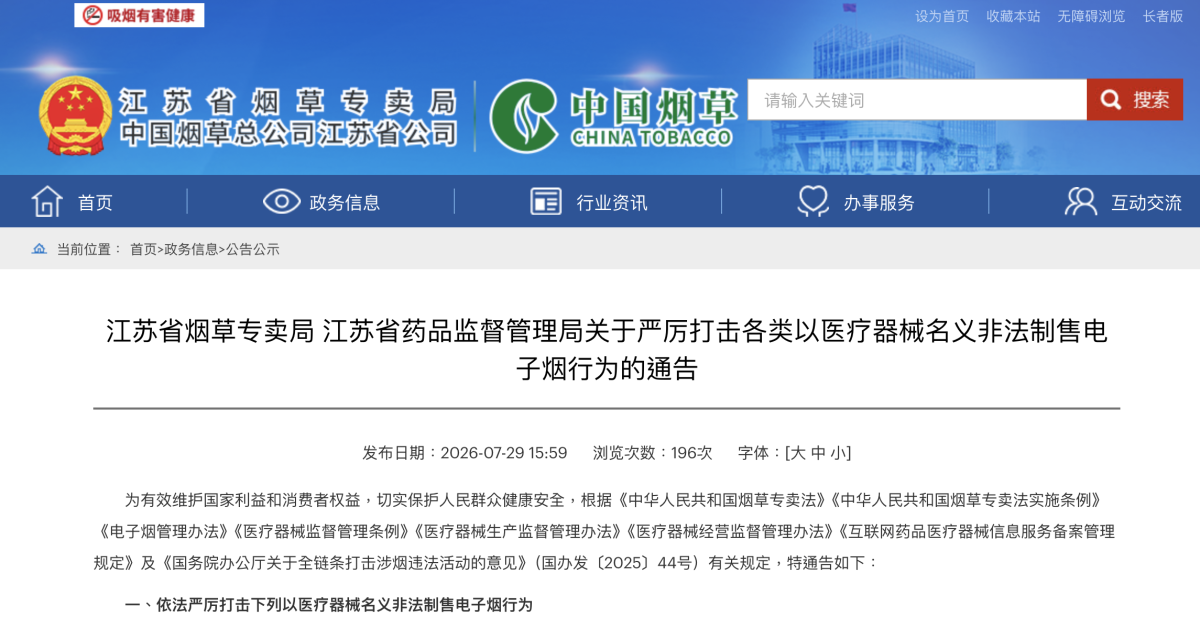
China’s Jiangsu Tobacco Monopoly Bureau and Drug Regulator Target Illegal Vape Sales Disguised as Medical Devices, Define Six Violations
China’s Jiangsu Tobacco Monopoly Bureau and Jiangsu Provincial Medical Products Administration have issued a joint notice targeting illegal production and sales of vape products disguised as medical devices. The notice identifies six categories of violations, including obtaining medical licenses through false materials, misusing medical device credentials, expanding production beyond approved scopes, and using medical device-related online platforms to promote or sell vape products. The action is based on China’s tobacco and medical device regulations and aims to strengthen vape oversight and consumer protection.
Aug.04