Guam checks 277 eligible retailers in 2025; eight found selling tobacco or disposable vapes to minors aged 16–20

Jan.05
Guam checks 277 eligible retailers in 2025; eight found selling tobacco or disposable vapes to minors aged 16–20
he Guam Behavioral Health and Wellness Center said that out of 277 eligible tobacco retailers inspected in 2025, eight were found selling tobacco or disposable e-cigarettes or vapes to minors aged 16–20, and one retailer failed to display the required “No Sale Under 21” prohibition sign.

Key Points 


• Findings: eight retailers sold tobacco or disposable vapes to minors aged 16–20; one lacked the “No Sale Under 21” sign

• Penalties: nine citations issued at $2,000–$4,000; potential penalties up to $20,000 under Public Law 37-90

• Compliance: 97.1% in 2025 vs 94.8% in 2024; above the federal 80% requirement

• Enforcement: GBHWC and DRT conduct random, unannounced checks in all 19 villages

• Program: Merchant Education Outreach Program launched January 2025, including door-to-door visits and materials


2Firsts, January 5, 2026 – According to the Guampdn, the Guam Behavioral Health and Wellness Center (GBHWC) said that out of 277 eligible tobacco retailers inspected in 2025, eight were found selling tobacco or disposable e-cigarettes or vapes to minors aged 16–20, and one retailer failed to display the mandatory “No Sale Under 21” prohibition sign.


The report said the nine retailers immediately received citations from Guam’s Department of Revenue and Taxation (DRT) ranging from $2,000 to $4,000. Under Public Law 37-90, tobacco violations may be penalized as high as $20,000 depending on the history of citations.


GBHWC said overall tobacco retailer compliance was 97.1% in 2025, higher than the 94.8% reported in 2024, and above the federally mandated rate of over 80%.


On Guam, GBHWC and DRT conduct random and unannounced tobacco retail compliance checks in all 19 villages. The report said both agencies are jointly responsible for carrying out the Tobacco Control Act of 1998 and the Youth Protection Act of 2017 aimed at youth tobacco or nicotine use prevention.


The monitoring activity is mandated by the federal government’s Public Law 102-321, the Synar Amendment, which requires states and territories receiving Substance Use Prevention, Treatment, Recovery Services Block Grant funds to establish and enforce the minimum legal age for purchasing and using tobacco products.


GBHWC director Carissa Pangelinan said the annual monitoring effort is supported through continued collaboration between government agencies and community partners. The report said GBHWC also launched the Merchant Education Outreach Program since January 2025 as a supplemental resource for tobacco and disposable electronic nicotine delivery systems (ENDS) products retailers. The program includes door-to-door educational visits, distribution of policy fact sheets and other materials to increase awareness of local regulations and help maintain compliance. Pangelinan said it was the first year the service was offered year-round, allowing engagement with retailers in their own environment, and said the initiatives help safeguard youth from prematurely accessing tobacco and ENDS products at the retail level.


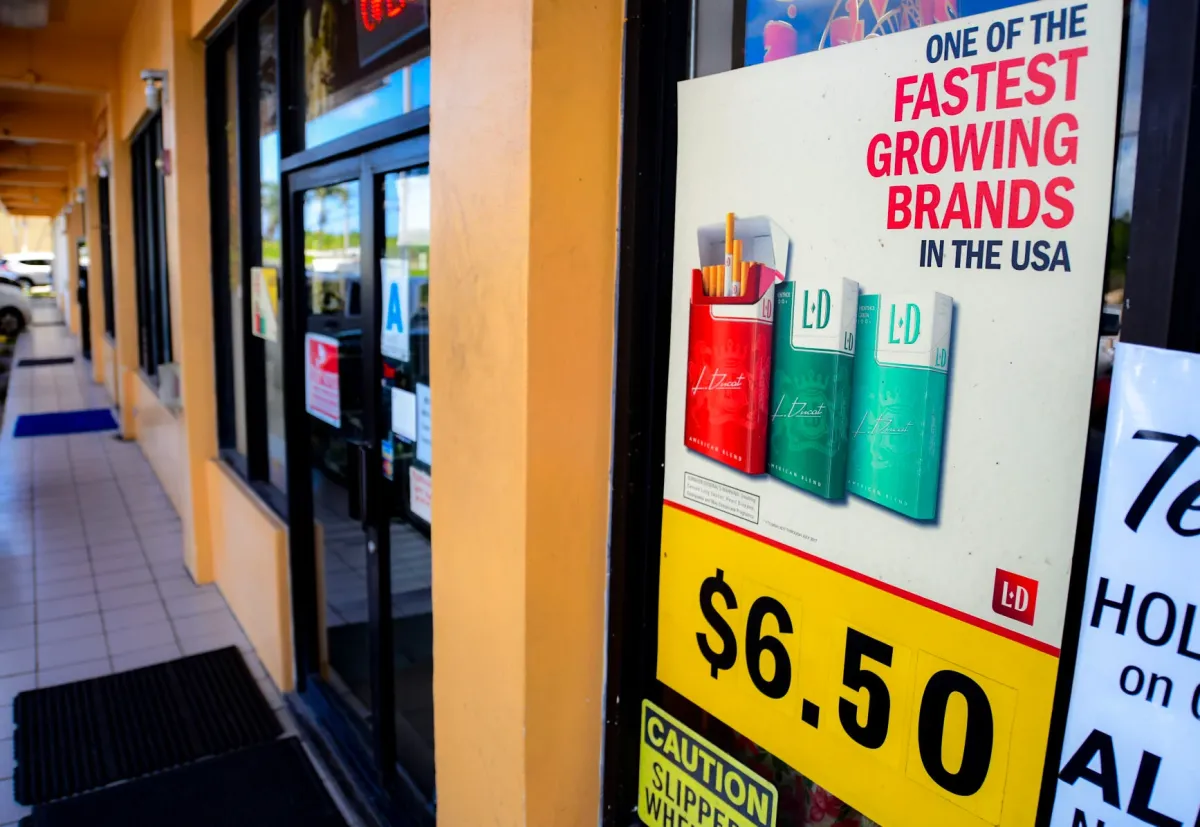
Image courtesy of Rick Cruz/Pacific Daily News.


We welcome news tips, article submissions, interview requests, or comments on this piece.

Please contact us at info@2firsts.com, or reach out to Alan Zhao, CEO of 2Firsts, on LinkedIn


Notice

1.  This article is intended solely for professional research purposes related to industry, technology, and policy. Any references to brands or products are made purely for objective description and do not constitute any form of endorsement, recommendation, or promotion by 2Firsts.

2.  The use of nicotine-containing products — including, but not limited to, cigarettes, e-cigarettes, nicotine pouchand heated tobacco products — carries significant health risks. Users are responsible for complying with all applicable laws and regulations in their respective jurisdictions.

3.  This article is not intended to serve as the basis for any investment decisions or financial advice. 2Firsts assumes no direct or indirect liability for any inaccuracies or errors in the content.

4.  Access to this article is strictly prohibited for individuals below the legal age in their jurisdiction.


Copyright


This article is either an original work created by 2Firsts or a reproduction from third-party sources with proper attribution. All copyrights and usage rights belong to 2Firsts or the original content provider. Unauthorized reproduction, distribution, or any other form of unauthorized use by any individual or organization is strictly prohibited. Violators will be held legally accountable.

For copyright-related inquiries, please contact: info@2firsts.com


AI Assistance Disclaimer


This article may have been enhanced using AI tools to improve translation and editorial efficiency. However, due to technical limitations, inaccuracies may occur. Readers are encouraged to refer to the cited sources for the most accurate information.

We welcome any corrections or feedback. Please contact us at: info@2firsts.com

Earnings Analysis | CTIHK H1 2026 Revenue Falls 26.9% as Core Businesses Diverge and New Growth Drivers Remain to Be Proven
China Tobacco International (HK) reported a 26.9% revenue decline in H1 2026, while gross profit fell only 9.5%, revealing sharp divergence across its businesses. Tobacco leaf imports contracted, while leaf exports and Brazil operations expanded strongly. Cigarette exports faced China duty-free market transition, and new tobacco products remained small. Meanwhile, CTIHK continues to strengthen its role as an investment and financing platform, though major external deals have yet to emerge. 2Firsts examines what these shifts mean for its next growth drivers.
Capital Markets
Aug.24
Charlie’s Says 30 PACHA Vape SKUs Tentatively Identified for FDA’s Non-Priority Enforcement Public List
Charlie’s Holdings said the U.S. Food and Drug Administration notified the company on June 23, 2026, that 30 PACHA vape SKUs with submitted PMTAs had been tentatively identified for inclusion on a planned public-facing FDA webpage. Under enforcement guidance issued by FDA in May, the webpage is intended to identify certain unauthorized products for which the agency generally does not intend to prioritize enforcement of premarket authorization requirements. Charlie’s disclosed the development alongside second-quarter revenue of $3.8 million, up 116% year over year.
Aug.25
After Apple Business Decline, South Korea’s ITM Semiconductor Expands KT&G Vape Supply Chain as Vape Revenue Rises 24.8%
South Korean electronics component supplier ITM Semiconductor is reshaping its business portfolio after a decline in Apple-related protection circuit business, expanding its supply of vape devices and cartridges to KT&G. According to News1 on August 18, 2026, ITM’s vape-related revenue rose 24.8% year on year to 75.5 billion won in the first half of 2026. The company began mass production of vape devices at its Cikarang, Indonesia facility in January 2026, strengthening export manufacturing capacity. Meanwhile, Samsung-related protection circuit sales continued to grow, providing support during the transition.
Aug.20
PMI Expands U.S. ZYN Portfolio With New 1.5 mg and 8 mg Strengths, Moves Toward a Unified 20-Pouch-Per-Can Format
Philip Morris International is expanding its U.S. ZYN nicotine pouch portfolio with new 1.5 mg and 8 mg strengths and plans to move its core 3 mg and 6 mg dry-pouch products from 15 to 20 pouches per can in the fourth quarter of 2026. ZYN ULTRA is also commercially available, with FDA authorization covering 10 products at 9 mg and one 11 mg Smooth product. PMI U.S. lists the new 1.5 mg and 8 mg strengths as commercially available, but as of September 10 they do not appear on the FDA’s public authorization list. Public materials do not identify which PMTA submissions cover the two new strengths or their current review status.
Sep.11
2Firsts Exclusive Analysis | RLX Q2 Revenue Rises 14.8%, Company Takes Control of Western European Distributor and Expands Multi-Category Strategy
business accounting for 68.5% of sales. A new controlling investment in a Western European distributor and plans to scale modern oral nicotine pouches point to a broader international strategy spanning channels and multiple product categories.
Special Report
Aug.14
How Large Is France’s Off-Channel Tobacco Market? Logista Says It Has Become Structural, While the Official Estimate Is 17.7% and Some Industry Studies Put It Above 50%
Logista France says tobacco consumption outside France’s official tobacconist network has become a large and structural market phenomenon, but official and industry estimates differ sharply. France’s TAFE study estimates that 17.7% of tobacco consumption escaped domestic taxation in 2023, with most of that volume attributed to cross-border purchasing rather than street sales. Some industry studies use broader off-channel definitions and put the figure above 50%. Meanwhile, French Customs seized 547.94 tonnes of tobacco in 2025, up 12%, showing continued pressure from illicit trade.
Sep.04