IMB 2024 Financial Report: Profit Up 4.5%, NGP Revenue Jumps 26%

Nov.19.2024
IMB 2024 Financial Report: Profit Up 4.5%, NGP Revenue Jumps 26%
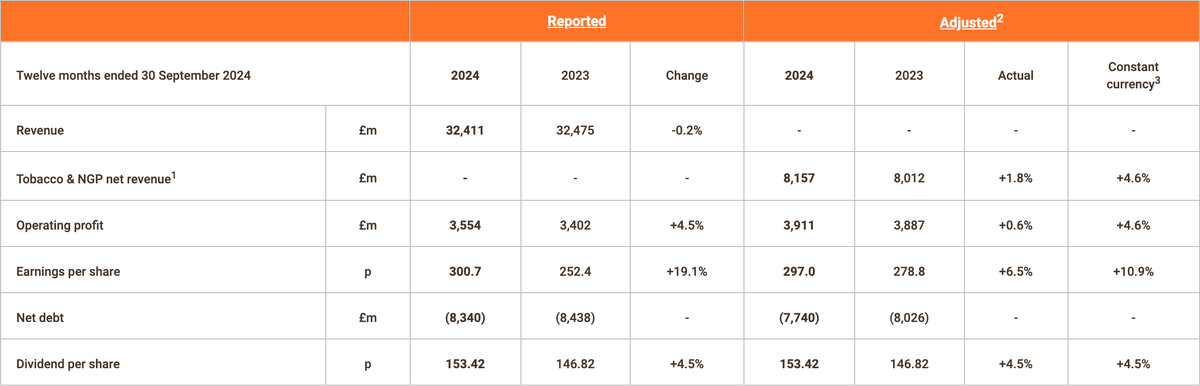
Imperial Brands released its full-year 2024 financial results, reporting a 0.2% year-on-year decline in total revenue to £32.411 billion, while adjusted operating profit increased by 4.5% year-on-year to £3.887 billion.

On November 19, Imperial Brands (IMB) announced its full-year financial results for the period ending September 30, 2024. The company reported a slight decline in total revenue, which fell by 0.2% year-on-year to £32.411 billion.


Despite the dip in revenue, adjusted operating profit rose by 4.5% to £3.887 billion. Adjusted net revenue for the "Tobacco and Next Generation Products (NGP)" segment increased by 4.6%, reaching £8.157 billion.


Key highlights of the report:


  • Tobacco and NGP net revenue increased by 4.6%.
  • Market share gains were reported in four out of IMB’s five priority markets, with an overall increase of 0.05%.
  • NGP's net revenue grew by 26%, with all three regions achieving growth and improved margins.
  • Logista's growth reflected strong tobacco pricing and benefits from last year’s acquisitions.
  • Adjusted earnings per share (EPS) rose by 10.9%, driven by profit growth and a reduced share count, while reported EPS increased by 19.1%.
  • Strong cash generation, with free cash flow reaching £2.4 billion.
  • IMB plans to return approximately £2.8 billion to shareholders in FY25, including a £1.25 billion share buyback and a 4.5% increase in the FY24 dividend.
 

IMB 2024 Financial Report: Profit Up 4.5%, NGP Revenue Jumps 26%
IMB Full-Year Report to September 30, 2024| Source: IMB official website


The report highlights that overall market share in IMB’s five priority markets increased by 5 basis points (bps). Growth was recorded in the U.S., Germany, Spain, and Australia, while the U.K. saw a decline.


In Europe, strong growth in tobacco and Next Generation Product (NGP) net revenue was noted, with a stable market share in Germany. In the Americas, the successful launch of the modern oral nicotine brand "Zone" drove a 29.4% increase in NGP net revenue. In Africa, Asia, and the Middle East, effective tobacco pricing strategies contributed to further market share expansion.


Notably, NGP's net revenue grew by 26.4%, with all three categories—heated tobacco, vaping, and modern oral —experiencing growth.


Stefan Bomhard, CEO of IMB, said:


"As we enter the final year of our current strategy, the investment we have made in consumer capabilities, cultural transformation and agile ways of working has supported another year of accelerated financial delivery and growing capital returns. "


"In tobacco, investment in our brands and sales force initiatives have delivered aggregate market share gains across our five priority markets, while delivering strong pricing. This was supported by an encouraging stabilisation in German market share for the first time under our strategy"


"In next generation products (NGP), we continue to build scale across our footprint with net revenues up 26.4% at constant currency driven by growth from all three regions and market share growth in all three categories. Our partnership approach to product innovation has enabled us to launch new products across all three categories during the year. This included our successful entry to the fast-growing modern oral category in the US with our brand ‘Zone’."


We welcome news tips, article submissions, interview requests, or comments on this piece.

Please contact us at info@2firsts.com, or reach out to Alan Zhao, CEO of 2Firsts, on LinkedIn


Notice

1.  This article is intended solely for professional research purposes related to industry, technology, and policy. Any references to brands or products are made purely for objective description and do not constitute any form of endorsement, recommendation, or promotion by 2Firsts.

2.  The use of nicotine-containing products — including, but not limited to, cigarettes, e-cigarettes, nicotine pouchand heated tobacco products — carries significant health risks. Users are responsible for complying with all applicable laws and regulations in their respective jurisdictions.

3.  This article is not intended to serve as the basis for any investment decisions or financial advice. 2Firsts assumes no direct or indirect liability for any inaccuracies or errors in the content.

4.  Access to this article is strictly prohibited for individuals below the legal age in their jurisdiction.


Copyright


This article is either an original work created by 2Firsts or a reproduction from third-party sources with proper attribution. All copyrights and usage rights belong to 2Firsts or the original content provider. Unauthorized reproduction, distribution, or any other form of unauthorized use by any individual or organization is strictly prohibited. Violators will be held legally accountable.

For copyright-related inquiries, please contact: info@2firsts.com


AI Assistance Disclaimer


This article may have been enhanced using AI tools to improve translation and editorial efficiency. However, due to technical limitations, inaccuracies may occur. Readers are encouraged to refer to the cited sources for the most accurate information.

We welcome any corrections or feedback. Please contact us at: info@2firsts.com

Product | HQD SiSA 80K Enters the U.S. Market With a Hookah-Inspired Approach to the High-Capacity Disposable Segment
The HQD SiSA 80K Hookah Disposable Vape has appeared across U.S. and cross-border online retail channels. The device comes prefilled with 28ml of e-liquid, uses a 5% nicotine salt configuration and carries a brand claim of up to 80,000 puffs. Beyond puff count, the product differentiates itself through hookah-inspired features including adjustable airflow, a flowing-water sound effect and flavor options associated with traditional hookah consumption.
Aug.18
From Border-Logistics Insiders to Retail Service Stations, Australia Mounts a Sweeping Crackdown on the Illicit Nicotine Trade as iGET Vapes Surface in A$80 Million Crime Networks
Australian authorities have disclosed two major enforcement actions that go beyond product seizures and retail closures to examine how illicit tobacco and vape networks operate. On Aug. 14, the Multi Agency Strike Team said seven people had been charged and two criminal networks were valued by authorities at a combined A$80 million, or about US$56.8 million. Investigators allege the groups used bonded warehouses, freight businesses and “trusted insiders” in legitimate industries to circumvent border controls. In a separate operation on Aug. 11, more than 100 service stations were targeted as authorities sought information on illicit tobacco importation, distribution networks and the movement of sales proceeds.
Aug.17
Japan’s Heated Tobacco Tax Changes Reshape Consumer Choices, Survey Reveals Impact of Price and Income
A consumer survey by Japanese heated tobacco information platform RELAZO found that rising tobacco prices and planned heated tobacco tax changes may influence smoking decisions among Japanese consumers. The survey covered 49,879 men and women aged 20 to 69 nationwide. It found that around 40% of respondents cumulatively indicated they may consider quitting when a pack reaches ¥600 (approximately US$4.1), while nearly 90% expressed potential quitting intentions at a ¥1,000 (approximately US$6.8) price level. The survey also found significant differences by income level, with lower-income respondents showing greater sensitivity to price increases.
Jul.24
Special Report | Russia, Ukraine and Belarus Launch Fresh Push to Rein in Vaping
Russia, Ukraine and Belarus are tightening vape regulation through different tools, from Ukraine’s stronger enforcement push and Belarus’s proposed advertising restrictions to Russia’s new GOST standard and regional sales-ban mechanism. As black-market concerns persist, some Russian experts argue that China’s tightly controlled but legalised model — built around licensing, traceability and taxation — may offer a more effective alternative to blanket prohibition.
Jul.15
South Korea Vape Strategies Diverge as BAT Reconsiders Exit and PMI Takes VEEV to About 14,000 Stores
BAT Rothmans says it previously considered exiting South Korea's vaping market because of competitive pressure from unregulated products, but is now reassessing conditions following changes to the country's nicotine regulatory framework. Vuse and other BAT vaping products remain available through existing distribution channels. The statement followed a South Korean media report that interpreted BAT's broader withdrawal from selected Vapour markets as a full exit from South Korea. Meanwhile, Philip Morris International launched VEEV inPRIME in the country in June and began expanding distribution to around 14,000 convenience stores and other retail channels in July. The contrasting moves highlight differing investment strategies as South Korea's regulated vaping market evolves.
Aug.14
Florida Governor DeSantis Expands TANF Restrictions, Blocking Welfare Benefits From Buying Tobacco and Vapes
Florida Governor Ron DeSantis announced an expansion of Temporary Assistance for Needy Families (TANF) restrictions that would prohibit Electronic Benefit Transfer (EBT) funds from being used to purchase tobacco and vaping products. The state will amend its TANF State Plan and submit the changes for federal approval. Florida officials said the restrictions would not affect eligibility for temporary cash assistance or the amount of benefits received, but would change how funds can be spent.
Aug.25