Impact of Tax Policies in Kentucky: Adult Smoking Rate Decreased to 17.4%

Regulations by 2FIRSTS.ai
Jul.15.2024
Impact of Tax Policies in Kentucky: Adult Smoking Rate Decreased to 17.4%
Kentucky tax policy effectively reduces smoking rates, with adult smoking dropping from 30% to 17.4% since 2011.

According to the Kentucky Public Service News Center on July 15, the latest data shows that a tax policy aimed at reducing smoking rates in the state of Kentucky has proven to be highly effective. Since the state legislature increased the tobacco tax to 60 cents per pack in 2011, the smoking rate among Kentucky adults has decreased from nearly 30% to 17.4% in 2022. In 2018, when the tobacco tax was raised by an additional 50 cents to $1.10 per pack, the percentage of adult smokers further declined to 17.4%.


Shannon Baker, the spokesperson for the American Lung Association in Kentucky, Tennessee, and Arkansas, stated that while the exact reasons for the decline in smoking rates cannot be determined, raising tobacco taxes is undoubtedly an effective method to reduce smoking rates. She recommended that Kentucky should further increase tobacco taxes by at least $1 and consider imposing equal tax rates on all nicotine products.


Although tobacco tax revenue increased after raising tax rates in 2011 and 2018, it decreased by 24% from 2019 to 2024. Shannon Baker emphasizes that in addition to raising taxes, states should increase funding for tobacco control programs and strictly enforce laws prohibiting the sale of tobacco to minors to reduce youth dependence on nicotine.


Furthermore, a 2023 survey on risky behaviors among teenagers found that 5.3% of high school students in Kentucky currently smoke, while 19.7% reported using e-cigarette products. Among middle school students, 2.2% reported smoking and 12.8% reported using e-cigarette products. Baker pointed out that the impact of e-cigarettes on reducing smoking rates should not be overlooked. She called for addressing the issue of youth e-cigarette use while strengthening regulations on tobacco retailers to ensure compliance with laws prohibiting the sale of tobacco to minors.


We welcome news tips, article submissions, interview requests, or comments on this piece.

Please contact us at info@2firsts.com, or reach out to Alan Zhao, CEO of 2Firsts, on LinkedIn


Notice

1.  This article is intended solely for professional research purposes related to industry, technology, and policy. Any references to brands or products are made purely for objective description and do not constitute any form of endorsement, recommendation, or promotion by 2Firsts.

2.  The use of nicotine-containing products — including, but not limited to, cigarettes, e-cigarettes, nicotine pouchand heated tobacco products — carries significant health risks. Users are responsible for complying with all applicable laws and regulations in their respective jurisdictions.

3.  This article is not intended to serve as the basis for any investment decisions or financial advice. 2Firsts assumes no direct or indirect liability for any inaccuracies or errors in the content.

4.  Access to this article is strictly prohibited for individuals below the legal age in their jurisdiction.


Copyright


This article is either an original work created by 2Firsts or a reproduction from third-party sources with proper attribution. All copyrights and usage rights belong to 2Firsts or the original content provider. Unauthorized reproduction, distribution, or any other form of unauthorized use by any individual or organization is strictly prohibited. Violators will be held legally accountable.

For copyright-related inquiries, please contact: info@2firsts.com


AI Assistance Disclaimer


This article may have been enhanced using AI tools to improve translation and editorial efficiency. However, due to technical limitations, inaccuracies may occur. Readers are encouraged to refer to the cited sources for the most accurate information.

We welcome any corrections or feedback. Please contact us at: info@2firsts.com

R.J. Reynolds Vapor Company Launches Flavored Vuse Pro Pods in U.S. Without FDA Marketing Authorization
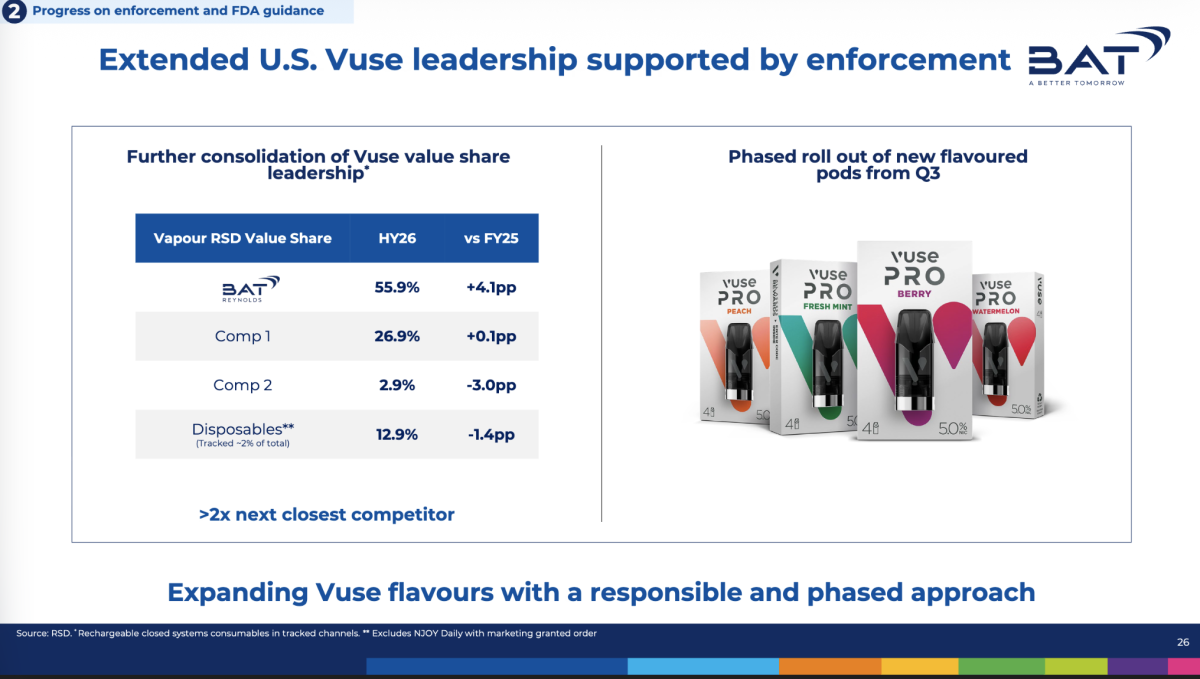
R.J. Reynolds Vapor Company has begun selling four flavored Vuse Pro pods — Peach, Berry, Watermelon and Fresh Mint — in Ohio and selected other U.S. markets. According to the Vuse U.S. FAQ, Vuse Pro contains approximately 5.0% nicotine by weight, and Vuse Pro pre-filled pods are intended for use with Vuse Alto devices. Reynolds told 2Firsts that product labeling lists an e-liquid capacity of 2.0 mL per pod. The Vuse Alto Power Unit received FDA marketing authorization in 2024, while the new Vuse Pro pods themselves have not received marketing granted orders. The rollout follows the FDA’s May 2026 revision of enforcement priorities for certain unauthorized vaping products with qualifying pending applications.
BAT
Sep.10
Product | APUS Launches Chloe 50K, Bringing Purse-Inspired Design to the U.S. High-Puff Disposable Market
APUS has introduced the Chloe 50K disposable vape, which has appeared across U.S.-facing online retail channels including Element Vape and Vapesourcing. The device combines a purse-inspired body and chain attachment with a 20ml e-liquid capacity, 1,250mAh rechargeable battery, dual mesh coil, and battery and e-liquid indicators. It is rated for up to 50,000 puffs. The product does not appear on the FDA’s current list of authorized e-cigarettes, and U.S. retail availability does not indicate FDA marketing authorization.
Jul.15
Australia Tobacco Tax Debate Spreads Within Labor as NSW Premier Minns Reaffirms Support for a Cut
Australia’s tobacco excise debate is increasingly exposing differences within the governing Labor Party. New South Wales Labor Premier Chris Minns reaffirmed on September 8 that he supports reducing tobacco excise, arguing that current tax settings are pushing consumers toward cheaper black-market cigarettes. Federal Health Minister Mark Butler continues to oppose an excise cut, while Treasurer Jim Chalmers and Assistant Treasurer Daniel Mulino have recently stopped short of ruling out future changes. The divergence follows the opposition Coalition’s proposal to cut tobacco excise by 80%.
Sep.08
Philippines Weighs Unified Vape Tax as Lawmakers Back Risk-Based Rates and Government Seeks to Fill ₱66 Billion Revenue Gap
Philippine lawmakers are considering an overhaul of the country's vape excise-tax regime to eliminate the wide gap between taxes on nicotine salt and freebase nicotine liquids and reduce incentives for misdeclaration. House Bill 5364, filed by Rep. Rufus Rodriguez and Rep. Maximo Rodriguez Jr., would impose a unified ₱10-per-milliliter tax on vapor products, with 5% annual increases beginning in 2027. Rodriguez says the proposal could generate an average ₱6 billion in annual collections from 2027 through 2030. The debate comes as the Philippine government considers tobacco, vape and other health-tax reforms to help offset around ₱66 billion in revenue expected to be forgone under a proposed tax-relief package.
Aug.18
PMI Expands Colorado Investment to $1.2 Billion to Boost ZYN Nicotine Pouch Production
Philip Morris International (PMI) is expanding its investment in its Golden, Colorado campus, bringing total investment to approximately $1.2 billion to support its smoke-free products business. The investment will strengthen PMI’s research, production and innovation capabilities in smoke-free products. As one of the world’s largest tobacco companies, PMI has continued advancing its “Smoke-Free Future” strategy through heated tobacco, oral nicotine and other reduced-risk product categories.
PMI
Jul.28
CCPIT Says Trade Friction Index for China-Related Electronics Sector Remains High, With Vape Products Among Areas of Focus
China Council for the Promotion of International Trade (CCPIT) held its July regular press conference on July 31, 2026, releasing the May 2026 Global Economic and Trade Friction Index. CCPIT spokesperson Yang Fan said the global trade friction index stood at 95 in May, remaining at a medium-to-high level. By industry, the electronics sector recorded the highest trade friction index among 13 monitored industries. In China-related trade frictions, the index stood at 93, with electronics products including drones, chips and vape products among areas where friction remained elevated.
Aug.03