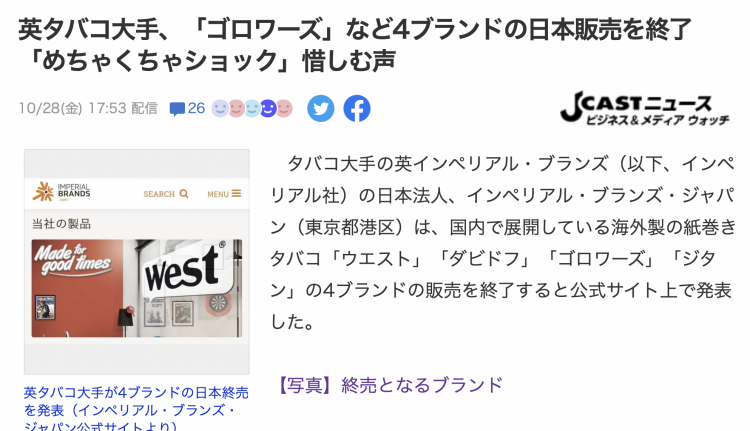
Imperial Brands Japan, a subsidiary of the UK tobacco giant Imperial Brands, sells foreign-made cigarettes such as "West," "Davidoff," and "Gauloises" in Japan. The company has officially announced on its website that four brands, including "Kotobuki," will no longer be sold.
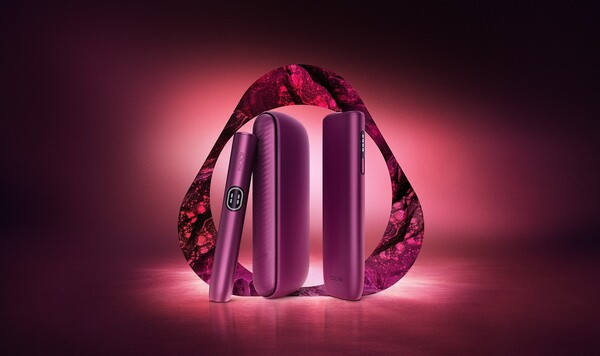
In the later part of the 2010s, the company began selling electronic cigarettes and heat-not-burn tobacco products in Japan, but it withdrew from both markets in 2021. It stated that it will focus on its traditional tobacco business.
Connection with Japanese Culture
Imperial was founded in the UK in 1901. In the 2000s, it expanded its operations by acquiring tobacco companies around the world, including Germany's Reemzma and Spain's Altadis. In 2013, it established a Japanese subsidiary called Japan Imperial Tobacco, which was later renamed to its current name in 2020. According to data from UK research company Euromonitor International, Imperial Tobacco was ranked the fifth largest company in the global cigarette market share in 2019, second only to Japan Tobacco (JT).
Imperial Brands Japan announced on its official website in late October that four cigarette brands, West, Davidoff, Gauloises, and Gitane, which are distributed in Japan, will gradually stop sales due to sufficient dealer inventory. Some stores have already sold out and the company expressed sincere gratitude to many customers for their patronage over the years.
Among discontinued brands, "Gauloises" and "Gitan" are renowned as representative French cigarettes. The song "Have You Ever Smoked Gauloise?" created by the late Noboru Kama and based on Gauloise cigarettes, has been covered by many artists and is well-known. In addition, Studio Ghibli's film "Porco Rosso," directed by Hayao Miyazaki, depicts the protagonist Porco Rosso smoking "Gitan" and has deep cultural roots in Japan.
In response to the news of four brands being discontinued, expressions of regret such as "I am shocked," "I'm sorry," and "I will miss you" have been circulating on Japanese social media platforms.
Imperial Brands Japan started developing the e-cigarette "myblu" (my blue) in June 2018 and the heated non-burning cigarette "PULZE" in May 2019 in the domestic market. However, sales of PULZE ended in June 2021. In April of the same year, the company announced that it would focus on its cigarette business, including West.
Statement:
This article has been compiled from third-party information and is intended for industry professionals for communication and learning purposes.
This article does not represent the views of 2FIRSTS, and 2FIRSTS cannot confirm the authenticity or accuracy of the content. The compilation of this article is only intended for industry communication and research.
Due to limitations in translation skills, the translated article may not fully convey the same meaning as the original. Please refer to the original article for accuracy.
2FIRSTS maintains complete alignment with the Chinese government on any domestic, Hong Kong, Macau, Taiwan, or international issues and stances.
The copyright of compiled information belongs to the original media and authors, and if there is any infringement, please contact us for removal.
Disclaimer
This article is provided solely for professional research, industry discussion, and informational purposes. Any references to brands, companies, products, technologies, or policies are made for factual reporting and analytical purposes only, and do not constitute endorsement, recommendation, promotion, or advertising by 2Firsts.
Nicotine-containing products, including but not limited to cigarettes, e-cigarettes, heated tobacco products, and nicotine pouches, carry significant health risks. Readers are responsible for complying with all applicable laws and regulations in their respective jurisdictions, including age restrictions and access limitations.
The information contained in this article should not be regarded as investment, legal, medical, regulatory, or commercial advice. While 2Firsts strives to ensure the accuracy and reliability of its content, it does not assume liability for any direct or indirect loss arising from errors, omissions, inaccuracies, or reliance on the information contained herein.
This article is not intended for individuals below the legal age for accessing tobacco or nicotine-related information in their jurisdiction.
Copyright Notice
This article is either original content produced by 2Firsts or content reproduced, translated, summarized, or adapted from third-party sources with attribution where applicable. The intellectual property rights of the original content remain with 2Firsts or the respective original rights holders.
No individual or organization may copy, reproduce, distribute, republish, modify, translate, or otherwise use this content without prior authorization. Any unauthorized use may result in legal action.
For copyright-related inquiries, corrections, or removal requests, please contact: info@2firsts.com.
AI-Assisted Translation and Editing Notice
Portions of this article may have been translated, edited, or reviewed with the assistance of artificial intelligence tools to improve efficiency and readability. Due to the limitations of AI-assisted translation and editing, discrepancies, omissions, or inaccuracies may exist when compared with the original source.
Where applicable, readers are advised to refer to the original source for the most complete and accurate information. If you identify any errors or believe that any content infringes upon your rights, please contact us at info@2firsts.com, and we will review and address the matter promptly.