Special announcement:
This article is intended for internal research and communication within the industry and does not endorse any specific brands or products. Minors are prohibited from accessing it.
At 12:00 Moscow time (17:00 Beijing time), the e-cigarette exhibition opened at the Crocus Expo exhibition center in Moscow, Russia. Many industry professionals, manufacturers, and consumers gathered at the exhibition site.
At the exhibition, 2FIRSTS conducted an exclusive interview with Jiang Bei, the head of the popular e-cigarette brand MOTI in Russia. Mr. Jiang, as the representative of MOTI in Russia, shared his insights on the e-cigarette industry and market trends in Russia.
I am optimistic about the Russian market in the long term.
Jiang Bei expressed his concern about the recent regulatory trends in the e-cigarette industry in Russia. The strict supervision imposed by the Russian government and the unstable ruble exchange rate have had an impact on e-cigarette sales.
However, he holds an optimistic view on the long-term prospects of the Russian market, despite its current sluggishness in the short term.
In standard journalistic English: "The Russian market is said to be promising in the long term but experiencing a slowdown in the short term.
The Russian State Duma passed a bill in April of this year regarding a "ban on flavoring additives". The bill proposes the establishment of a list of additives and substances, with its contents to be determined by the Russian government. The ban will take effect on September 1, 2023.
However, Jiang Bei stated that currently in the Russian e-cigarette market, this law has not yet had a significant impact on Magic Flute.
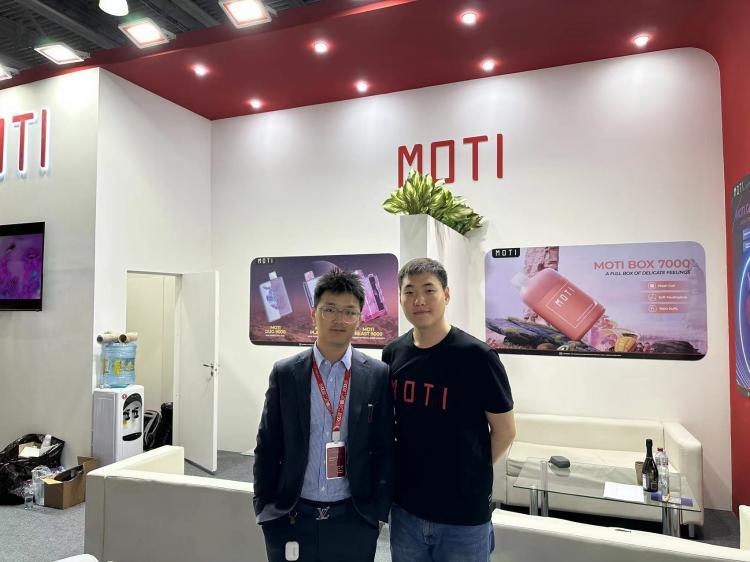
Image source: 2FIRSTS - The Magic Flute booth at the e-cigarette exhibition in Moscow.
The reality factors that contribute to the existence of a grey area.
Jiang Bei emphasized that the strategic focus of MoDi in the Russian market is to adjust and adapt according to market changes. Therefore, he has made his own observations on the Russian market and has found that certain problems are not as simple as they initially seemed, such as the issue of grey area operations, which has real-world factors influencing its existence.
The image source for the Magic Flute e-cigarette booth at the Moscow e-cigarette exhibition is 2FIRSTS.
He gave an example of the Far East region of Russia, where if someone earns only 5000 rubles per month, they would not be able to afford e-cigarettes with the additional 20 rubles per milliliter e-liquid tax imposed by the government. In a way, the black market for e-cigarettes has helped alleviate this contradiction.
However, he also stated that grey areas have always been rigorously cracked down on by the government and will become even more difficult to operate in the future.
The disposable e-cigarette remains the mainstream form of e-cigarette in Russia.
Recently, there has been a lot of attention from manufacturers on whether disposable or refillable e-cigarette products will be the future trend. Russia, being the fourth largest e-cigarette market in the world, is also expected to be involved in this debate.
The products showcased by Magic Flute at the e-cigarette exhibition in Moscow were displayed at the company's booth. The photo credits belong to 2FIRSTS.
Jiangbei stated to 2FIRSTS that in the current Russian market, the use of interchangeable magazines "is not particularly easy to do," and he provided analysis from two perspectives.
Firstly, when catering to the business sector, bulk buyers in the market prefer to purchase disposable products. Currently, the demand for such products is already quite significant, resulting in distributor and retailer preference for disposable products.
If the regional distributor is relatively small, they may not have sufficient funds or time to wait for (other types of products).
Furthermore, with regards to the consumer end, he believes that Russian consumers have already adapted to the current form of products and that too frequent changes may cause them trouble.
The consumers have already adapted to this pattern, and it would be difficult for them to change easily.
In addition, he mentioned that although refillable products have been available on the market, their market response has not been ideal compared to disposable products.
Despite recent regulatory measures taken by Russia, Jiang Bei remains optimistic about the future of the e-cigarette market in Russia and hopes to make progress while maintaining stability.
Let's continue with steady progress.
He stated that Moet Hennessy aims to meet the demands of Russian consumers and secure its brand position.
Russia is a buyer's market where brand is crucial," stated Jiang Bei.
Disclaimer
This article is provided solely for professional research, industry discussion, and informational purposes. Any references to brands, companies, products, technologies, or policies are made for factual reporting and analytical purposes only, and do not constitute endorsement, recommendation, promotion, or advertising by 2Firsts.
Nicotine-containing products, including but not limited to cigarettes, e-cigarettes, heated tobacco products, and nicotine pouches, carry significant health risks. Readers are responsible for complying with all applicable laws and regulations in their respective jurisdictions, including age restrictions and access limitations.
The information contained in this article should not be regarded as investment, legal, medical, regulatory, or commercial advice. While 2Firsts strives to ensure the accuracy and reliability of its content, it does not assume liability for any direct or indirect loss arising from errors, omissions, inaccuracies, or reliance on the information contained herein.
This article is not intended for individuals below the legal age for accessing tobacco or nicotine-related information in their jurisdiction.
Copyright Notice
This article is either original content produced by 2Firsts or content reproduced, translated, summarized, or adapted from third-party sources with attribution where applicable. The intellectual property rights of the original content remain with 2Firsts or the respective original rights holders.
No individual or organization may copy, reproduce, distribute, republish, modify, translate, or otherwise use this content without prior authorization. Any unauthorized use may result in legal action.
For copyright-related inquiries, corrections, or removal requests, please contact: info@2firsts.com.
AI-Assisted Translation and Editing Notice
Portions of this article may have been translated, edited, or reviewed with the assistance of artificial intelligence tools to improve efficiency and readability. Due to the limitations of AI-assisted translation and editing, discrepancies, omissions, or inaccuracies may exist when compared with the original source.
Where applicable, readers are advised to refer to the original source for the most complete and accurate information. If you identify any errors or believe that any content infringes upon your rights, please contact us at info@2firsts.com, and we will review and address the matter promptly.