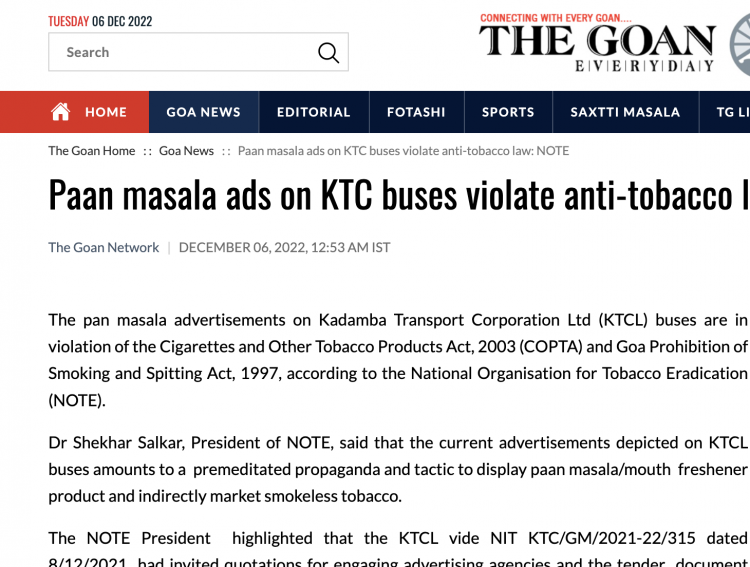
According to the National Tobacco Control Organisations, advertising for pan masala found on Kadamba Transport Corporation Ltd (KTCL) buses has violated the 2003 Cigarettes and Other Tobacco Products Act (COPTA) and the 1997 Goa Prohibition of Smoking and Spitting Act.
Dr. Shekhar Salkar, the president of NOTE, has stated that the current advertisements on KTCL buses are a deliberate form of marketing strategy designed to showcase paan masala and mouth freshener products and indirectly promote smokeless tobacco.
The President emphasized that the KTCL vide NIT KTC/GM/22/315 invitation dated August 12, 2021, to hire advertising agents, contained provisions stating that any company found to be in violation of the regulations would be barred from having their advertisements displayed by the central government or acting against good morals or current legal regulations.
Salkar said that the paan masala/mouth freshener advertisement currently displayed on your bus not only violates the COTPA act but also goes against the bidding specifications set by your office. Additionally, he criticized the ad for being in poor taste and unethical.
Taking into account that children and young people under the age of 15 are the largest users of KTCL services in the state, the aforementioned indirect promotions of tobacco products that pose a risk of oral cancer and other diseases can also be considered a violation of child rights in Goa, according to a law passed in 2003.
2FIRSTS will continue to track updates on this topic, with further information available on the "2FIRSTSAPP". Scan the QR code below to download the app.
Disclaimer
This article is provided solely for professional research, industry discussion, and informational purposes. Any references to brands, companies, products, technologies, or policies are made for factual reporting and analytical purposes only, and do not constitute endorsement, recommendation, promotion, or advertising by 2Firsts.
Nicotine-containing products, including but not limited to cigarettes, e-cigarettes, heated tobacco products, and nicotine pouches, carry significant health risks. Readers are responsible for complying with all applicable laws and regulations in their respective jurisdictions, including age restrictions and access limitations.
The information contained in this article should not be regarded as investment, legal, medical, regulatory, or commercial advice. While 2Firsts strives to ensure the accuracy and reliability of its content, it does not assume liability for any direct or indirect loss arising from errors, omissions, inaccuracies, or reliance on the information contained herein.
This article is not intended for individuals below the legal age for accessing tobacco or nicotine-related information in their jurisdiction.
Copyright Notice
This article is either original content produced by 2Firsts or content reproduced, translated, summarized, or adapted from third-party sources with attribution where applicable. The intellectual property rights of the original content remain with 2Firsts or the respective original rights holders.
No individual or organization may copy, reproduce, distribute, republish, modify, translate, or otherwise use this content without prior authorization. Any unauthorized use may result in legal action.
For copyright-related inquiries, corrections, or removal requests, please contact: info@2firsts.com.
AI-Assisted Translation and Editing Notice
Portions of this article may have been translated, edited, or reviewed with the assistance of artificial intelligence tools to improve efficiency and readability. Due to the limitations of AI-assisted translation and editing, discrepancies, omissions, or inaccuracies may exist when compared with the original source.
Where applicable, readers are advised to refer to the original source for the most complete and accurate information. If you identify any errors or believe that any content infringes upon your rights, please contact us at info@2firsts.com, and we will review and address the matter promptly.