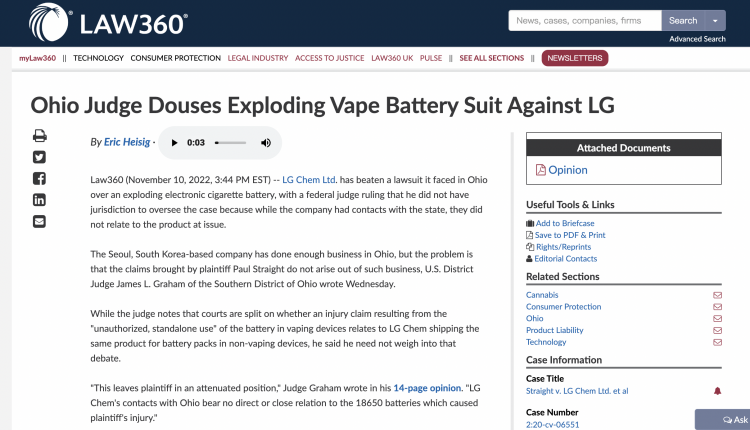
LG Chem Ltd. has successfully defeated a lawsuit in Ohio over exploding batteries in electronic cigarettes. A federal judge ruled that he did not have jurisdiction over the case, as the company, although having contact with the state, was not related to the disputed product.
Judge James L. Graham of the United States District Court for the Southern District of Ohio wrote on Wednesday that the Seoul-based company has done enough business in Ohio, but the issue is that the plaintiff, Paul Straight's claims are not related to this business.
Although the judge pointed out that there was a dispute in court regarding whether a claim for injury caused by "unauthorized, independent use" of e-cigarette devices with batteries was related to the transportation of non-e-cigarette device battery packs by LG Chemical, he said he did not need to make a judgment on this argument.
This puts plaintiffs in a weakened position," wrote Judge Graham in his 14-page opinion. "There is no direct or close relationship between LG Chem and Ohio's contact with the 18650 battery that caused the plaintiffs' injuries.
Straight claims in his lawsuit that the battery of his e-cigarette exploded, causing burns to his left thigh and causing his jeans to catch on fire. He alleges that he suffered second and third-degree burns to his thigh and left wrist, which have now left him limping.
He has filed a lawsuit against LG Chem and its American subsidiary. He has also sued Vapor Station LLC for selling him a battery from one of their stores, as well as the company that supplied the battery to the store. The claims include violations of implied warranties under the Magnuson-Moss Warranty Act and Ohio state law.
LG Chemical maintains that it has not authorized any company to sell individual batteries. The judge pointed out that these batteries are meant for use in battery packs for power tools and other products.
Judge Graham has allowed for evidence collection to help resolve the jurisdictional dispute. LG Chem argues that it did not manufacture, sell, or distribute batteries in Ohio, while Straight maintains that the company's other business activities in the state are sufficient for the judge to exercise a specific jurisdiction.
The judge does not accept what is being said.
Judge Graham stated, "In fact, LG Chem has confirmed that it neither received revenue from the sale or distribution of 18650 batteries in Ohio, nor advertised or solicited business for 18650 batteries in Ohio.
Although the judge stated that Straight could not reject LG Chem's claim by testing for "association," he also rejected Straight's argument that it was unfair to dismiss the case because evidence showed that LG Chem knew the batteries were being used for vaping devices and posed a risk.
However, the lawsuit against another defendant is still under trial. Straight withdrew claims against Vapor Station and LG Chem's US subsidiary, but its claims against Picktown Vapor LLC for distributing batteries still remain.
A spokesperson for LG Energy Solutions, which is currently responsible for producing LG batteries, declined to comment on Thursday.
The lawyer for Straight did not immediately respond to a request for comment via email on Thursday.
This case has the docket number 2:20-cv-06551 and is being heard in the Southern District of Ohio court in the United States.
Statement:
This article is a compilation of third-party information intended for industry exchange and learning purposes only.
This article does not represent the views of 2FIRSTS, and 2FIRSTS cannot confirm the authenticity or accuracy of the content of the article. The translation of this article is only intended for communication and research within the industry.
Due to limitations in translation ability, the translated article may not fully reflect the original text. Please refer to the original text.
2FIRSTS aligns completely with the Chinese government on any statements or positions related to domestic affairs, issues involving Hong Kong, Macau, Taiwan, and foreign relations.
The copyright of compiled information belongs to the original media and author. If there is any infringement, please contact us to request deletion.
Disclaimer
This article is provided solely for professional research, industry discussion, and informational purposes. Any references to brands, companies, products, technologies, or policies are made for factual reporting and analytical purposes only, and do not constitute endorsement, recommendation, promotion, or advertising by 2Firsts.
Nicotine-containing products, including but not limited to cigarettes, e-cigarettes, heated tobacco products, and nicotine pouches, carry significant health risks. Readers are responsible for complying with all applicable laws and regulations in their respective jurisdictions, including age restrictions and access limitations.
The information contained in this article should not be regarded as investment, legal, medical, regulatory, or commercial advice. While 2Firsts strives to ensure the accuracy and reliability of its content, it does not assume liability for any direct or indirect loss arising from errors, omissions, inaccuracies, or reliance on the information contained herein.
This article is not intended for individuals below the legal age for accessing tobacco or nicotine-related information in their jurisdiction.
Copyright Notice
This article is either original content produced by 2Firsts or content reproduced, translated, summarized, or adapted from third-party sources with attribution where applicable. The intellectual property rights of the original content remain with 2Firsts or the respective original rights holders.
No individual or organization may copy, reproduce, distribute, republish, modify, translate, or otherwise use this content without prior authorization. Any unauthorized use may result in legal action.
For copyright-related inquiries, corrections, or removal requests, please contact: info@2firsts.com.
AI-Assisted Translation and Editing Notice
Portions of this article may have been translated, edited, or reviewed with the assistance of artificial intelligence tools to improve efficiency and readability. Due to the limitations of AI-assisted translation and editing, discrepancies, omissions, or inaccuracies may exist when compared with the original source.
Where applicable, readers are advised to refer to the original source for the most complete and accurate information. If you identify any errors or believe that any content infringes upon your rights, please contact us at info@2firsts.com, and we will review and address the matter promptly.