Marco's Vapor to Permanently Close in Response to FDA Regulations

Regulations by 2FIRSTS.ai
May.14.2024
Marco's Vapor to Permanently Close in Response to FDA Regulations
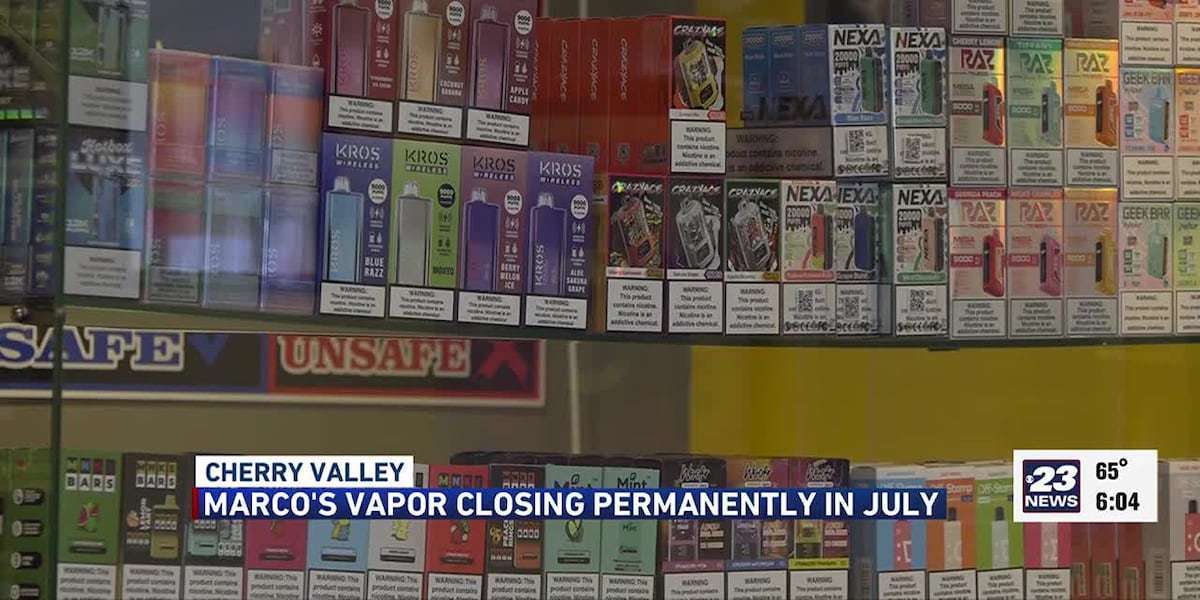
Marco's Vapor in Illinois' Cherry Valley will permanently close by July 1, 2024 due to FDA regulations on e-cigarettes.

According to a report by the Associated Press on May 14th, Marco's Vapor, a smoke shop in Cherry Valley, Illinois, announced recently that it will permanently close its doors on July 1, 2024 due to the strict regulations imposed by the U.S. Food and Drug Administration (FDA).


Store owner Marco Altamore states that the strict regulation of e-cigarettes by the FDA has made it impossible for him to continue operating in the United States. Currently, only three e-cigarette manufacturers, including Logic Technology Development LLC, NJOY LLC, and RJ Reynolds Vapor Company, are authorized by the FDA to sell their products in the US.


Alta Moreno revealed that the FDA has rejected millions of other e-cigarette devices and e-liquid applications submitted by the e-cigarette industry, including Marco's Vapor's own Custom Clouds brand. Despite the imminent closure of the store, Moreno continues to advocate for the e-cigarette industry.


He said, "Our goal has always been to help people quit smoking. My staff and team receive calls from customers all day, asking, 'I have been your customer for ten years, where should I go next to buy an e-cigarette?' Because my customers will continue to use e-cigarettes, as it is effective for them."


We welcome news tips, article submissions, interview requests, or comments on this piece.

Please contact us at info@2firsts.com, or reach out to Alan Zhao, CEO of 2Firsts, on LinkedIn


Notice

1.  This article is intended solely for professional research purposes related to industry, technology, and policy. Any references to brands or products are made purely for objective description and do not constitute any form of endorsement, recommendation, or promotion by 2Firsts.

2.  The use of nicotine-containing products — including, but not limited to, cigarettes, e-cigarettes, nicotine pouchand heated tobacco products — carries significant health risks. Users are responsible for complying with all applicable laws and regulations in their respective jurisdictions.

3.  This article is not intended to serve as the basis for any investment decisions or financial advice. 2Firsts assumes no direct or indirect liability for any inaccuracies or errors in the content.

4.  Access to this article is strictly prohibited for individuals below the legal age in their jurisdiction.


Copyright


This article is either an original work created by 2Firsts or a reproduction from third-party sources with proper attribution. All copyrights and usage rights belong to 2Firsts or the original content provider. Unauthorized reproduction, distribution, or any other form of unauthorized use by any individual or organization is strictly prohibited. Violators will be held legally accountable.

For copyright-related inquiries, please contact: info@2firsts.com


AI Assistance Disclaimer


This article may have been enhanced using AI tools to improve translation and editorial efficiency. However, due to technical limitations, inaccuracies may occur. Readers are encouraged to refer to the cited sources for the most accurate information.

We welcome any corrections or feedback. Please contact us at: info@2firsts.com

China’s E-Cigarette Exports Fall Slightly to USD 10.6 Billion in 2025, U.S. Market Further Consolidates Lead
China’s e-cigarette exports totaled approximately USD 10.60 billion in 2025, down 3.3% year-on-year from USD 10.96 billion in 2024, according to annual trade data released by the General Administration of Customs of China. Despite the mild decline, exports remained firmly above the USD 10 billion mark, with a clear rebound in the fourth quarter.
Jan.20 by 2FIRSTS.ai
British Columbia Sues Juul Over Youth Nicotine Addiction
British Columbia has filed a civil lawsuit against Juul Labs, alleging the company fuelled youth nicotine addiction through highly addictive products and deceptive marketing practices. The claim was submitted to the B.C. Supreme Court under the newly enacted Vaping Product Damages and Health Care Costs Recovery Act.
Dec.15 by 2FIRSTS.ai
Lancet Study Finds Rising Use of Nicotine Pouches in Britain
A study published in The Lancet has found that nicotine pouch use is increasing in Britain, particularly among young men. Usage among people aged 16 to 24 has risen sharply since early 2022.
Dec.17 by 2FIRSTS.ai
Echo Guo: The Accumulating Risks Behind the Surge in Chinese Vape Exports to the U.S.
Chinese vape exports to the U.S. jumped from about 2.2 million kg in June to 14.8 million kg in October 2025, despite tougher enforcement, the Washington Examiner reported. 2Firsts finds the surge reflects delayed bulk shipments, not demand recovery. With U.S. inventory exceeding 160 million devices and distributors paying ~10% upfront, cash-flow stress has shifted to Chinese manufacturers, and discounted stock is spilling into other markets.
Dec.14 by Echo Duo
Tobacco-Free Kids Condemns PMI for Marketing Zyn to Youth via F1 Sponsorship
Yolonda C. Richardson, President and CEO of the Campaign for Tobacco-Free Kids, issued a statement on December 10, 2025, condemning Philip Morris International (PMI) for partnering with Ferrari to promote Zyn nicotine pouches on Formula 1 cars. She said PMI’s claim that the sponsorship targets adults is misleading, as F1’s audience has become increasingly young—with over 4 million children aged 8–12 now following the sport.
Dec.12 by 2FIRSTS.ai
Korea’s MFDS sets 2026 plan to manage and disclose harmful constituents in tobacco products
South Korea’s Ministry of Food and Drug Safety (MFDS) said it has established its 2026 work plan to systematically manage harmful constituents in tobacco products and disclose related information under the Tobacco Harmfulness Management Act, which took effect in November 2025.
Jan.16 by 2FIRSTS.ai