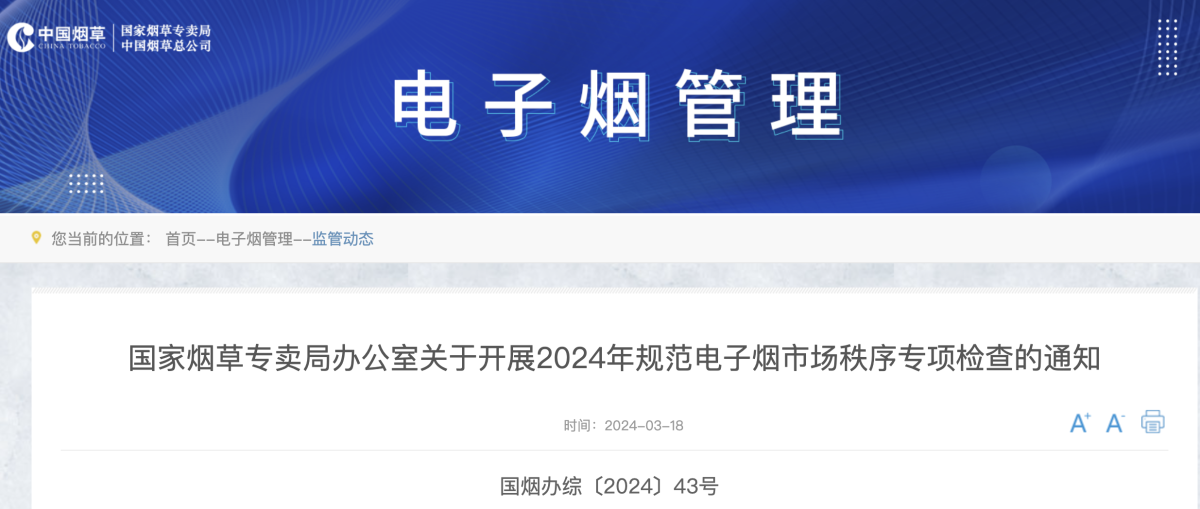
State Tobacco Monopoly Administration No. 43 of 2024
Provincial Tobacco Monopoly Bureaus,
In order to strengthen the supervision of the e-cigarette market in accordance with the law, maintain a good market order, promote the smooth and healthy operation of the e-cigarette industry, and continue to consolidate the achievements of legal and standardized governance of the e-cigarette industry, the State Tobacco Monopoly Administration has decided to organize a special inspection in 2024 to regulate the market order of e-cigarettes. The relevant matters are hereby notified as follows:
I. Overall Requirements
Guided by Xi Jinping Thought on Socialism with Chinese Characteristics for a New Era, thoroughly implement the spirit of the 19th National Congress and the Second Plenary Session of the 20th Central Committee of the Party, and implement the legislative purpose of strengthening e-cigarette regulation, regulating market order, safeguarding people's health and safety, and promoting industrial governance through legalization and standardization. Adhere to the principles of law and regulation, problem orientation, and overall coordination, conduct a comprehensive inspection of the e-cigarette market entities that have obtained tobacco monopoly licenses in accordance with the law, focus on investigating illegal e-cigarette operations by entities that have not obtained licenses, increase efforts to rectify problems and investigate cases, maintain a high-pressure crackdown on illegal e-cigarette production and operation, continuously rectify behaviors that disrupt the e-cigarette market order, guide business entities to operate in compliance with the law, and create a fair, just, and transparent business environment to build a stable and healthy market foundation for the e-cigarette industry.
II. Work Arrangements
This special inspection will last for 4 months and will be conducted in three stages.
Mobilization and Deployment Phase (from now until March 31)
The State Tobacco Monopoly Administration has issued a special inspection plan. Provincial tobacco monopoly bureaus are required to develop specific inspection implementation plans based on local conditions, focusing on key inspection areas, refining measures, mobilizing deployment, and coordinating arrangements for special inspections in their jurisdictions to ensure that all tasks are effectively implemented.
Inspection Phase (April 1 to June 30)
Each provincial tobacco monopoly bureau is coordinating inspections with local tobacco monopoly bureaus within their jurisdiction, forming relevant inspection teams to carry out specific inspection tasks. Special attention is being placed on combining targeted inspections with daily supervision, case investigation, and policy promotion, integrating on-site inspections, tracking of leads, situation analysis, and corrective actions. Efforts are being made to strengthen administrative law enforcement and crack down on various illegal activities related to e-cigarettes in accordance with the law, addressing prominent issues that disrupt the market order for e-cigarettes.
Summary and Improvement Phase (June 30 to July 15, measures to be adhered to in the long term)
Each provincial tobacco monopoly bureau will comprehensively summarize the progress and achievements of the special inspection work in their jurisdiction, beneficial experiences, prominent issues, major cases handled, policy suggestions, etc., and report the special inspection situation to the State Tobacco Monopoly Administration before July 15. Strengthen the application of the results of special inspections, continuously optimize the top-level design of the e-cigarette regulatory system measures in their jurisdiction, strengthen cross-departmental coordination and supervision, and establish a sound long-term regulatory mechanism.
During the special inspection period, the State Tobacco Monopoly Administration will combine the progress of work in various regions and organize supervisory groups to conduct inspections on the provincial-level tobacco monopoly bureaus in a timely manner.
III. Targets of Inspection and Key Points of Examination
Through a combination of written and on-site methods, inspections are carried out in a layered manner. It is insisted to simultaneously push forward inspections, standardize, rectify, and hold people accountable. Based on the inspection results, all discovered problems are required to be rectified, and those engaged in illegal activities will be held accountable according to procedures. Those suspected of committing crimes will be promptly referred to judicial authorities for criminal prosecution.
- Key inspections focus on verifying the compliance of e-cigarette related manufacturing enterprises in terms of production operations, licensing requirements, quality assurance systems, investment in fixed assets and establishing new production capacities, logistics and packaging labeling, sales and promotion, safety protocols, corporate management system development, and rectification of any legal violations.
- Focus on checking the institutional construction of certified e-cigarette wholesale companies, brand (specification) management, logistics management, marketing activities management, and rectification of violations and non-compliance issues.
- Focus on inspecting the compliance operations of e-cigarette retail market entities, procurement channels, sales management, and the rectification of illegal activities.
- Focus on investigating the illegal operation of e-cigarettes by unlicensed market entities. For those found to be operating e-cigarette production and sales without a license, relevant government departments will collaborate to shut them down and hold them accountable for their violations of laws and regulations.
IV. Job Requirements
- Enhance ideological understanding and strengthen organizational leadership. Improve political positioning, deeply understand the importance of special inspections in protecting the health and safety of the people, especially children and adolescents, safeguarding the legitimate rights and interests of businesses and consumers, and promoting the stable and healthy operation of industries. Each provincial-level tobacco monopoly bureau should establish a special inspection working group, refine tasks, ensure responsibilities are fulfilled, and supervise implementation at each level to ensure the high-quality and efficient completion of special inspection tasks.
- In an orderly manner, efforts are made to ensure the effectiveness of inspections. Focus on new situations and changes in the e-cigarette industry, market, and operators, highlight key inspection areas in a layered manner, coordinate implementation, and rigorously enforce fair and civilized law enforcement. Optimize inspection methods, innovate supervision and inspection tools, establish and improve mechanisms such as joint inspections, "double random, one open" supervision, "Internet + supervision", credit supervision, etc., improve the supervision ledger for each enterprise, and enhance the quality and effectiveness of supervision and inspection. Strengthen the dissemination of e-cigarette laws, regulations, and regulatory policies, regulate the business activities of e-cigarette market entities, and guide market entities to operate in full compliance with the law.
- Promoting the investigation and handling of cases to enhance regulatory efficiency. When problems are found during inspections, they are promptly ordered and supervised for rectification according to the principle of "who is in charge, who is responsible", strengthening follow-up regulatory coordination. Administrative law enforcement cases are conducted in accordance with laws and regulations, focusing on classification, precise enforcement, and proportionate penalties. A sound mechanism for coordinating administrative law enforcement with criminal justice is established, and suspected criminal cases are transferred for handling in accordance with the law. Strengthening the collection of clues and supervision of cases, promoting the linkage between punishment and administrative permits, legally clearing out e-cigarette market entities that are illegal, bad, or not suitable for supervision, and continuously consolidating the foundation of market entities for the stable and healthy operation of the e-cigarette industry.
- In-depth analysis and summarization, establishment of long-term mechanisms. We must adhere to a systematic approach, carefully summarize the experiences and practices of special inspections, and analyze the reasons for recurring, widespread, and emerging issues from the perspective of regulatory measures and mechanisms. At the same time, we need to promote individual case handling, case management, and system governance in sync to continuously strengthen the foundation of regulatory system. Strengthening the combination of measures and regions, deepening the construction of a comprehensive e-cigarette regulatory system characterized by multi-party collaboration and joint management.
Each provincial tobacco monopoly bureau should regularly report special inspection plans, typical cases, and stage progress to the State Tobacco Monopoly Administration, with major cases and important situations reported at any time. Strengthen publicity, use cases to interpret laws, and strengthen publicity guidance around the organization and preparation of special inspections, joint law enforcement, major achievements, laws and regulations, and other aspects to create a good public opinion atmosphere.
Office of the State Tobacco Monopoly Administration
March 18, 2024
We welcome news tips, article submissions, interview requests, or comments on this piece.
Please contact us at info@2firsts.com, or reach out to Alan Zhao, CEO of 2Firsts, on LinkedIn
Notice
1. This article is intended solely for professional research purposes related to industry, technology, and policy. Any references to brands or products are made purely for objective description and do not constitute any form of endorsement, recommendation, or promotion by 2Firsts.
2. The use of nicotine-containing products — including, but not limited to, cigarettes, e-cigarettes, nicotine pouchand heated tobacco products — carries significant health risks. Users are responsible for complying with all applicable laws and regulations in their respective jurisdictions.
3. This article is not intended to serve as the basis for any investment decisions or financial advice. 2Firsts assumes no direct or indirect liability for any inaccuracies or errors in the content.
4. Access to this article is strictly prohibited for individuals below the legal age in their jurisdiction.
Copyright
This article is either an original work created by 2Firsts or a reproduction from third-party sources with proper attribution. All copyrights and usage rights belong to 2Firsts or the original content provider. Unauthorized reproduction, distribution, or any other form of unauthorized use by any individual or organization is strictly prohibited. Violators will be held legally accountable.
For copyright-related inquiries, please contact: info@2firsts.com
AI Assistance Disclaimer
This article may have been enhanced using AI tools to improve translation and editorial efficiency. However, due to technical limitations, inaccuracies may occur. Readers are encouraged to refer to the cited sources for the most accurate information.
We welcome any corrections or feedback. Please contact us at: info@2firsts.com