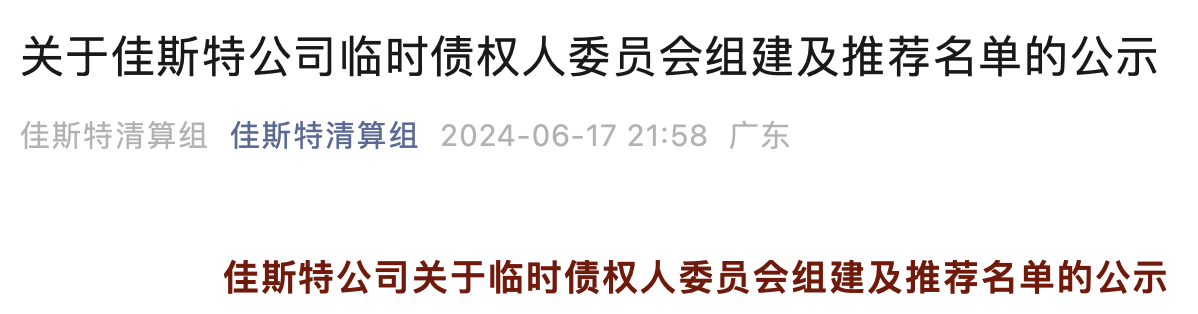
On the evening of June 17, the JSTE Liquidation Team released a public announcement regarding the establishment and recommended list of the temporary creditors committee for JSTE Company. The announcement stated that in order to better promote the self-liquidation process of JSTE Electronic Technology (Dongguan) Co., Ltd. (referred to as JSTE Company), the liquidation team suggested and the shareholders' meeting agreed to establish a temporary creditors committee. At the same time, due to the circumstances of the JSTE Company case, the liquidation team suggested that the initial number of members of the temporary creditors committee be 7.
It is worth noting that the list of recommended creditors includes Chen Yongqiang from Bank of China Limited Dongguan (Dalang Branch), Luo Zhixian from Dongguan Huaze Energy Limited, Huang Zhiyong from Dongguan Sibiray Industrial Co., Ltd., Zhao Xiaohua from Shenzhen Desheng Zhuoyue Hardware Products Co., Ltd., Luo Ruliang and Suo Wenjing from China Merchants Bank Limited Dongguan Branch, Liu Zhan from Shenzhen Xingzewei Technology Co., Ltd., and Lei Zhengxia from Jiasite Electronic Technology (Dongguan) Co., Ltd.
The following is the original announcement related matters and recommended list.
Candidate selection criteria
1. Has influence among creditors. 2. Proactively advocates for rights, has a sense of justice and fairness. 3. Has the resources and ability to assist in progressing liquidation cases, explaining the work of the liquidation team, and advancing asset restructuring in liquidation work. 4. Institutions or individuals residing in Dongguan or Shenzhen are given priority consideration, as it facilitates participating in the coordination work of the liquidation team.
Translate to standard journalistic English: The cat was rescued from the burning building by firefighters.
The process of appointing members to the ad hoc creditors committee.
The liquidation committee publicly announces the recommendations or self-nominations of candidates for the interim creditors' committee to all creditors.
Creditors are self-nominating or being nominated by the liquidation committee. Currently, seven individuals have been recommended, but this number may be adjusted later depending on the circumstances.
The liquidation team selects and recommends the best candidates based on the internal evaluation of the creditor's self-recommendation form/recommendation form.
The recommended list will be published on the public account for individuals to provide feedback and raise any objections.
Translate to standard journalistic English: "The suspect was taken into custody following a high-speed chase through city streets." - The suspect was apprehended after a pursuit at high speeds on urban roads.
Regarding the plan for the formation of an ad hoc creditors' committee
The ad hoc committee of creditors (hereinafter referred to as "committee members") has recommended a list of candidates and a backup list. In order to avoid situations where committee members approved by creditors' meetings are unable or unwilling to fulfill their duties, act improperly, or commit misconduct (hereinafter referred to as "reasons for removal") which may impact the progress of the liquidation process, the liquidation team, based on experience, has prepared a backup list. If a member from the recommended list is removed for reasons stated, the next member from the backup list will be appointed after the removal procedure is carried out by the creditors' committee.
The reasons for expulsion include:
Voluntarily resigning from one's position.
Failure to fulfill obligations. Not attending creditor meetings or exercising voting rights for two consecutive times.
Using their position as a member of the creditors' committee to seek personal gain, obstruct the liquidation process, or disclose confidential information (such as leaking the lowest price of inventory items).
The individual's debts were found to be falsely declared, involved in fraudulent litigation, or subject to a lawsuit, or the individual initiated proceedings to confirm debts, all of which may affect their ability to fulfill their responsibilities fairly due to conflicting interests.
Due to health, capacity, or time constraints, as well as being detained or other circumstances that make it unsuitable to continue serving as a member of the creditors' committee.
Without a valid reason or constructive feedback, the opposition to the proposed motion is purely emotional.
Spreading information harmful to the case being settled.
Without the approval or involvement of the auditing team, engaging in inappropriate interactions with suppliers or related stakeholders.
As a result of intentional or gross negligence, creditors' interests have been harmed.
Dismissal procedure: After the occurrence of grounds for dismissal, the temporary creditors' committee chairperson (currently China Bank Dongguan Branch, the largest creditor) will preside over the convening of a temporary creditors' committee meeting to vote for over half approval to complete the dismissal procedure. If the temporary creditors' committee chairperson triggers the dismissal procedure, the liquidation team will propose to the shareholders' meeting to replace the temporary creditors' committee chairperson.
Supervision system: In order to ensure that members of the temporary debt committee perform their duties fairly, strict supervision of the members of the temporary debt committee is required. The liquidation team, all creditors, and stakeholders can all supervise the members.
Reporting procedure: Once any member of the committee is found to have clues involving grounds for removal, the above-mentioned personnel can report to the liquidation team. The liquidation team will conduct a lawful investigation and process according to the procedures. If the reported member is found to be true, the liquidation team will recommend the chairman of the temporary creditors' meeting to exercise the removal procedure at the creditors' committee. If the chairman of the creditors' meeting is reported, the liquidation team will report to the shareholders' meeting to replace the chairman of the creditors' meeting. If the workers' representative is reported, the liquidation team will organize a new election for the workers.
Expansion of the standby list and drawing system: In addition to the existing standby list, other creditors can also recommend themselves to join the standby list pool of the ad hoc creditors' committee. After review by the liquidation team, as long as they meet the conditions for removal from the list, they can be included in the pool. Members added to the pool later do not need to go through a selection process. If there are vacancies in the ad hoc creditors' committee, the chairperson of the ad hoc creditors' meeting and the liquidation team will draw from the standby list pool. The drawing process will be recorded with video evidence and the results will be made public.
Scope of the creditors' committee's authority.
Verify debts.
Supervisory Liquidation Team;
Selecting and replacing temporary creditors' committee members.
Participate in reviewing and voting on the liquidation plan of JSTE Company.
Review and vote on important resolutions and matters involving all creditors of JSTE Company.
Interim creditors' committee meeting mechanism and voting rules: Routine matters can be voted on in writing, while major matters must be discussed in a live meeting with sufficient exchange of opinions or through a video conference held remotely. Each person has one vote at the meeting, and a resolution is passed if more than 2/3 of all present creditors agree. In the event of a deadlock with a 50%:50% split, the decision will be based on the opinion of the party with the larger total amount of debt.
One-third of regular e-cigarette users say they smoke traditional cigarettes more than five times a day, and 40% of them frequently use e-cigarettes. Meanwhile, only 10% of regular smokers say they use e-cigarettes at least five times a day.
We welcome news tips, article submissions, interview requests, or comments on this piece.
Please contact us at info@2firsts.com, or reach out to Alan Zhao, CEO of 2Firsts, on LinkedIn
Notice
1. This article is intended solely for professional research purposes related to industry, technology, and policy. Any references to brands or products are made purely for objective description and do not constitute any form of endorsement, recommendation, or promotion by 2Firsts.
2. The use of nicotine-containing products — including, but not limited to, cigarettes, e-cigarettes, nicotine pouchand heated tobacco products — carries significant health risks. Users are responsible for complying with all applicable laws and regulations in their respective jurisdictions.
3. This article is not intended to serve as the basis for any investment decisions or financial advice. 2Firsts assumes no direct or indirect liability for any inaccuracies or errors in the content.
4. Access to this article is strictly prohibited for individuals below the legal age in their jurisdiction.
Copyright
This article is either an original work created by 2Firsts or a reproduction from third-party sources with proper attribution. All copyrights and usage rights belong to 2Firsts or the original content provider. Unauthorized reproduction, distribution, or any other form of unauthorized use by any individual or organization is strictly prohibited. Violators will be held legally accountable.
For copyright-related inquiries, please contact: info@2firsts.com
AI Assistance Disclaimer
This article may have been enhanced using AI tools to improve translation and editorial efficiency. However, due to technical limitations, inaccuracies may occur. Readers are encouraged to refer to the cited sources for the most accurate information.
We welcome any corrections or feedback. Please contact us at: info@2firsts.com