Report: Vermont Trust Company Increases Stake in Altria Group

Aug.07.2024
Report: Vermont Trust Company Increases Stake in Altria Group
According to a report by DAILY POLITICAL on August 6, Vermont Trust Company increased its holdings in Altria Group.

According to a report from DAILY POLITICAL on August 6th, Vermont Trust company disclosed in its latest report to the U.S. Securities and Exchange Commission (SEC) that it increased its holdings of Altria Group (Altria Group, Inc., NYSE: MO) by 0.8% in the second quarter.


During the period, the company purchased an additional 320 shares, bringing their total holdings of the company's stock to 42,091 shares. As of the end of the most recent quarter, the Vermont Trust Company's stake in Altria Group was valued at $1,917,000.


Other large investors have also made changes to their holdings in the company. Maryland Capital Advisors Inc. increased its stake in Altria Group by 154.4% in the first quarter. Now, Maryland Capital Advisors Inc. owns 575 shares of the company, worth $25,000, after acquiring an additional 349 shares.


Accordant Advisory Group Inc purchased new shares of Altria Group in the first quarter valued at approximately $26,000.


In the first quarter, BNP Paribas of France acquired shares of Altria Group worth around $27,000, while Westend Capital Management LLC purchased shares of Altria Group valued at approximately $29,000.


Finally, Criterion Capital Advisors LLC purchased new shares of Altria Group in the fourth quarter, worth approximately $27,000. Institutional investors and hedge funds own 57.41% of the company's shares.


Wall Street analysts' views on Altria Group stock.


Multiple research companies recently shared their views on Altria Group. Stifel Nicolaus, in a report on Thursday, August 1, raised Altria Group's target price from $50.00 to $54.00 and assigned a "buy" rating to the company. UBS Group, in a report on Monday, April 8, raised Altria Group's target price from $36.10 to $36.50 and assigned a "sell" rating to the company.


In its report on Wednesday, July 10th, Bank of America raised Altria Group's target price from $47.00 to $48.00 and gave the company a "neutral" rating. Argus upgraded Altria Group's rating to "hold" in its report on Friday, May 31st.


Finally, StockNews.com upgraded Altria Group's rating from "hold" to "buy" in a report issued on Friday, June 28th. One analyst gave the stock a sell rating, three analysts gave it a hold rating, and three analysts issued buy ratings. According to MarketBeat.com data, the current consensus rating for the stock is "hold" with a consensus target price of $47.90.


We welcome news tips, article submissions, interview requests, or comments on this piece.

Please contact us at info@2firsts.com, or reach out to Alan Zhao, CEO of 2Firsts, on LinkedIn


Notice

1.  This article is intended solely for professional research purposes related to industry, technology, and policy. Any references to brands or products are made purely for objective description and do not constitute any form of endorsement, recommendation, or promotion by 2Firsts.

2.  The use of nicotine-containing products — including, but not limited to, cigarettes, e-cigarettes, nicotine pouchand heated tobacco products — carries significant health risks. Users are responsible for complying with all applicable laws and regulations in their respective jurisdictions.

3.  This article is not intended to serve as the basis for any investment decisions or financial advice. 2Firsts assumes no direct or indirect liability for any inaccuracies or errors in the content.

4.  Access to this article is strictly prohibited for individuals below the legal age in their jurisdiction.


Copyright


This article is either an original work created by 2Firsts or a reproduction from third-party sources with proper attribution. All copyrights and usage rights belong to 2Firsts or the original content provider. Unauthorized reproduction, distribution, or any other form of unauthorized use by any individual or organization is strictly prohibited. Violators will be held legally accountable.

For copyright-related inquiries, please contact: info@2firsts.com


AI Assistance Disclaimer


This article may have been enhanced using AI tools to improve translation and editorial efficiency. However, due to technical limitations, inaccuracies may occur. Readers are encouraged to refer to the cited sources for the most accurate information.

We welcome any corrections or feedback. Please contact us at: info@2firsts.com

South Korea Constitutional Court Upholds Volume-Based E-Liquid Tax, With Challenged Rates at KRW 370 and KRW 628 per Milliliter
South Korea's Constitutional Court has upheld fixed taxes on nicotine-containing e-cigarette liquids based on solution volume, ruling that challenged provisions imposing KRW 370 per milliliter in individual consumption tax and KRW 628 per milliliter in tobacco consumption tax do not violate the Constitution. The cases stemmed from historical disputes involving importers that reported nicotine as being extracted from tobacco stems rather than leaves. South Korea has since broadened its tobacco definition to include synthetic nicotine, while current tax laws provide reduced rates for certain products not derived from tobacco.
Sep.18
Philippines BIR Steps Up Illicit Vape Enforcement Ahead of Christmas Shopping
The Philippines’ Bureau of Internal Revenue is intensifying enforcement against illicit vape and tobacco products ahead of the Christmas shopping season, directing regional and enforcement offices to strengthen monitoring of production sites, warehouses, distribution channels and retail outlets. The BIR destroyed 240,550 illicit vape products in August with an estimated tax liability of about PHP1.53 billion. A nationwide tax-compliance operation in July also inspected 3,590 businesses involved in tobacco and vapor products.
Regulations
Sep.17 by 2Firsts Perspectives
JAMA Study: U.S. Vape Directories Fail to Sustainably Curb Unlisted Sales as Product Shifts May Redistribute Brand Share 2Firsts Recommended
A study by CDC Foundation researchers found no sustained decline in e-cigarette sales across Alabama, Oklahoma and Louisiana, the first three U.S. states to implement e-cigarette directory laws. Louisiana initially saw a significant sales decline, followed by a rebound and a persistent reduction in product availability. Sales also shifted from nontobacco-flavored disposables toward prefilled cartridges, with Vuse Alto driving much of the increase in menthol cartridges. By April 2025, unlisted products still accounted for more than half of e-cigarette nicotine sales in all three states.
Sep.18
Japan's Heated Tobacco Use Rises From 0.1% to 14.9% Over a Decade as Growth Extends Beyond Cigarette Switching
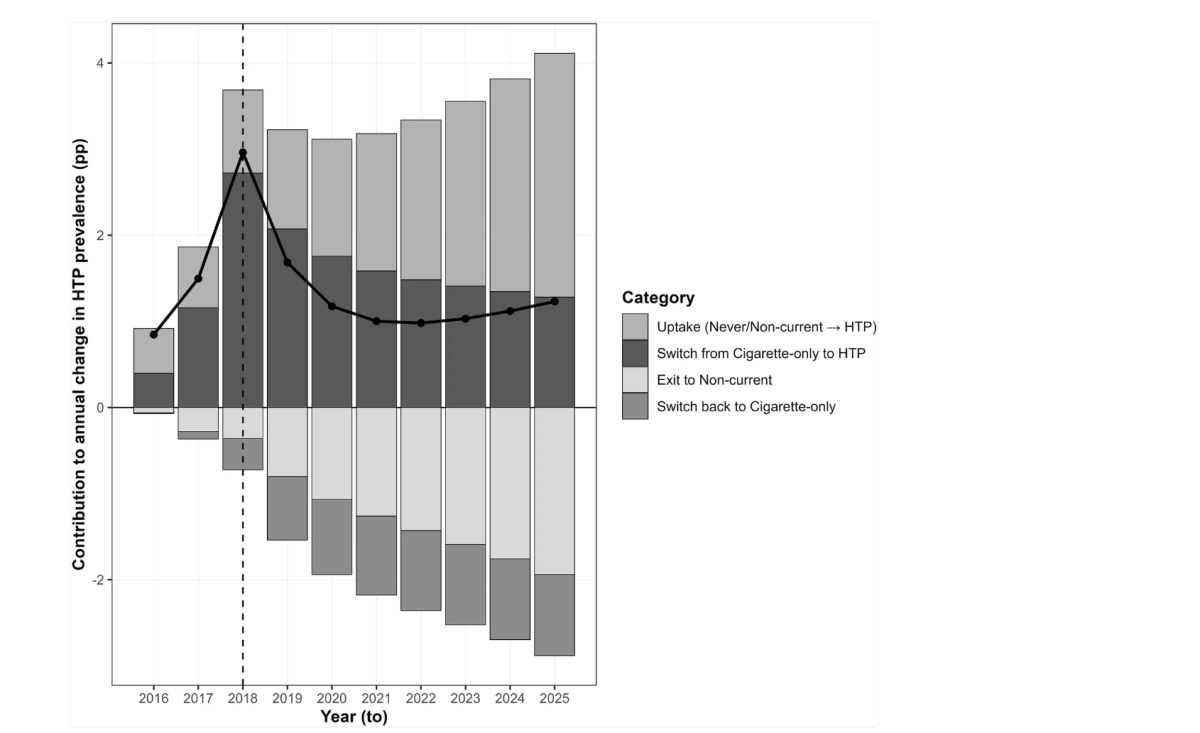
A decade-long study published in The Lancet Regional Health – Western Pacific found that heated tobacco product use in Japan increased from 0.1% in 2015 to 14.9% in 2025, although growth slowed after 2018. Switching from conventional cigarettes remained an important source of HTP uptake, while the contribution from previously non-current users increased. Approximately 56% of HTP users also smoked conventional cigarettes in 2025. Separate industry data show that Japan's heated tobacco sales reached 73.4 billion units in fiscal 2025, approaching conventional cigarette sales of 78.2 billion units.
SCIENCE
Nov.10
Vape Manufacturer Ispire Expands Malaysia Operations, Negotiates Southeast Asia OEM Deal as Nicotine Pouch and US Age-Gating Businesses Develop
US-listed vaping technology and manufacturing company Ispire Technology reported fiscal first-quarter 2027 revenue of $27.5 million on November 9, 2026, down 9.3% year over year but up 3.2% sequentially. Gross margin recovered to 16.2%, while its net loss widened to $6.4 million from $3.3 million a year earlier. Management attributed the sales decline primarily to tighter European vaping regulation and reduced distributor orders. Ispire is expanding manufacturing in Malaysia and negotiating an OEM/ODM agreement with a Southeast Asian vaping brand, with an announcement anticipated in January 2027. The company estimates that Malaysian manufacturing offers an approximately 25% US tariff advantage over China-based production. However, it continues to purchase products from Shenzhen Yi Jia Technology Co., Ltd., a manufacturer controlled by its chairman, and reported $52 million in non-current related-party payables at September 30.
company
Nov.11 by 2Firsts Perspectives
Russia's Vape Ban Decisions Reach 17 Regions With 39 More Considering Laws, Putting Over 3,000 St. Petersburg Retail Outlets in Focus
Russia's regional vape retail restrictions are expanding. State Duma Speaker Vyacheslav Volodin said on November 7 that 17 regions had adopted decisions to ban vape sales, while another 39 were preparing or considering similar legislation. On November 12, lawmakers in Leningrad Oblast and the Republic of Karelia adopted bans scheduled to begin on March 1, 2027. A day earlier, St. Petersburg unanimously approved a five-year ban proposal in its first reading. The city has 615 specialist vape shops and more than 2,400 other retail outlets selling vaping products alongside other goods. Under Federal Law No. 186-FZ, enacted in June 2026, Russian regions may prohibit retail sales of electronic nicotine delivery systems and related liquids between March 2027 and March 2032. The legislation also restricts licensed suppliers from delivering covered products to retail premises in regions where bans apply.
Regulations
Nov.13