Request to Delay E-Cigarette Tax Policy in Indonesia

Regulations by 2FIRSTS.ai
Dec.27.2023
Request to Delay E-Cigarette Tax Policy in Indonesia
Indonesian business associations urge government to delay e-cigarette tax policy due to financial burden concerns. (19 words)

According to a report from DDTC News on December 27th, some commercial associations in Indonesia are urging the government to delay the e-cigarette taxation policy.


This request comes from the National E-Cigarette Association Alliance of Indonesia, which includes the Indonesian Individual E-Cigarette Association (APVI), the Indonesian E-Cigarette Users Alliance (AVI), the Indonesian E-Cigarette E-Liquid Producers Association (PPEI), the Indonesian E-Cigarette Tobacco Entrepreneurs Alliance (APPNINDO), and the Bali E-Cigarette Association (AVB).


In 2024, the tax on e-cigarettes in Indonesia is set to increase by approximately 15%. The national association of e-cigarette in Indonesia is urging for a delay in implementing the e-cigarette tax policy, while also hoping that the Ministry of Finance will not raise the tax rates when implementing this taxation policy.


They pointed out that "if the tax on e-cigarettes increases by more than 10%, it would be a significant burden for most small and medium-sized enterprises.


We welcome news tips, article submissions, interview requests, or comments on this piece.

Please contact us at info@2firsts.com, or reach out to Alan Zhao, CEO of 2Firsts, on LinkedIn


Notice

1.  This article is intended solely for professional research purposes related to industry, technology, and policy. Any references to brands or products are made purely for objective description and do not constitute any form of endorsement, recommendation, or promotion by 2Firsts.

2.  The use of nicotine-containing products — including, but not limited to, cigarettes, e-cigarettes, nicotine pouchand heated tobacco products — carries significant health risks. Users are responsible for complying with all applicable laws and regulations in their respective jurisdictions.

3.  This article is not intended to serve as the basis for any investment decisions or financial advice. 2Firsts assumes no direct or indirect liability for any inaccuracies or errors in the content.

4.  Access to this article is strictly prohibited for individuals below the legal age in their jurisdiction.


Copyright


This article is either an original work created by 2Firsts or a reproduction from third-party sources with proper attribution. All copyrights and usage rights belong to 2Firsts or the original content provider. Unauthorized reproduction, distribution, or any other form of unauthorized use by any individual or organization is strictly prohibited. Violators will be held legally accountable.

For copyright-related inquiries, please contact: info@2firsts.com


AI Assistance Disclaimer


This article may have been enhanced using AI tools to improve translation and editorial efficiency. However, due to technical limitations, inaccuracies may occur. Readers are encouraged to refer to the cited sources for the most accurate information.

We welcome any corrections or feedback. Please contact us at: info@2firsts.com

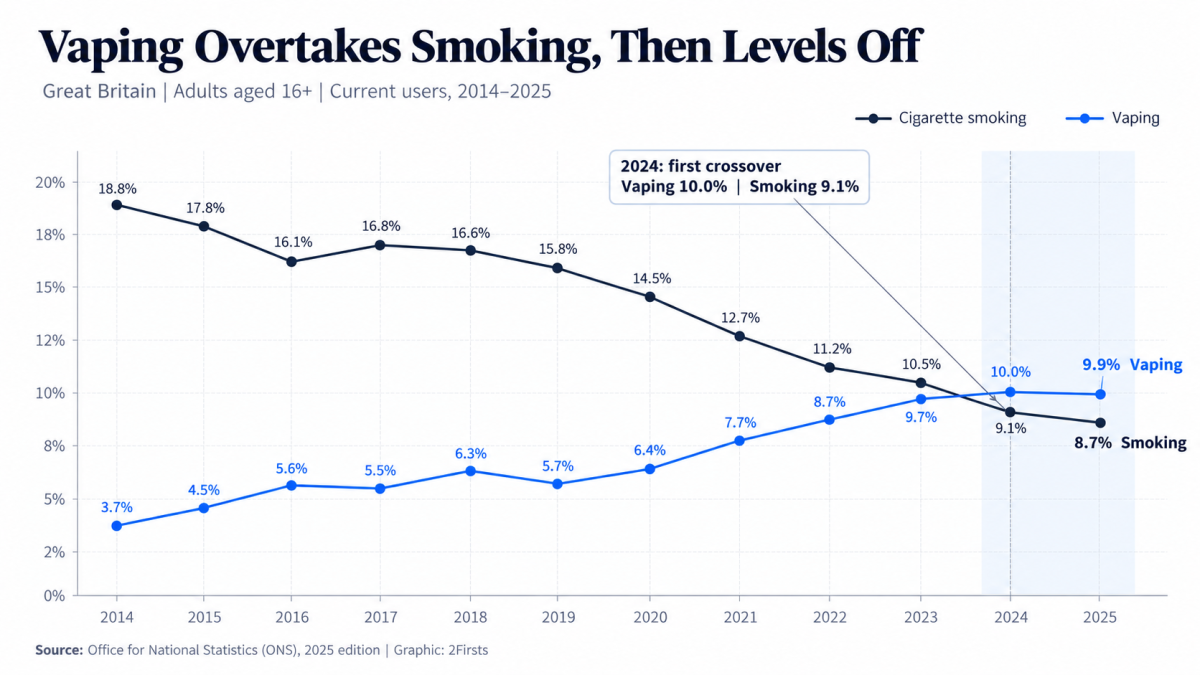
Latest UK ONS Data: Vaping Rate Edges Down to 9.9% in 2025, a Year After Overtaking Cigarette Smoking
Vaping prevalence in Great Britain edged down to 9.9% in 2025 from 10.0% in 2024, with the number of adult users holding at approximately 5.4 million for a second consecutive year, according to the Office for National Statistics (ONS). E-cigarette use had risen from 6.4% in 2020 to 10.0% in 2024, when it exceeded cigarette smoking prevalence for the first time. Cigarette smoking continued to decline to 8.7% in 2025, widening the gap to 1.2 percentage points. Daily vaping declined slightly, while usage among adults aged 25–34 increased despite falling rates in other age groups.
DATA
Oct.14
Product | OXVA Introduces XLIM PRO 4 With Liquid-Level Anti-Burn Technology and Dedicated Pods
Vaping brand OXVA introduced the XLIM PRO 4 refillable pod system in October 2026, featuring Anti-Burn Tech (ABT) based on smart e-liquid-level detection. The system can issue refill alerts and stop power output when e-liquid levels become too low. ABT requires the XLIM PRO 4 device and a dedicated XLIM ABT cartridge. Standard XLIM pods remain compatible but do not support ABT protection. OXVA previously introduced temperature-based anti-burn technology in the XLIM Pro 2 DNA, developed with Evolv. The new device features a 1,800mAh battery, 5–30W output and a 0.98-inch HD color screen. OXVA's official store lists the device at $37.90 and dedicated ABT replacement cartridges at $12.99. Independent testing confirmed the low-liquid protection response but recorded varying cartridge lifespans.
product
Oct.30
Los Angeles Cracks Down on Illicit Flavored Vapes and Counterfeit Goods: 12 Businesses Searched, 24 Arrested, Eight Truckloads Seized
Los Angeles authorities searched 12 businesses and arrested 24 people during a multi-agency operation targeting illicit flavored vaping products, flavored cigarettes and counterfeit merchandise on October 22, 2026. The Los Angeles County Sheriff's Department said approximately eight tractor-trailer loads of merchandise were seized. Alleged violations involved flavored tobacco sales restrictions, tobacco licensing requirements and counterfeit trademark laws. Local, state and federal agencies participated. Authorities have not disclosed the number, brands or value of vaping products seized. Investigations remain ongoing.
Enforcement
Oct.28
Russia’s Vape Device Labeling Regime Enters Force: Registration Starts in September, Mandatory Coding in December
Russia's digital labeling regime for reusable e-cigarettes and similar personal vaping devices entered its first mandatory phase in September 2026. From September 1, manufacturers, importers and other market participants must register with the national Chestny ZNAK tracking system. From December 1, newly manufactured and imported covered devices will be required to carry digital identification codes and be reported as entering circulation. Russia has also issued new operational guidance for imports, marking the transition from a voluntary pilot to phased mandatory implementation.
Sep.15
US ITC Judge Finds Glas Infringed Two JUUL Vape Patents, Recommends Restrictions on Related Imports——Glas Received FDA Marketing Authorization for Four Vape Pods in May 2026; Proposed Restrictions Remain Under Commission Review
A U.S. International Trade Commission (USITC) administrative law judge issued an initial determination on October 20, 2026, finding that certain Glas vaping devices, cartridges and components infringed 12 claims across two patents asserted by JUUL, constituting a violation of Section 337 of the Tariff Act of 1930. The judge recommended a limited exclusion order and a cease and desist order against the Glas respondents. Five months earlier, the FDA authorized four Glas e-cigarette pods, including mango, blueberry and two menthol variants. The patent investigation concerns device and cartridge structures and is separate from FDA premarket review. The proposed import restrictions have not become final, and their product-level scope remains unresolved.
company
Nov.05
Special Report | How Capital Is Reassessing the Global Tobacco and Modern Nicotine Industry: Lessons from a New York Forum
Capital is reassessing the global tobacco and modern nicotine industry as heated tobacco, vaping and nicotine pouches reshape demand, profitability and regulation. At the 2026 New Approaches Summit in New York, investors and analysts examined whether smoke-free growth can sustain earnings, how regulation shapes startup value, and whether shareholder engagement can be more effective than divestment. The debate points to a broader shift: tobacco transition is increasingly becoming a capital-allocation, governance and valuation question.
Capital Markets
Oct.05