Revoke of Killon Street Off License due to Illegal Sales

Regulations by 2FIRSTS.ai
Nov.23.2023
Revoke of Killon Street Off License due to Illegal Sales
The licensing authority in Bury revokes the license of Killon Street Off over illegal sale of cigarettes and e-cigarettes.

According to a report by the Bury Times, the license of Killon Street Off in Bury, UK, has been revoked, and the designated premises supervisor (DPS) has been dismissed. This action was taken due to the discovery of illicit sales of cigarettes and e-cigarettes in the store.


The City Council Committee has found that Killon Street Off License has breached its obligations to prevent crime and disorder, as well as protect children from harm. As a result, the company's license has been revoked and its designated premises supervisor (DPS) has been dismissed.


The local authorities' licensing hearing committee learned at a meeting last week that "illegal cigarettes and illegal e-cigarettes" were found at the premises.


In April, the Trading Standards Bureau and the Greater Manchester Police (GMP) executed a search warrant at the premises, uncovering 39 illegal e-cigarettes and 40 illegal packs of cigarettes.


We welcome news tips, article submissions, interview requests, or comments on this piece.

Please contact us at info@2firsts.com, or reach out to Alan Zhao, CEO of 2Firsts, on LinkedIn


Notice

1.  This article is intended solely for professional research purposes related to industry, technology, and policy. Any references to brands or products are made purely for objective description and do not constitute any form of endorsement, recommendation, or promotion by 2Firsts.

2.  The use of nicotine-containing products — including, but not limited to, cigarettes, e-cigarettes, nicotine pouchand heated tobacco products — carries significant health risks. Users are responsible for complying with all applicable laws and regulations in their respective jurisdictions.

3.  This article is not intended to serve as the basis for any investment decisions or financial advice. 2Firsts assumes no direct or indirect liability for any inaccuracies or errors in the content.

4.  Access to this article is strictly prohibited for individuals below the legal age in their jurisdiction.


Copyright


This article is either an original work created by 2Firsts or a reproduction from third-party sources with proper attribution. All copyrights and usage rights belong to 2Firsts or the original content provider. Unauthorized reproduction, distribution, or any other form of unauthorized use by any individual or organization is strictly prohibited. Violators will be held legally accountable.

For copyright-related inquiries, please contact: info@2firsts.com


AI Assistance Disclaimer


This article may have been enhanced using AI tools to improve translation and editorial efficiency. However, due to technical limitations, inaccuracies may occur. Readers are encouraged to refer to the cited sources for the most accurate information.

We welcome any corrections or feedback. Please contact us at: info@2firsts.com

Global Nicotine-Pouch E-Commerce Group Haypp Shuts Sweden’s Snusnetto Over Age Verification as Identity Checks Become Industry Infrastructure for New Nicotine Products
Sweden's Supreme Administrative Court has declined to hear an appeal over age verification for tobacco and nicotine products collected from parcel lockers, leaving in place a lower-court ruling that geo-located BankID verification is insufficient to securely verify the actual recipient. Haypp Group has stopped tobacco and nicotine sales through Snusnetto and is deploying a new system across its other Swedish e-commerce sites to verify the age of the person who actually opens the locker and receives the shipment. The change comes as age verification across next-generation nicotine products expands from purchase checks into retail, delivery and, for some e-cigarettes, device access itself.
Regulations
Oct.20
FDA Rescinds Denials for 280 Charlie’s Vape and E-Liquid Products; Court Vacates MDOs for Five Other Firms on Same Day
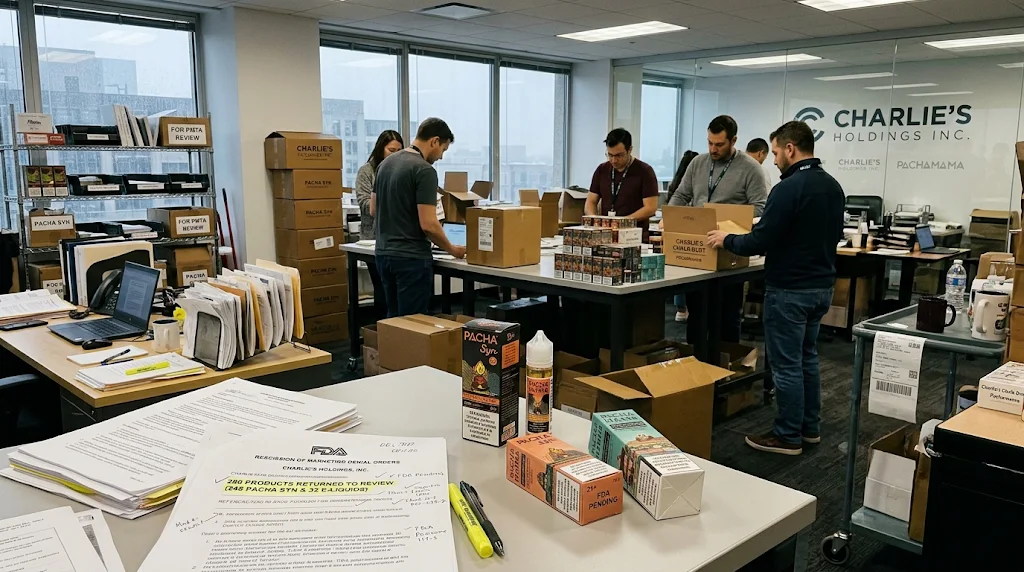
The U.S. Food and Drug Administration (FDA) rescinded marketing denial orders (MDOs) covering 280 e-cigarette and e-liquid products owned by Charlie’s Holdings on November 18, 2026. The products include 248 PACHA Syn disposable vapes and 32 Charlie’s Chalk Dust and Pachamama e-liquids. On the same day, the U.S. Court of Appeals for the Fifth Circuit vacated MDOs involving five other vaping companies and remanded their cases to the FDA. Both actions were linked to the court’s August ruling in NicQuid. Charlie’s affected PMTAs have returned to review without receiving marketing authorization. The company reported retaining 678 PMTA assets, while third-quarter 2026 net revenue fell 55.9% year over year.
product
Nov.24
U.S. Judge Stays Helix, NJOY Challenge to FDA PMTA Rule Pending New Rulemaking Court Stays Altria's Helix, NJOY Challenge to PMTA Rule as FDA Prepares New Rulemaking
A federal judge in Texas on Oct. 8 granted a joint request by the FDA and plaintiffs including Altria subsidiaries Helix Innovations and NJOY to stay litigation challenging the agency's 2021 PMTA rule. The court cited FDA's anticipated rulemaking concerning the regulation at issue. FDA announced on Sept. 28 that it intends to reassess the PMTA framework and could initiate new rulemaking to replace it. The parties must file a joint status report within 45 days and every 45 days thereafter. A motion by three Reynolds American companies to intervene remains pending.
Regulations
Oct.10
German Bundestag Passes Tobacco Tax Hikes: Vape Liquid Duty to Reach €0.44/ml, Heated Tobacco Taxes to Rise and Cigarettes Seen Near €12 a Pack
Germany's Bundestag passed amendments to the Tobacco Tax Act on October 15, 2026, setting out annual excise tax increases from 2027 through 2030 for e-cigarette liquids, heated tobacco, cigarettes and other tobacco products. Under the Finance Committee's amended bill, duty on qualifying e-liquids will rise from €0.32/ml in 2026 to €0.44/ml in 2030, an increase of 37.5%. Heated tobacco will retain its tax calculation based on 80% of the corresponding cigarette excise duty. The average price of a 20-cigarette pack is projected to approach €12 by 2030, with some brands potentially reaching €14. The legislation is projected to generate approximately €11.8 billion in additional tax revenue over four years and remains subject to further legislative procedures.
Regulations
Oct.19
On-Site Report | CTP Details PMTA Backlog, 180-Day Review Goal and sPMTA Process
FDA’s Center for Tobacco Products detailed new PMTA review data and process changes at the 2026 FDLI conference. Pending PMTAs fell from about 450,000 at the start of 2025 to 135,000 by September 2026. CTP also discussed its 180-day review goal, current sPMTA pilot, alternate-supplier planning, more than 50,300 pending SE reports, and lessons from the nicotine pouch pilot already being applied to ENDS review.
Regulations
Oct.07
Special Report | Vape bans and tougher rules: the South Caucasus takes different paths
Azerbaijan's sweeping e-cigarette ban has raised concerns over enforcement errors and the emergence of illicit sales, while neighboring Armenia is tightening technical rules and preparing higher excise taxes. Georgia, meanwhile, has resisted calls for broader vape restrictions and introduced preferential taxes for some domestically produced cigarettes. The divergent approaches across the South Caucasus highlight a regional policy dilemma: how to curb nicotine use and protect public health without encouraging black markets or creating unintended economic consequences for businesses and consumers.
Nov.03