Key Point
- The U.S. ITC terminated Investigation 337-TA-1410 after invalidating key claims of Reynolds’ vape patent, removing the immediate risk of import bans for dozens of companies.
- The investigation had targeted 35 respondents across the vape supply chain, including manufacturers, distributors, and retailers.
- However, Investigation 337-TA-1486 has already opened a new legal front focusing on regulatory compliance and unfair competition.
- The new case raises allegations related to PACT Act reporting, state tax compliance, FDA marketing authorization, and flavored product restrictions.
- Together, the two investigations reflect a shift in Section 337 litigation from patent disputes to broader compliance enforcement across the vape supply chain.
2Firsts,Mar 10,2026,Shenzhen
On March 10, 2026, the U.S. International Trade Commission (ITC) issued its final determination in Investigation 337-TA-1410, concluding that key patent claims asserted by R.J. Reynolds Vapor Company against dozens of vape manufacturers and distributors were invalid. The Commission therefore terminated the investigation with a finding of no violation of Section 337, eliminating the possibility of an import ban on the accused products.
The Patent Case Ends: ITC Invalidates Reynolds’ Key Claims
Filed in July 2024, the investigation centered on U.S. Patent No. 11,925,202, which Reynolds argued covered structural elements used in modern disposable vaporizer devices. The complaint named 35 respondents across the global vape supply chain, including manufacturers, distributors, and retailers—many based in China.
In August 2025, the presiding Administrative Law Judge (ALJ) issued an initial determination finding that certain respondents infringed claims 4 and 12 of the ’202 patent. The ALJ also found that Reynolds satisfied the domestic industry requirement and recommended a general exclusion order, a remedy that could have blocked imports of certain disposable vape products into the United States.
However, the Commission reached a different conclusion on review.
The ITC determined that claims 1, 4, and 12 of the asserted patent were invalid as obvious under U.S. patent law. Because claims 4 and 12 depend on claim 1, the ruling effectively invalidated the core patent claims underlying the case. Concluding that the device architecture lacked sufficient inventiveness in light of prior art, the Commission overturned the ALJ’s infringement findings and terminated the investigation.
The decision removed the immediate risk that the accused disposable vape products could be barred from entering the U.S. market. For companies that participated in the case, it marked the end of nearly two years of litigation without the imposition of trade remedies.
The outcome also underscores how patent validity can become decisive in Section 337 disputes.
When the complaint was filed in 2024, Tang Shunliang, a partner at Tian Yuan Law Firm, warned in an analysis published by industry media outlet 2Firsts that the broad scope of the asserted patent claims could face significant validity challenges, including arguments that the device configuration might be considered obvious in light of prior technologies.
A Case That Seemed to End — But Did Not
At first glance, the outcome of Investigation 337-TA-1410 appeared to bring an end to Reynolds’ sweeping patent challenge against the disposable vape industry.
With the ITC invalidating the asserted patent claims and terminating the investigation with no violation, some industry participants viewed the decision as a setback for Reynolds’ attempt to use patent litigation to curb competing disposable vape products.
For the respondents, the ruling also removed the immediate threat of a broad import restriction that could have disrupted shipments of disposable devices into the United States.
Yet the apparent conclusion of Investigation 1410 did not necessarily mark the end of Reynolds’ legal strategy in the U.S. vape market.
Even before the patent dispute reached its final stage, another investigation had begun to take shape at the ITC.
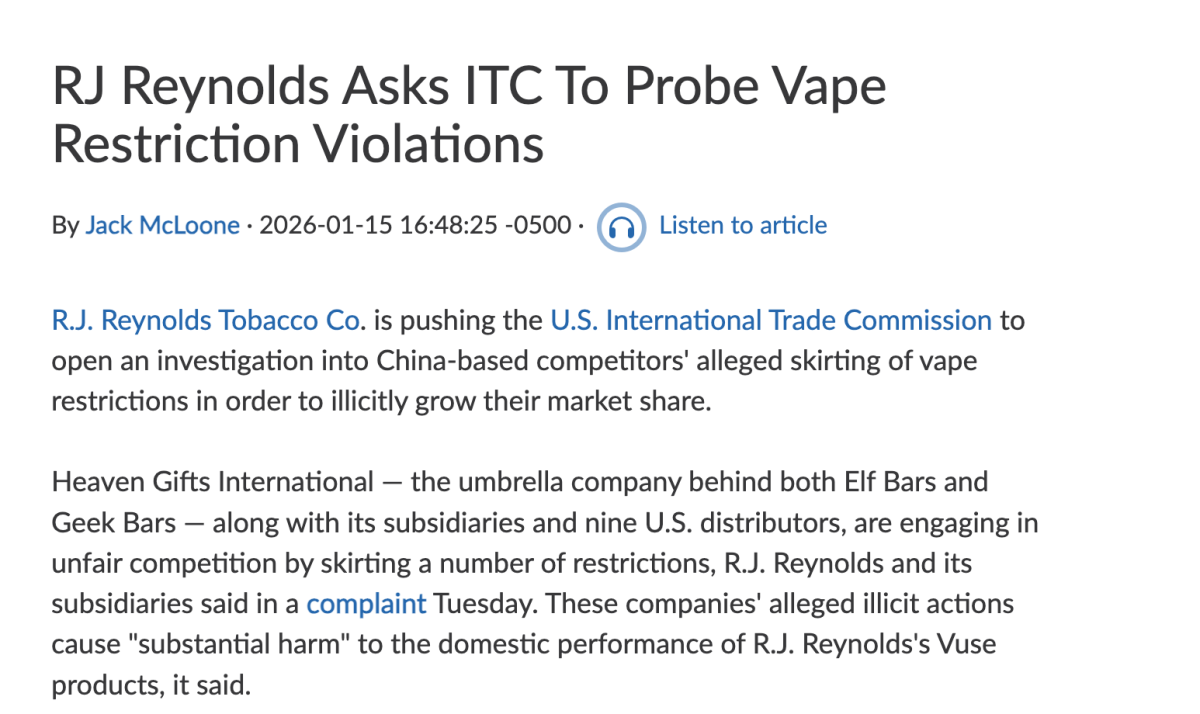
In Investigation 337-TA-1486, Reynolds and affiliated complainants shifted the focus away from device design and patent protection toward a different battleground: market access and regulatory compliance.
Rather than alleging that competing products infringed a specific patent, the newer complaint centers on claims of unfair competition, arguing that certain manufacturers and distributors failed to comply with U.S. regulatory requirements when bringing products into the market.
ChainManufacturers, Distributors and Retailers: The Broad Net of the First 337 Case
The earlier 1410 investigation was notable not only for its outcome but also for the unusually broad set of companies named in the complaint.
When Reynolds filed the case in 2024, it listed 35 respondents spanning multiple levels of the vape supply chain, including manufacturers, distributors, and retailers. Many were based in China, reflecting the country’s central role in producing disposable vaporizer devices.
Among them, 18 companies actively participated in the investigation, presenting legal defenses and technical arguments. Their participation ultimately allowed them to benefit from the Commission’s determination that the asserted patent claims were invalid.
Another 15 respondents were found in default after failing to respond to the complaint or participate in the investigation. In Section 337 proceedings, default determinations can carry significant consequences. If the Commission ultimately finds a violation, companies in default may face exclusion orders or cease-and-desist orders without presenting substantive defenses.
However, because the Commission ultimately found no violation of Section 337, no exclusion orders or other remedies were imposed on the defaulting respondents.
Two respondents exited the investigation earlier through consent orders: Kimsun Technology and Bidi Vapor.
Taken together, the respondent structure illustrates the broad litigation strategy Reynolds initially pursued, targeting multiple points across the supply chain rather than focusing solely on direct competitors.
The Second Battlefield: Investigation 337-TA-1486
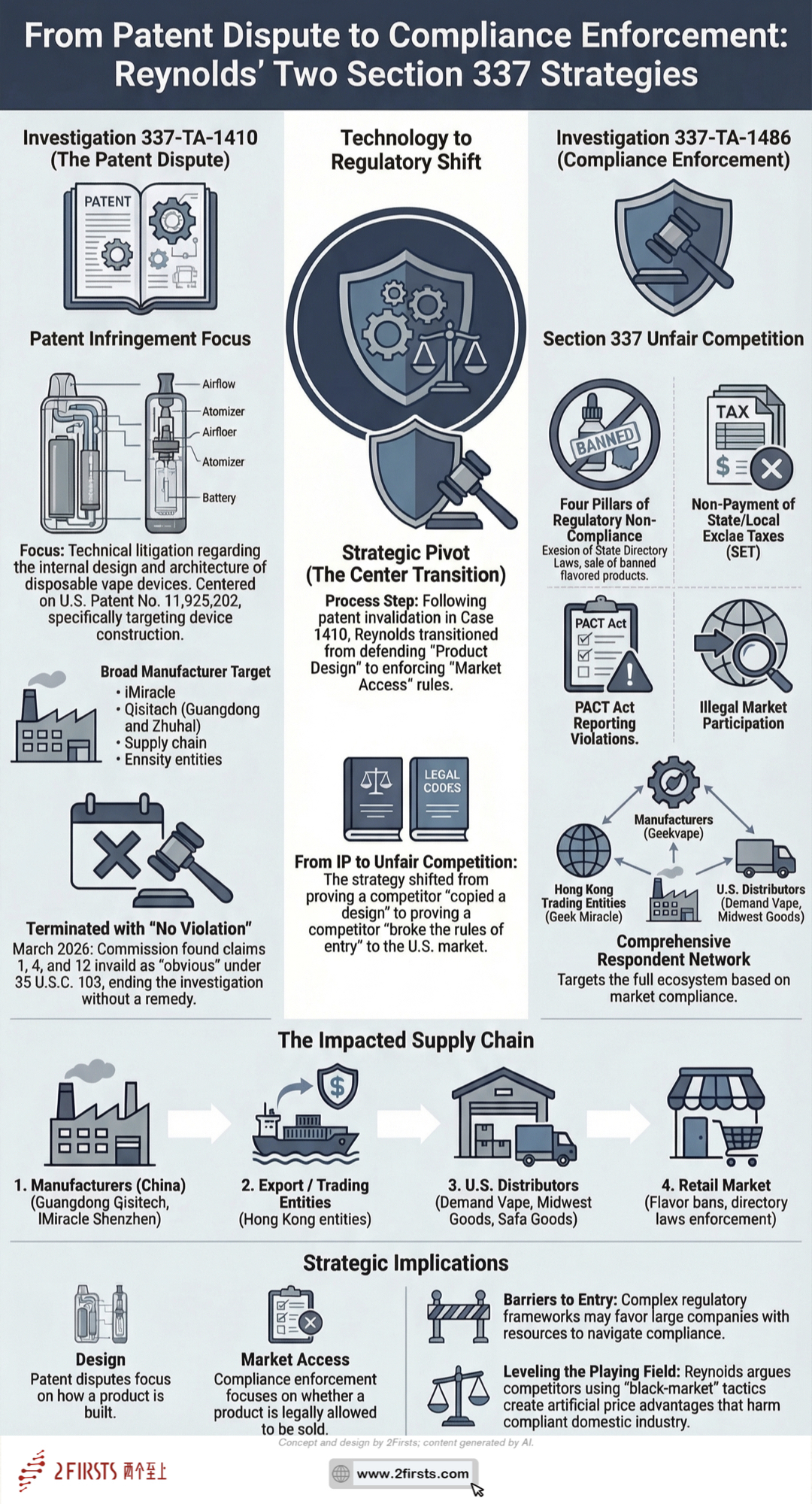
While Investigation 337-TA-1410 centered on patent infringement, Investigation 337-TA-1486 reflects a markedly different legal approach.
Instead of challenging the technological design of vape devices, the newer complaint focuses on unfair competition under Section 337, examining whether certain disposable vape products entered the U.S. market in violation of regulatory requirements.
The complaint references several regulatory frameworks, including alleged violations of the Prevent All Cigarette Trafficking (PACT) Act, which imposes registration, reporting, and shipping obligations on sellers of tobacco and nicotine products.
It also raises questions regarding state-level tax compliance, alleging that some products may have been sold without properly remitting required excise taxes or fulfilling associated reporting obligations.
Another key issue involves authorization from the U.S. Food and Drug Administration (FDA). Under the FDA’s regulatory framework, electronic nicotine delivery systems must obtain marketing authorization before they can legally be sold in the United States.
The complaint also references flavor restrictions adopted in several U.S. jurisdictions, which limit the sale of flavored vaping products.
Taken together, these allegations highlight a shift in litigation strategy. Whereas patent cases focus on device design and intellectual property rights, Investigation 1486 concentrates on how products are imported, distributed, and sold within the U.S. market.
Some industry observers note that navigating these regulatory frameworks can also create competitive barriers, potentially favoring companies with the resources to meet complex compliance requirements.
Targeting Key Supply Chain Hubs in the Second 337 Case
A comparison of the respondent lists in Investigations 1410 and 1486 suggests an evolution in litigation strategy.
In the earlier case, Reynolds cast a wide net across the disposable vape ecosystem, naming 35 respondents spanning multiple layers of the supply chain.
By contrast, the respondent list in Investigation 1486 appears more selective. Several companies involved in the earlier case reappear in the new investigation, indicating continued focus on certain market participants.
At the same time, the newer complaint introduces additional respondents connected to both manufacturing operations and U.S. distribution networks, targeting key points through which disposable vape products enter and circulate in the American market.
This mix of overlap and expansion reflects a shift from broad industry coverage toward targeted pressure on strategically important actors within the supply chain.
In practical terms, legal actions directed at manufacturers and major distribution hubs can influence product flows through critical commercial channels rather than affecting isolated companies.
Given the interconnected nature of the disposable vape supply chain—linking overseas manufacturers, importers, and domestic distributors—such actions may have ripple effects across broader trade networks.
BAT Signals Enforcement as a Turning Point in the U.S. Vape Market
The disputes unfolding at the ITC also reflect broader tensions shaping the U.S. vape industry, where regulatory enforcement has become an increasingly important competitive factor.
Executives at British American Tobacco (BAT)—the parent company of Reynolds—have repeatedly highlighted enforcement as a key issue affecting market dynamics.
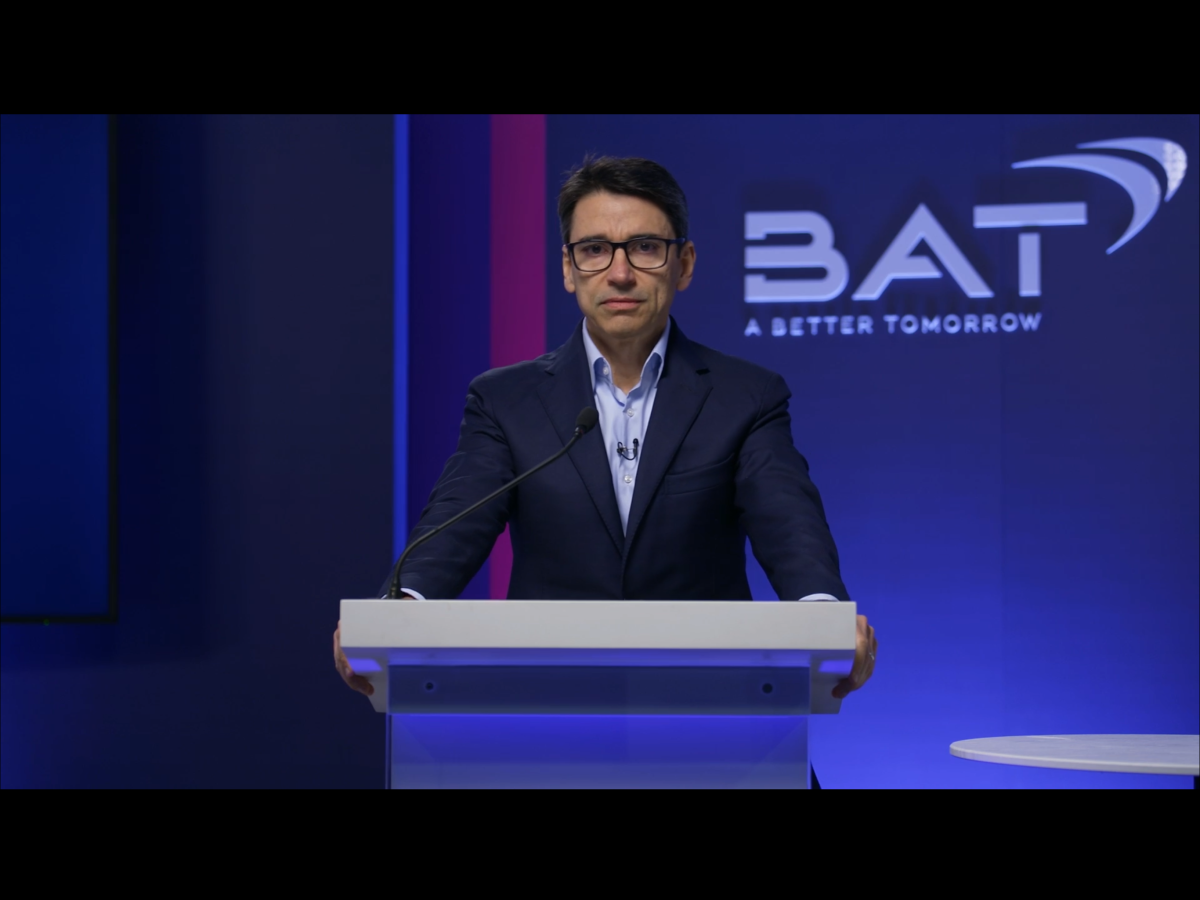
During a recent earnings call, BAT Chief Executive Tadeu Marroco said stronger action against unauthorized vape products in the United States would be critical to restoring fair competition.
Marroco argued that the widespread presence of illegal or non-compliant disposable vape products has distorted competition, placing companies that comply with regulatory requirements at a disadvantage.
“What we want to see in the U.S. is a level playing field,” he said, adding that companies investing in regulatory approvals should not be undercut by products that bypass those requirements.
For BAT, which markets vaping products including Vuse, stronger enforcement is closely tied to its prospects in the U.S. market.
Against this backdrop, investigations such as 337-TA-1410 and 337-TA-1486 illustrate how litigation may increasingly intersect with regulatory enforcement in shaping the competitive landscape of the vape industry.
For more updates on global vape regulation and industry developments, follow 2Firsts.
Cover image generated by AI.