Rising Concerns of Youth E-Cigarette Use in Indiana

Aug.01.2022
Rising Concerns of Youth E-Cigarette Use in Indiana
Statistics show alarming increase in e-cigarette use among Indiana students, particularly in high and middle schools. Parents urged to stay vigilant.

Statistics concerning children and e-cigarettes are becoming increasingly concerning in Fort Wayne, Indiana (WANE). This is an issue that every parent should be aware of before sending their child to school this year.


In the state of Indiana, from 2012 to 2018, the use of electronic cigarettes among high school students increased by 400% and among middle school students by 360%.


Mary Claire Clark, President and CEO of the Allen County Drug and Alcohol Consortium, stated that the use of electronic cigarettes among young people is becoming an epidemic. "The youngest we've seen in our investigations may be fourth-grade students," she said.


Clark stated that companies like JUUL, worth millions of dollars, should bear most of the responsibility for causing children to become addicted.


From the outset, their flavor profiles and marketing were aimed at a younger demographic, as they were aware that this cohort of Generation Z is at a critical age for decision-making, and they did not want electronic cigarettes to taste like traditional cigarettes," said Mari Clarke.


Parents like Jana Clark have five children between the ages of 15 and 24, and she states that e-cigarettes are highly attractive to young children. They can use e-cigarettes very discreetly at school without being detected. Jana Clark says, "My children will come home with stories of students using e-cigarettes during class. You know, they just casually slide the e-cigarette up their hoodie sleeves, making it look like they are drinking from a water bottle or something, but they are actually smoking and exhaling smoke.


Although Jana Clark believes that her children have never used e-cigarettes, as a parent, she says you can never be too sure. "Honestly, I say that they have never used e-cigarettes, but I don't know if they have tried it because it is common among young people. When they go out with friends, I'm not sure if they will try it," said Jana Clark.


Jana Clark stated that they are currently working with local schools to develop strategies to replace suspension or expulsion for students caught using e-cigarettes. "We are looking for a more educational and supportive approach. These children are being specifically targeted by a strategy from a massive machine worth millions, if not billions, that knows how to get them addicted to a substance," said Mary Claire Clark.


As an AI language model, I do not have the capability to identify the text you would like me to translate. Please provide the text you want me to translate so I can assist you better.


Disclaimer

This article is provided solely for professional research, industry discussion, and informational purposes. Any references to brands, companies, products, technologies, or policies are made for factual reporting and analytical purposes only, and do not constitute endorsement, recommendation, promotion, or advertising by 2Firsts.

Nicotine-containing products, including but not limited to cigarettes, e-cigarettes, heated tobacco products, and nicotine pouches, carry significant health risks. Readers are responsible for complying with all applicable laws and regulations in their respective jurisdictions, including age restrictions and access limitations.

The information contained in this article should not be regarded as investment, legal, medical, regulatory, or commercial advice. While 2Firsts strives to ensure the accuracy and reliability of its content, it does not assume liability for any direct or indirect loss arising from errors, omissions, inaccuracies, or reliance on the information contained herein.

This article is not intended for individuals below the legal age for accessing tobacco or nicotine-related information in their jurisdiction.


Copyright Notice

This article is either original content produced by 2Firsts or content reproduced, translated, summarized, or adapted from third-party sources with attribution where applicable. The intellectual property rights of the original content remain with 2Firsts or the respective original rights holders.

No individual or organization may copy, reproduce, distribute, republish, modify, translate, or otherwise use this content without prior authorization. Any unauthorized use may result in legal action.

For copyright-related inquiries, corrections, or removal requests, please contact: info@2firsts.com.


AI-Assisted Translation and Editing Notice

Portions of this article may have been translated, edited, or reviewed with the assistance of artificial intelligence tools to improve efficiency and readability. Due to the limitations of AI-assisted translation and editing, discrepancies, omissions, or inaccuracies may exist when compared with the original source.

Where applicable, readers are advised to refer to the original source for the most complete and accurate information. If you identify any errors or believe that any content infringes upon your rights, please contact us at info@2firsts.com, and we will review and address the matter promptly.


JTI Proposes 25-Cent Irish Cigarette Tax Increase, Says It Could Raise €45 Million
Japan Tobacco International's Irish business has proposed a €0.25 tax increase on a pack of 20 cigarettes in its pre-Budget 2027 submission, below the €0.50-or-more increases typically imposed in recent Irish budgets. JTI says the proposal could generate around €45 million in additional Exchequer revenue while limiting further movement toward illicit and non-Irish-tax-paid tobacco. Revenue's existing estimate for a comparable €0.25 increase, including pro-rata rises on other tobacco products, is about €18 million for a full year.
JTI
Sep.18 by 2Firsts Perspectives
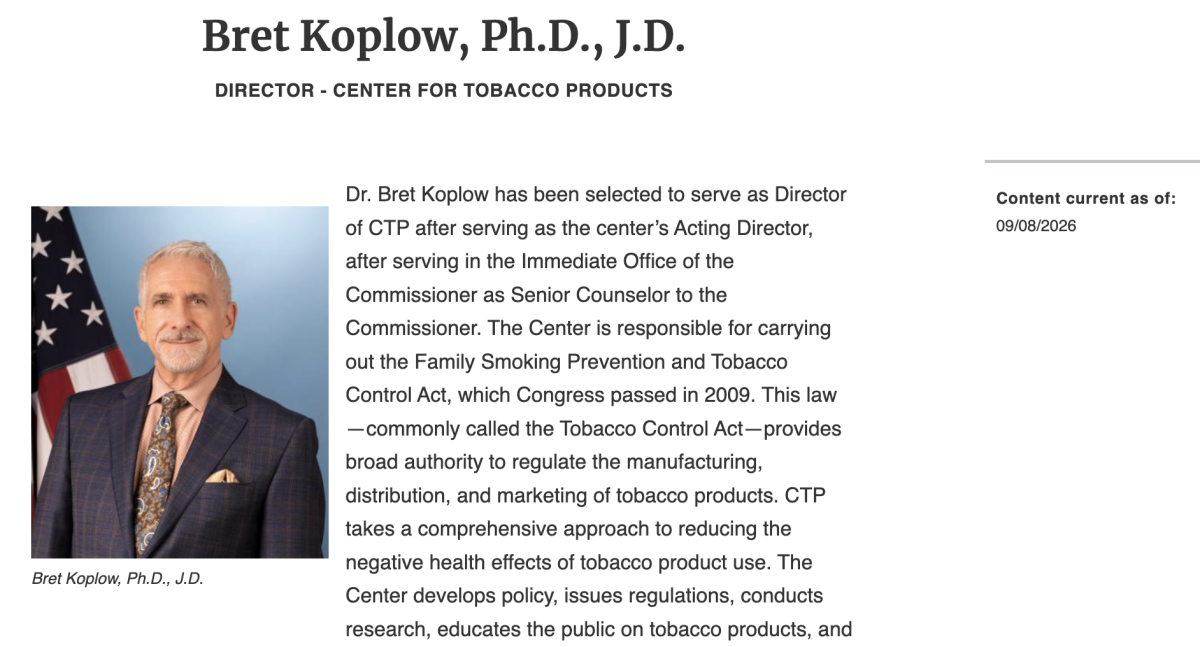
Bret Koplow Takes Permanent Charge of FDA Tobacco Center After Pushing Faster PMTA Reviews, as HHS Emphasizes Innovation and Access to Lower-Risk Alternatives
The U.S. Department of Health and Human Services has named Bret Koplow permanent director of the FDA’s Center for Tobacco Products, ending his period as acting chief. Koplow has spent years working on tobacco regulation, law and policy inside the FDA and, while serving as acting director, pushed for faster PMTA reviews and nicotine pouch review pilots. HHS also said CTP will prioritize innovation and access to less harmful alternatives for adult smokers while continuing efforts to protect youth.
Sep.09
FDA Grants PMTA Authorization to 11 ZYN ULTRA Nicotine Pouches, Bringing Total Authorized Pouches to 43
The U.S. Food and Drug Administration authorized 11 ZYN ULTRA nicotine pouch products made by Swedish Match USA through the premarket tobacco product application pathway on August 21, 2026. Ten of the authorized products have a labeled nicotine content of 9 mg, while ZYN ULTRA Smooth was authorized at 11 mg. The reviews were conducted through FDA’s nicotine pouch PMTA pilot program. FDA has now authorized 43 nicotine pouch products, including 23 through the pilot.
Aug.24
Couche-Tard Posts Double-Digit U.S. Same-Store Growth in Other Nicotine Products, Led by Pouches
Alimentation Couche-Tard said U.S. same-store sales in its “other nicotine products” category grew at a double-digit rate in the first quarter of fiscal 2027, led by nicotine pouches, while overall U.S. same-store merchandise revenues increased 1.7%. The company also said its Canadian nicotine business continued to face regulatory pressure and illicit-market headwinds. The U.S. performance coincides with Couche-Tard's participation in efforts to reopen Canadian convenience-store access to authorized nicotine pouches, though the company has not established a direct causal link between the two.
Sep.14
Special Report | Can Nicotine Be Replaced? 6-MN Is Already on the Market While Key Human Evidence Is Still Missing
Nicotine analogues such as 6-methylnicotine are already appearing in e-cigarettes and oral pouches, even as key human evidence remains limited. A new Nixodine-S study adds nonclinical data showing differences from nicotine in cytotoxicity and receptor activity, while independent studies point to a more complex toxicological picture. With supply-chain activity growing and FDA seeking clearer authority over nicotine analogues, the industry now faces a larger question: what evidence is needed before these substances can credibly replace nicotine?
SCIENCE
Sep.23
China Tobacco Hubei explores staged nicotine pouch delivery, using dynamic membranes to slow early release and gradient particles to sustain later delivery
China Tobacco Hubei Industrial Co., Ltd. disclosed several oral nicotine-related patent applications in August 2026, including two that approach staged nicotine release from different directions. One uses a high-viscosity membrane that forms inside the pouch after contact with saliva to slow rapid early release, while the other uses gradient particles with a faster-disintegrating outer layer and a slower core to create a fast-to-sustained release profile. Together, the filings explore how nicotine pouches could balance initial delivery with release later in use.
Sep.03