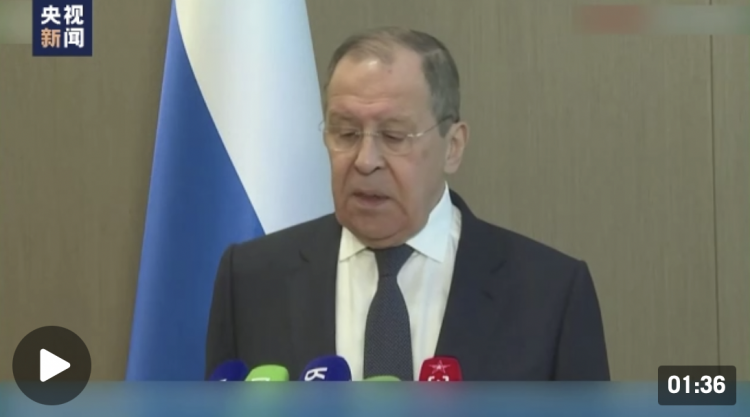
On July 29th, local time, Russian Foreign Minister Lavrov and US Secretary of State Blinken had a telephone conversation discussing the situation in Ukraine, global food security, and the exchange of detained individuals between the two countries.
The Russian Foreign Ministry stated that Lavrov had engaged in a phone call with Blinken to discuss the situation in Ukraine. Lavrov emphasized that Russia will fully achieve its goals and objectives in the ongoing military conflict in Ukraine. He also alleged that the Ukrainian military is causing harm to civilians through the use of weapons from the United States and NATO. Lavrov and Blinken also discussed the matter of exchanging detained individuals between the two countries.
During discussions about the food security issue, Lavrov briefed Blinken on the details of a series of agreements signed in Istanbul on July 22 regarding the transportation of Ukrainian grain from Black Sea ports and the promotion of Russian food and fertilizer exports. Lavrov highlighted that the situation has become more complicated due to US sanctions and that the US has yet to fulfill its promise to grant exemptions for the supply of Russian food.
US Secretary of State Blinken has stated that he had a "frank and direct" conversation with Lavrov and urged Russia to accept the US proposal to release detained American basketball player Brittany Griner and former Marine Paul Whelan during the call. According to information released by the Russian Ministry of Foreign Affairs, Lavrov suggested that the US return to a "quiet diplomatic" approach in the exchange of prisoners, rather than engaging in hyped-up media coverage.
On the 27th, Blinken stated that the US had issued a "substantial proposal" to Russia, requesting the release of two American citizens. According to a source cited by CNN, the White House intends to release Russian arms dealer Viktor Bout as part of a swap.
American female basketball player Griner was detained in Moscow in February when authorities found an e-cigarette containing cannabis oil in her luggage, leading to drug smuggling charges. Former US Marine Whelan was arrested in December 2018 at a Moscow hotel and was convicted of espionage by a Russian court in June 2020.
This article contains excerpts or reprints from third-party sources, whose copyright belongs to the original media and authors. If there is any infringement, please contact us for deletion. Any unit or individual that needs to reproduce must contact the author and should not reproduce directly.
Disclaimer
This article is provided solely for professional research, industry discussion, and informational purposes. Any references to brands, companies, products, technologies, or policies are made for factual reporting and analytical purposes only, and do not constitute endorsement, recommendation, promotion, or advertising by 2Firsts.
Nicotine-containing products, including but not limited to cigarettes, e-cigarettes, heated tobacco products, and nicotine pouches, carry significant health risks. Readers are responsible for complying with all applicable laws and regulations in their respective jurisdictions, including age restrictions and access limitations.
The information contained in this article should not be regarded as investment, legal, medical, regulatory, or commercial advice. While 2Firsts strives to ensure the accuracy and reliability of its content, it does not assume liability for any direct or indirect loss arising from errors, omissions, inaccuracies, or reliance on the information contained herein.
This article is not intended for individuals below the legal age for accessing tobacco or nicotine-related information in their jurisdiction.
Copyright Notice
This article is either original content produced by 2Firsts or content reproduced, translated, summarized, or adapted from third-party sources with attribution where applicable. The intellectual property rights of the original content remain with 2Firsts or the respective original rights holders.
No individual or organization may copy, reproduce, distribute, republish, modify, translate, or otherwise use this content without prior authorization. Any unauthorized use may result in legal action.
For copyright-related inquiries, corrections, or removal requests, please contact: info@2firsts.com.
AI-Assisted Translation and Editing Notice
Portions of this article may have been translated, edited, or reviewed with the assistance of artificial intelligence tools to improve efficiency and readability. Due to the limitations of AI-assisted translation and editing, discrepancies, omissions, or inaccuracies may exist when compared with the original source.
Where applicable, readers are advised to refer to the original source for the most complete and accurate information. If you identify any errors or believe that any content infringes upon your rights, please contact us at info@2firsts.com, and we will review and address the matter promptly.