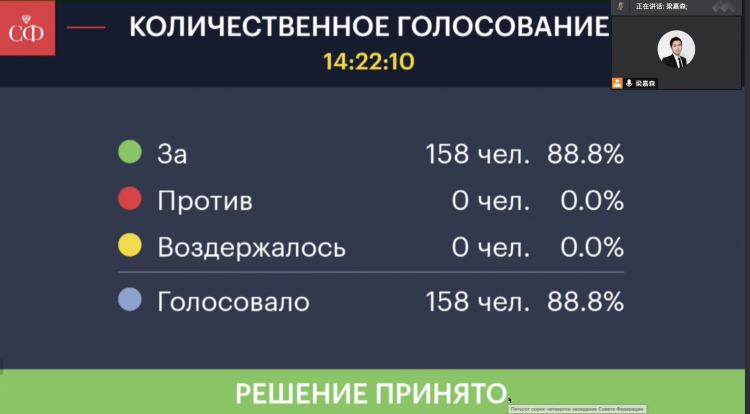
On April 26th, the Russian upper house of parliament, the Federation Council, voted to pass a partial legislation amendment with a 88.8% majority. This amendment includes a ban on electronic cigarette additives in Russia.
During a session of the upper house of parliament, Valentina Matviyenko, the chairwoman of the Federation Council of Russia, stated that she does not support a complete ban on electronic cigarettes as this may lead to more harm. Instead, she suggested that the government should strengthen control over the market for electronic cigarettes, rather than adopt a "one-size-fits-all" policy.
Valentina Ivanovna Matviyenko, the Speaker of the Federal Council, as seen in a screenshot from 2FIRSTS live stream.
According to information obtained by 2FIRSTS, the bill passed by the Federal Commission will be submitted to the President for signing. If the President deems the bill complies with national law, it will be signed into law. Once signed, it will be published in the government bulletin and will become official law 10 days after the announcement.
In addition, whether Russia will completely ban flavored e-cigarettes remains uncertain and is contingent upon the release of an additive list by the Russian federal government.
2FIRSTS will continue to follow the issue of the "Russian e-cigarette additive ban" and provide updates. Stay tuned.
Further reading:
The Russian Ministry of Health supports a ban on additives in electronic cigarettes and the government will introduce a "list of additives.
Timeline and Background of the "Russian Electronic Cigarette Additive Ban" Bill Passed in Three Readings in One Day.
Article 3: Ban on Additives in Russian E-cigarettes to Take Effect on September 1st, Full Proposal Attached. Article 4: First Discussion of Ban on Additives in Russian E-cigarettes to Be Held on April 11th.
Russia proposes a maximum fine of 500,000 rubles for selling e-cigarettes to minors.
What is the progress of the ban on certain flavors in Russia's legislative process? Here is a breakdown of Russia's legislative process.
Interview with Russian electronic cigarette manufacturer: Compliance regulation trend is irreversible, full ban on electronic cigarettes is not possible.
Expert Analysis Series:
Expert analysis 1: Russian flavor ban covers all e-cigarette products, specific additive standards yet to be disclosed.
Expert Analysis 2: Russia sets minimum retail price for e-cigarettes to reduce demand for nicotine products.
Expert interpretation 3: Russia proposes to ban the online sale and offline display of electronic cigarettes, effective from June 1st.
Topic: Progress of Russian E-Cigarette Flavor Ban and Expert Analysis (Click on the image below to jump to the page)
Disclaimer
This article is provided solely for professional research, industry discussion, and informational purposes. Any references to brands, companies, products, technologies, or policies are made for factual reporting and analytical purposes only, and do not constitute endorsement, recommendation, promotion, or advertising by 2Firsts.
Nicotine-containing products, including but not limited to cigarettes, e-cigarettes, heated tobacco products, and nicotine pouches, carry significant health risks. Readers are responsible for complying with all applicable laws and regulations in their respective jurisdictions, including age restrictions and access limitations.
The information contained in this article should not be regarded as investment, legal, medical, regulatory, or commercial advice. While 2Firsts strives to ensure the accuracy and reliability of its content, it does not assume liability for any direct or indirect loss arising from errors, omissions, inaccuracies, or reliance on the information contained herein.
This article is not intended for individuals below the legal age for accessing tobacco or nicotine-related information in their jurisdiction.
Copyright Notice
This article is either original content produced by 2Firsts or content reproduced, translated, summarized, or adapted from third-party sources with attribution where applicable. The intellectual property rights of the original content remain with 2Firsts or the respective original rights holders.
No individual or organization may copy, reproduce, distribute, republish, modify, translate, or otherwise use this content without prior authorization. Any unauthorized use may result in legal action.
For copyright-related inquiries, corrections, or removal requests, please contact: info@2firsts.com.
AI-Assisted Translation and Editing Notice
Portions of this article may have been translated, edited, or reviewed with the assistance of artificial intelligence tools to improve efficiency and readability. Due to the limitations of AI-assisted translation and editing, discrepancies, omissions, or inaccuracies may exist when compared with the original source.
Where applicable, readers are advised to refer to the original source for the most complete and accurate information. If you identify any errors or believe that any content infringes upon your rights, please contact us at info@2firsts.com, and we will review and address the matter promptly.