[2Firsts] In 2024, the global tobacco industry, led by innovations like e-cigarettes, heated tobacco products, and nicotine pouches(OND), continued its rapid evolution. While these advancements present new opportunities for tobacco harm reduction, they have also raised concerns among regulators and the public about their safety and potential risks. Addressing these challenges has placed scientific research at the forefront of the industry’s priorities.
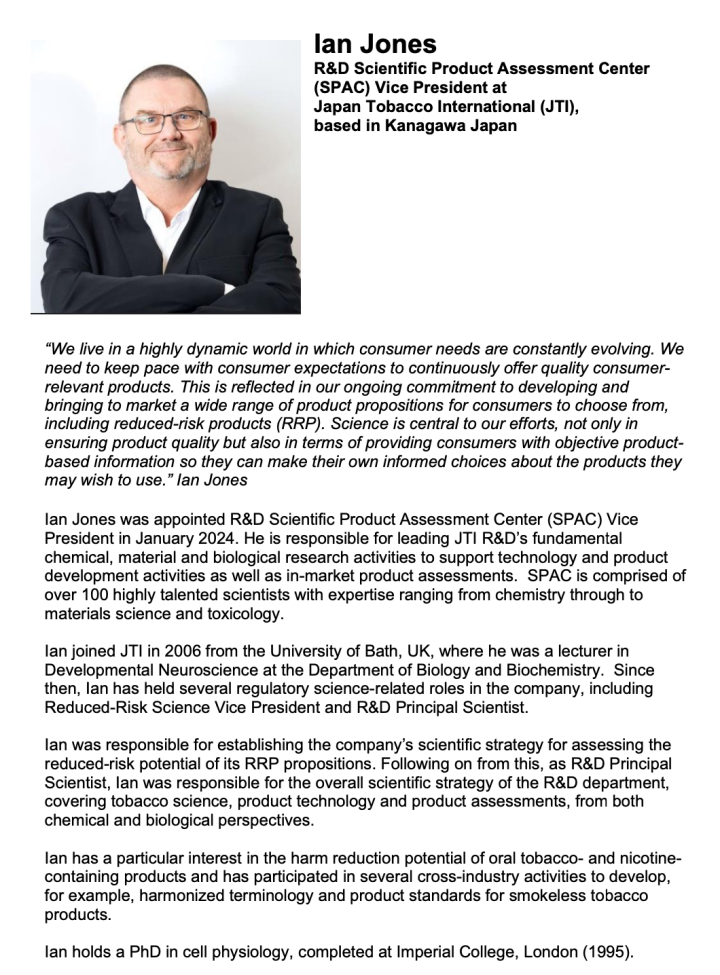
With decades of experience and significant investment in scientific research, international tobacco companies have taken the lead in exploring solutions to these pressing issues. Recently, 2Firsts reached out to Japan Tobacco International (JTI) to discuss its scientific initiatives, perspectives, and future plans. Dr. Ian Jones, Vice President of the R&D Scientific Product Assessment Center at JTI, shared his insights in an email interview.

Opportunities and Challenges in Global THR Science
The tobacco harm reduction (THR) landscape faces significant challenges despite its parallels with well-established harm reduction strategies, such as seatbelts in cars or condoms to prevent sexually transmitted diseases. According to Jones, “One challenge is regulatory frameworks that in some countries are failing to recognise the harm reduction potential of high-quality products that do not burn tobacco or produce smoke. A second challenge is a lack of a unified consistent public health messaging that clearly and credibly communicates the scientific evidence supporting the potential of RRP.”
Jones also highlighted progress in markets like the UK, where Public Health England has acknowledged the harm reduction potential of products like electronic vapor products (EVPs) and heated tobacco products (HTPs). JTI, as a strong proponent of consumer choice, continues to create a wide range of high-quality products that aim to exceed the combustible experience and support consumers in their risk-reduction journey.
“Meaningful harm reduction,” Jones emphasized, “requires not only product risk reduction but also the widespread availability, affordability, and acceptance of RRPs among adult tobacco consumers as a satisfying alternative to traditional cigarettes.”
Understanding Oral Nicotine Delivery: Challenges and Progress
Oral nicotine delivery (OND) products, despite being perceived as recent innovations, have a long history. “While oral nicotine delivery (OND) products may seem a very recent innovation, in reality, they have been around for several decades. This means that we have a good scientific understanding of the delivery of nicotine through oral products,” Jones explained.
However, he emphasized that new forms of OND, such as nicotine pouches, present unique challenges. “There are still open scientific questions about the dynamics of nicotine delivery from pouched products as well as the influence of other pouch ingredients,” Jones said, adding that addressing these questions is a key scientific priority. Efforts are also underway to establish global product testing standards and quality benchmarks for nicotine pouches.
Key Differences Among RRPs
Reduced-Risk Products (RRPs) such as electronic vapor products (EVPs), heated tobacco products (HTPs), and oral nicotine delivery (OND) products share the common goal of avoiding tobacco combustion, which is the primary cause of harm in smoking. Ian Jones highlighted a significant similarity across RRPs: “None of these product types combust tobacco during use. This is what gives them their reduced-risk potential since many of the adverse health outcomes associated with smoking are attributed to the byproducts of combusting tobacco.”
However, their differences are equally important. “In terms of their differences, the most obvious is that heated tobacco products (HTPs) contain tobacco, whereas e-vapor (EVP) and oral nicotine delivery (OND) products do not contain tobacco but contain nicotine instead,” Jones explained. Additionally, OND products are technically simpler, resembling oral food items, while EVP and HTP products are inhalation-based, involving different heating mechanisms.
Jones further emphasized that these distinctions not only affect consumer preferences but also require tailored scientific approaches to ensure product safety, efficacy, and quality. Addressing these differences is critical for advancing RRPs as viable alternatives to combustible cigarettes.
JTI’s Comprehensive Scientific Framework and Commitment to Harm Reduction
JTI’s scientific research spans the entire value chain, from technology ideation and innovation to detailed consumer studies. As Ian Jones explained, “The overarching purpose of science is to ensure that we deliver quality product propositions to consumers that are scientifically sound from a reduced-risk perspective, while at the same time meeting the expectations of consumers, for example, in terms of taste.”
Science plays a central role in advancing tobacco harm reduction. According to Jones, “The success of any harm reduction intervention is dependent on two factors: its potential to reduce the risks associated with a particular activity and the number of people who adopt the intervention.” JTI approaches harm reduction with a rigorous reduced-risk assessment process, guided by frameworks such as the US FDA’s Modified Risk Tobacco Products (MRTP) guidance. “We conduct a range of studies, from chemical analysis of vapor to biological assessments and clinical tests, to scientifically prove the risk reduction potential in individual users,” Jones noted. Additionally, JTI conducts surveys and population-level studies to monitor the long-term public health impacts of reduced-risk products.
Transparency is a cornerstone of JTI’s strategy. “It is vital that consumers, scientists, and the regulatory community have access to facts and solid data to support their decision-making process,” Jones emphasized. He also highlighted JTI’s commitment to informing, educating, and collaborating with stakeholders who are interested in the science behind reduced-risk products.
JTI champions consumer choice. As Jones elaborated, “We will continue creating a wide range of high-quality products to ensure high-quality experiences, while enabling consumers to pursue a risk-reduction journey.” JTI is committed to exceeding the combustible experience, making reduced-risk products (RRPs) a widely accepted alternative to smoking that satisfies adult consumer needs and expectations. Jones also stressed that, “JTI believes that meaningful harm reduction will only come about, however, through both product risk reduction and RRPs availability, affordability, and acceptance amongst adult tobacco consumers as a satisfying alternative to traditional cigarettes.”
Opportunities and Challenges in Global THR Science
Global tobacco harm reduction (THR) offers significant opportunities but faces persistent challenges. Jones explained that, while harm reduction is well-established in other areas like seatbelts, applying it to tobacco often encounters resistance, particularly from regulators. “THR does seem to be struggling to gain traction, especially from regulators,” he noted, citing inconsistent policies that fail to recognize the potential of non-combustible products.
Public misconceptions about RRPs and nicotine add to the difficulty. “There are still significant misconceptions towards RRPs and nicotine in general, and this continues to have a negative impact,” Jones said. However, he highlighted progress in markets like the UK, where Public Health England supports products like EVPs and HTPs as less harmful alternatives.
Jones emphasized that meaningful harm reduction requires collaboration among stakeholders, science-based regulation, and public education to address these challenges effectively.
A Role for Media in Advancing THR Awareness
Jones stressed the importance of media in advancing THR awareness. “Media could have a role in helping create platforms for dialogue between scientists, regulators, manufacturers and consumers,” he said, emphasizing the need for open communication.
He described THR science as a jigsaw puzzle, where individual studies form pieces of a bigger picture. “Each study is a piece of the puzzle… connect several pieces together, and the picture starts to reveal itself,” he explained. Accurate, transparent reporting can help dispel misconceptions about RRPs, enabling adult smokers to make informed decisions.
“Significant misconceptions towards RRPs and nicotine continue to have a negative impact,” Jones added, calling for balanced, evidence-based narratives to reshape public and regulatory perspectives.
Below is the full transcript of 2Firsts’ conversation with Dr. Ian Jones.
On the Category:
2Firsts: Latest scientific developments and challenges in OND products?
Ian Jones: While oral nicotine delivery (OND) products may seem a very recent innovation, in reality, they have been around for several decades. This means that we have a good scientific understanding of the delivery of nicotine through oral products.
The form of delivery, however, is evolving, with nicotine pouches, which are a derivative of snus, a traditional Swedish oral tobacco product.
While nicotine pouches share similarities with other OND products, there are still open scientific questions about the dynamics of nicotine delivery from pouched products as well as the influence of other pouch ingredients. Understanding these differences are one of the major scientific challenges today and efforts are being made to address these questions. In parallel there are initiatives to establish global product testing methods and quality standards for nicotine pouches, which necessitate scientific inputs and data.
2Firsts: From a scientific perspective, how do EVP, HTP, and OND differ in their characteristics, value, and risks within the harm reduction field?
Ian Jones: First, I would like to highlight the main similarity, namely that none of these product types combust tobacco during use. This is what gives them their reduced-risk potential since many of the adverse health outcomes associated with smoking are attributed to the byproducts of combusting tobacco.
In terms of their differences, the most obvious is that heated tobacco products (HTPs) contain tobacco whereas e-vapor (EVP) and oral nicotine delivery (OND) products do not contain tobacco but contain nicotine instead. The products also differ in their mode of working. OND products are the most technically simple and are similar in style to oral food products. EVP and HTP are inhalation products, EVP heating a liquid to form an inhalable vapor whereas HTPs heat tobacco
It is difficult to provide a ‘one size fits all’ classification for the reduced-risk potential of each product category as there are brand-specific considerations, such as what other ingredients, for example flavors, are added to the product, the product size, and so on. In general, however, as I mention above, the lack of tobacco combustion is a common denominator and is likely to be one of the largest contributors to reduced-risk potential.
On JTI's Science:
2Firsts: An overview of JTI's scientific research framework.
Ian Jones: Science in JTI spans the entire value chain, from technology ideation and innovation all the way through to consumer studies. The overarching purpose of science is to ensure that we deliver quality product propositions to consumers that are scientifically sound from a reduced-risk perspective, while at the same time meeting the expectations of consumers, for example in terms of taste.
Science also plays a crucial role in realizing and enhancing tobacco harm reduction. The success of any harm reduction intervention is dependent on two factors: its potential to reduce the risks associated with a particular activity and the number of people who adopt the intervention.
We follow a rigorous reduced-risk assessment in line with guidance from public health authorities, such as the US FDA’s guidance document for industry on MRTP (Modified Risk Tobacco Products) Applications. We conduct a range of studies, from chemical analysis of vapor to biological assessments and clinical tests, to scientifically prove the risk reduction potential in individual users. In addition, we conduct surveys to monitor long-term effects and impacts on public health.
It is vital that consumers, scientists and the regulatory community have access to facts and solid data to support their decision-making process. We are keen to inform, educate, and collaborate with all those interested in learning about the science behind RRPs.
2Firsts: How does science connect with product development, consumers, markets, and ESG initiatives?
Ian Jones: As I mentioned previously, science touches on almost all aspects of the value chain, including technology, product development and stewardship. Science can be brought to bear to address specific consumer needs for example, such as a more longer lasting flavor experience or use of more sustainable packaging materials. To efficiently achieve this, our scientific teams are in close contact with departments right across the business to ensure that activities are tailored to evolving consumer needs.
Consumer preferences for RRP products vary from market to market. We continue to expand our portfolio of smokeless alternatives. We plan to invest approximately 450 billion Yen in RRP, mainly in HTS, between 2024 and 2026, to support commercialization efforts, R&D and capital expenditures. Through such investments, we aim to provide our consumers with the products they demand and desire, while making sure they are designed to be more sustainable throughout their lifecycles. For example, we launched a return scheme for Ploom in Japan by introducing convenient collection boxes for used devices.
On Global THR Science:
2Firsts: What opportunities and challenges does global THR science face?
Ian Jones: This is a really interesting question as, on the face of it, tobacco harm reduction (THR) should not really face many obstacles. Afterall, the general concept of harm reduction touches on many aspects of our lives, like the use of seatbelts in cars to reduce injuries in car accidents or the use of condoms to reduce the risk of sexually transmitted disease.
In comparison to these well-established harm reduction approaches, THR does seem to be struggling to gain traction, especially from regulators. One challenge is regulatory frameworks that in some countries are failing to recognise the harm reduction potential of high-quality products that do not burn tobacco or produce smoke. A second challenge is a lack of a unified consistent public health messaging that clearly and credibly communicates the scientific evidence supporting the potential of RRP. There does seem to be progress however in some quarters. In the UK, where I am originally from for example, Public Health England has acknowledged the HR potential of products such as EVP and HTS.
JTI champions consumer choice. We will continue creating a wide range of high-quality products to ensure high-quality experiences, while enabling consumers to pursue a risk-reduction journey. JTI is committed to exceeding the combustible experience, making RRP a widely accepted alternative to smoking that satisfies adult consumer needs and expectations. JTI believes that meaningful harm reduction will only come about, however, through both product risk reduction and RRPs availability, affordability and acceptance amongst adult tobacco consumers as a satisfying alternative to traditional cigarettes.
2Firsts: How can further development be promoted?
Ian Jones: From a product perspective, I am sure that we will continue to see a variety of new product concepts being trialled over the coming years. As in any FMCG sector, some will resonate with consumers, others will not. So, the consumer remains at the center and will have an important voice in how RRP categories evolve.
From a THR perspective, there is broad alignment among manufacturers that science-based regulation should be a key element of public policies, resulting in balanced and proportionate decisions. The science underpinning regulatory submissions enables the industry to offer more choice in tobacco harm reduction.
Science has an important role to play in a smoker’s journey, from the willingness to try new products to making an informed choice to use RRPs as an alternative to smoking. However, it takes a lot of time, hard work and significant investment to scientifically substantiate the reduced risk profile of high-quality RRPs. Today the totality of the available evidence indicates that their potential for risk reduction compared to cigarettes is promising.
2Firsts: How can science and media collaborate to advance progress together?
Ian Jones: From my perspective, I think the best advice I can give to media is to understand that we are building a scientific jigsaw puzzle. Each study is a piece of the puzzle. On its own it does not tell you so much about the bigger picture you are trying to create (THR in this case) but start to connect several pieces of the puzzle together (i.e. studies), and the picture starts to reveal itself. Jumping to a conclusion based on a single study, without seeing how it contributes to the bigger picture, is never helpful.
Media could have a role in helping create platforms for dialogue between scientists, regulators, manufacturers and consumers. Today, there are still significant misconceptions towards RRPs and nicotine in general, and this continues to have a negative impact on the public’s perception as well as the regulatory environment of RRPs. When adults who smoke are well- informed of the harm reduction potential of RRPs, they are able to make an informed choice on whether they wish to use such products or not.
It is important we tackle this issue with open, transparent, data-driven and evidence-based information.
About Dr. Ian Jones
This article is part of 2Firsts’ ongoing coverage of global developments in tobacco harm reduction.
2Firsts is dedicated to reporting on global THR scientific research and fostering deeper and more comprehensive exchanges among science, industry, and regulation. Our mission is to advance the global development of THR initiatives.
We welcome article submissions, interview opportunities, or commentary. Please contact us at info@2firsts.com or connect with 2Firsts CEO Alan Zhao on LinkedIn here.
(Cover Image: JTI Official Website)
*This article is an original article of 2FIRSTS Technology Co., Ltd. The copyright and license rights belong to the company. Any entity or individual shall make link and credit 2FIRSTS when taking actions to copy, reprint or distribute the original article. The company retains the right to pursue its legal responsibility.