Shunho Stock Confirms Patent Authorization for Synthetic Nicotine Composition

Regulations by 2FIRSTS.ai
May.08.2024
Shunho Stock Confirms Patent Authorization for Synthetic Nicotine Composition
Shunho shares confirm subsidiary Yunnan Xike's patent approval for synthetic nicotine composition in the US for medical business expansion.

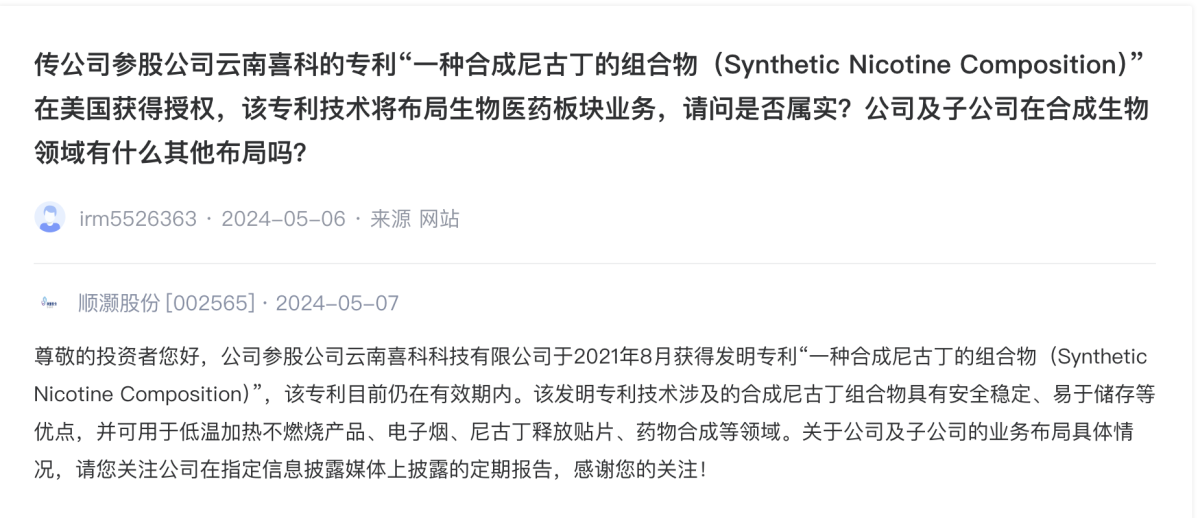
On May 6th, an investor asked a question to Shunho shares (003565) on the interactive platform, "It is rumored that the company's shareholding company Yunnan Xike has been granted authorization for the patent 'Synthetic Nicotine Composition' in the United States. This patented technology will be used to expand into the biopharmaceutical sector. Can you confirm this? Does the company or its subsidiaries have any other strategic plans in the field of synthetic biology?
 

Shunho Stock Confirms Patent Authorization for Synthetic Nicotine Composition
Question and answer details | Image source: Interactive Easy


Shunho Corporation stated that its affiliated company, Yunnan Xike Technology Co., Ltd., was granted the invention patent "Synthetic Nicotine Composition" in August 2021, and this patent is still valid. The synthetic nicotine composition covered by this patent technology has the advantages of safety, stability, and ease of storage. It can be used in various fields such as low-temperature HNB products, e-cigarettes, nicotine release patches, pharmaceutical synthesis, etc.


We welcome news tips, article submissions, interview requests, or comments on this piece.

Please contact us at info@2firsts.com, or reach out to Alan Zhao, CEO of 2Firsts, on LinkedIn


Notice

1.  This article is intended solely for professional research purposes related to industry, technology, and policy. Any references to brands or products are made purely for objective description and do not constitute any form of endorsement, recommendation, or promotion by 2Firsts.

2.  The use of nicotine-containing products — including, but not limited to, cigarettes, e-cigarettes, nicotine pouchand heated tobacco products — carries significant health risks. Users are responsible for complying with all applicable laws and regulations in their respective jurisdictions.

3.  This article is not intended to serve as the basis for any investment decisions or financial advice. 2Firsts assumes no direct or indirect liability for any inaccuracies or errors in the content.

4.  Access to this article is strictly prohibited for individuals below the legal age in their jurisdiction.


Copyright


This article is either an original work created by 2Firsts or a reproduction from third-party sources with proper attribution. All copyrights and usage rights belong to 2Firsts or the original content provider. Unauthorized reproduction, distribution, or any other form of unauthorized use by any individual or organization is strictly prohibited. Violators will be held legally accountable.

For copyright-related inquiries, please contact: info@2firsts.com


AI Assistance Disclaimer


This article may have been enhanced using AI tools to improve translation and editorial efficiency. However, due to technical limitations, inaccuracies may occur. Readers are encouraged to refer to the cited sources for the most accurate information.

We welcome any corrections or feedback. Please contact us at: info@2firsts.com

Maldives Implements World's First Generational Prohibition on Tobacco, Banning Sales and Smoking for Those Born After 2007
The Maldives has implemented a generational tobacco ban, effective November 1, 2025, making it the only country to permanently prohibit anyone born on or after January 1, 2007 from buying or using tobacco. Initiated by President Mohamed Muizzu, the policy aims to create a tobacco-free generation and includes a nationwide ban on e-cigarettes, with fines up to 50,000 rufiyaa (US$3,200) for violations.
Nov.03 by 2FIRSTS.ai
2025 China Shenzhen Top 500 Enterprises List: 13 E-cigarette Companies Include
Shenzhen e-commerce companies dominate 2025 Top 500 list, including 13 e-cigarette businesses. Shenzhen FirstUnion Tech climbs 57 spots.
Oct.30 by 2FIRSTS.ai
Belarus Proposes 20% Tax Increase on Vaping Products and Nicotine Items
Belarus will increase excise taxes in 2026 on vapes, liquids for electronic smoking systems, and non-tobacco nicotine products, with a proposed 20% rise aimed at aligning these rates with traditional cigarettes. Electronic smoking devices and heated tobacco systems will also be added to the list of excisable goods. Excise taxes on filtered cigarettes and heated tobacco will rise by 7% and 3% respectively.
Nov.13 by 2FIRSTS.ai
South Korea Publishes List of Major Tax Delinquents: Vape Wholesaler Owes Over USD 15.5 Million
The Korea Customs Service (KCS) has released a list of 236 habitual and large-scale customs tax delinquents with total unpaid taxes amounting to approximately USD 917 million. Among them, a vape wholesaler tops the individual list, owing about USD 15.57 million, while another vape-related company owes roughly USD 12.02 million.
Nov.11 by 2FIRSTS.ai
Australia Leads COP11 Seminars as Exploding Illicit Tobacco Market Raises Questions
Australia sent a delegation to COP11 in Switzerland and is leading three major seminars to showcase its vape and tobacco control policies. But at home, illicit cigarette sales are skyrocketing amid record-high taxes, drawing criticism from the tobacco industry and prompting doubts over policy effectiveness.
Nov.20 by 2FIRSTS.ai
Special Report | Anti-Vaping Campaign in the Baltics Goes Sideways
2Firsts analyzes vaping regulations across the Baltic states. Following Latvia’s flavor ban, tax revenues fell and the black market expanded, while similar measures in Estonia and Lithuania have also failed to deliver results. The region’s anti-vaping policies are now triggering market imbalance and policy reassessment.
Oct.13