South Korea Imposes Age Verification for E-Cigarette Sales, Fines Up to $14,000

Nov.27.2024
South Korea Imposes Age Verification for E-Cigarette Sales, Fines Up to $14,000
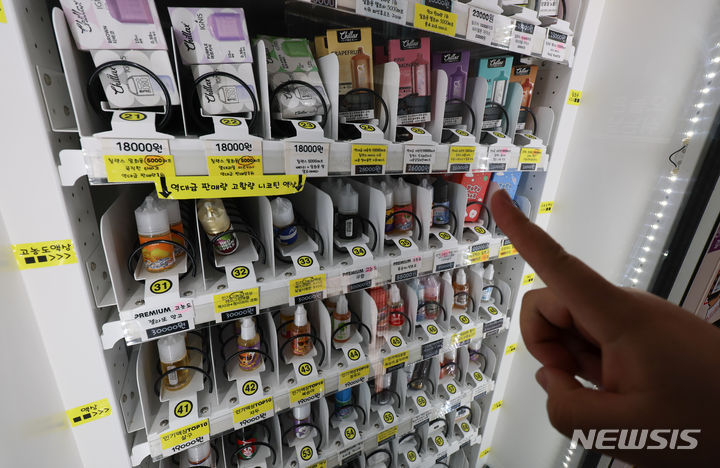
South Korea's Ministry of Gender Equality and Family Bans E-Cigarette Sales, Imposes Up to 2 Years in Prison or $14,000 Fine for Violations; Strengthens Online and Offline Sales Monitoring in Collaboration with the Korean E-Cigarette Association to Prevent Sales to Minors

The South Korean Ministry of Gender Equality and Family reiterated that selling e-cigarettes to adolescents could result in penalties, according to a report by N.News on November 26th.


The department emphasized that age and identity verification must be conducted when selling e-cigarettes. If sold to minors, violators can be punished in accordance with Article 59 of the Youth Protection Act, with penalties including up to two years in prison or a fine of not more than 20 million Korean won (14,000 dollars).


The department is continuing to strengthen its supervision of both online and offline venues, providing guidance and inspections to e-cigarette vendors. It is also requesting the Korean e-cigarette association to increase cooperation efforts in order to collectively promote the implementation of the ban on sales to youth.


Regular age and identity verification checks will be conducted on online sales platforms. If violations are found, corrective measures will be taken, such as issuing rectification orders, to ensure that minors cannot easily access e-cigarette products.


The Ministry of Gender Equality and Family is one of South Korea's central administrative agencies and is the government department responsible for policies related to women, youth, and families.


We welcome news tips, article submissions, interview requests, or comments on this piece.

Please contact us at info@2firsts.com, or reach out to Alan Zhao, CEO of 2Firsts, on LinkedIn


Notice

1.  This article is intended solely for professional research purposes related to industry, technology, and policy. Any references to brands or products are made purely for objective description and do not constitute any form of endorsement, recommendation, or promotion by 2Firsts.

2.  The use of nicotine-containing products — including, but not limited to, cigarettes, e-cigarettes, nicotine pouchand heated tobacco products — carries significant health risks. Users are responsible for complying with all applicable laws and regulations in their respective jurisdictions.

3.  This article is not intended to serve as the basis for any investment decisions or financial advice. 2Firsts assumes no direct or indirect liability for any inaccuracies or errors in the content.

4.  Access to this article is strictly prohibited for individuals below the legal age in their jurisdiction.


Copyright


This article is either an original work created by 2Firsts or a reproduction from third-party sources with proper attribution. All copyrights and usage rights belong to 2Firsts or the original content provider. Unauthorized reproduction, distribution, or any other form of unauthorized use by any individual or organization is strictly prohibited. Violators will be held legally accountable.

For copyright-related inquiries, please contact: info@2firsts.com


AI Assistance Disclaimer


This article may have been enhanced using AI tools to improve translation and editorial efficiency. However, due to technical limitations, inaccuracies may occur. Readers are encouraged to refer to the cited sources for the most accurate information.

We welcome any corrections or feedback. Please contact us at: info@2firsts.com

PMI says Colorado ZYN plant build advances as first pouches hit market in 2025
Philip Morris International (PMI) is investing $600 million to build a ZYN nicotine pouch plant in Aurora, Colorado. While the facility is still under construction, PMI said production started in September 2025 and the first pouches made at the site have already gone to market.
Feb.10 by 2FIRSTS.ai
Kazakhstan Investigates Social-Media Vape Sales Linked to a Banking “Drop” Arrangement
Kazakhstan’s Financial Monitoring Agency (AFM) in Ulytau Region is conducting a pre-trial investigation into alleged illegal vape sales and the unlawful acquisition of access to a bank account. Authorities say a Satpayev resident has sold banned devices via social media since 2024 and used a “dropper” arrangement to disguise proceeds.
Jan.27 by 2FIRSTS.ai
Russia’s Volgograd fines retailer 300,000 rubles for unlabelled nicotine products, orders confiscation and destruction
Volgograd, Russia say a retailer was caught selling unlabelled nicotine products, including electronic nicotine delivery devices flagged in the national “Honest Sign” tracking system as already withdrawn from circulation. A local court fined the entrepreneur 300,000 rubles and ordered 41 confiscated items to be destroyed, with the decision now in effect.
Feb.05 by 2FIRSTS.ai
Belarus plans to tighten licensing for e-cigarette and e-liquid trade; Lukashenko expresses support
A report says Belarus plans to tighten, at the legislative level, the licensing of trade in electronic cigarettes and related mixtures (e-liquids). The draft law was discussed at a meeting chaired by President Alexander Lukashenko with the leadership of the Council of Ministers, according to a BelTA correspondent.
Feb.06 by 2FIRSTS.ai
Guam names retailers fined for selling tobacco to under-21 customers; penalties range from $2,000 to $4,000
Guam disclosed enforcement details for its 2025 tobacco retail compliance program, showing a 97.1% compliance rate among 277 inspected retailers. Nine violations were recorded, including eight underage sales cases and one signage violation, with fines ranging from $500 to $4,000.
Feb.10 by 2FIRSTS.ai
FDA Details Carcinogenicity Tiering and ELCR Framework as Small Manufacturers Press for Predictability
During the “Toxicological Profile” session at FDA’s Feb 10 PMTA roundtable, officials outlined the carcinogenicity tiering system and Excess Lifetime Cancer Risk (ELCR) framework used in ENDS reviews under the APPH standard. Small manufacturers questioned database transparency, exposure assumptions, and the existence of clear compliance benchmarks. FDA reiterated toxicological risk is assessed case by case within a broader population-level determination.
Feb.11