Key Points
- South Korea will enforce the revised Tobacco Business Act on April 24, 2026.
- Synthetic nicotine liquid e-cigarettes will be legally defined as tobacco.
- Mandatory health warnings will apply to affected products.
- Use in smoke-free areas will be subject to penalties.
- Advertising, promotion, and online sales will be strictly restricted.
2Firsts, December 29,2025 – According to South Korea’s Ministry of Health and Welfare and the Korea Health Promotion Institute,
amendments to the Tobacco Business Act will take effect on April 24, 2026, formally classifying synthetic nicotine liquid e-cigarettes as tobacco products.
This revision represents the first change to South Korea’s legal definition of tobacco since the law’s enactment in 1988. Previously, tobacco regulations were based on the use of tobacco leaves, leaving synthetic nicotine products outside the scope of tobacco control laws.
The government has conducted public consultations and research on e-cigarette regulation since 2021, including annual tobacco control policy forums and market monitoring. Studies by the Ministry of Health and Welfare, the Ministry of Food and Drug Safety, and the Korea Disease Control and Prevention Agency have identified carcinogens and other harmful substances in synthetic nicotine liquid e-cigarettes.
Under the revised law, synthetic nicotine e-cigarettes will be subject to the National Health Promotion Act, requiring mandatory health warning images and text on packaging. Authorities said compliance will be closely monitored.
Advertising regulations will also be strengthened. Tobacco advertisements inside retail stores and in newspapers or magazines must display health warnings prominently at the bottom center.
With the expanded definition, using synthetic nicotine e-cigarettes in smoke-free areas such as schools, hospitals, and government buildings will be punishable. Flavor-based marketing targeting youth and young adults will be restricted, prohibiting packaging or advertising that emphasizes fruit or dessert flavors.
Advertising and promotional activities will be significantly limited. Except for designated areas inside licensed retailers, online advertising, external store displays, sponsorship of vape expos, and promotional events will be banned. Online sales via e-commerce platforms or social media will also be prohibited.
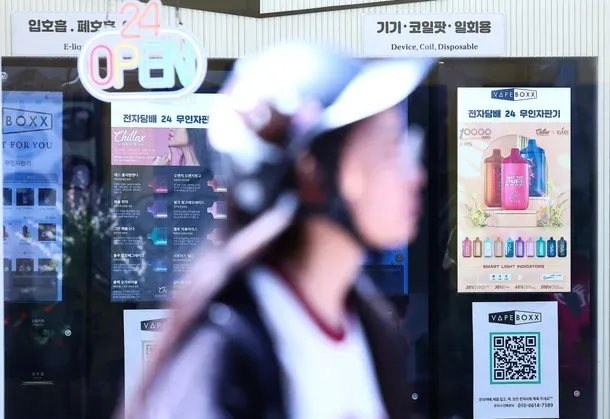
Regulation of unattended vending machines will be tightened, requiring location restrictions and mandatory age-verification systems. From February 2026, vending machines selling tobacco products will be progressively banned in educational protection zones.
Photo credit: Newsis
We welcome news tips, article submissions, interview requests, or comments on this piece.
Please contact us at info@2firsts.com, or reach out to Alan Zhao, CEO of 2Firsts, on LinkedIn
Notice
1. This article is intended solely for professional research purposes related to industry, technology, and policy. Any references to brands or products are made purely for objective description and do not constitute any form of endorsement, recommendation, or promotion by 2Firsts.
2. The use of nicotine-containing products — including, but not limited to, cigarettes, e-cigarettes, nicotine pouchand heated tobacco products — carries significant health risks. Users are responsible for complying with all applicable laws and regulations in their respective jurisdictions.
3. This article is not intended to serve as the basis for any investment decisions or financial advice. 2Firsts assumes no direct or indirect liability for any inaccuracies or errors in the content.
4. Access to this article is strictly prohibited for individuals below the legal age in their jurisdiction.
Copyright
This article is either an original work created by 2Firsts or a reproduction from third-party sources with proper attribution. All copyrights and usage rights belong to 2Firsts or the original content provider. Unauthorized reproduction, distribution, or any other form of unauthorized use by any individual or organization is strictly prohibited. Violators will be held legally accountable.
For copyright-related inquiries, please contact: info@2firsts.com
AI Assistance Disclaimer
This article may have been enhanced using AI tools to improve translation and editorial efficiency. However, due to technical limitations, inaccuracies may occur. Readers are encouraged to refer to the cited sources for the most accurate information.
We welcome any corrections or feedback. Please contact us at: info@2firsts.com