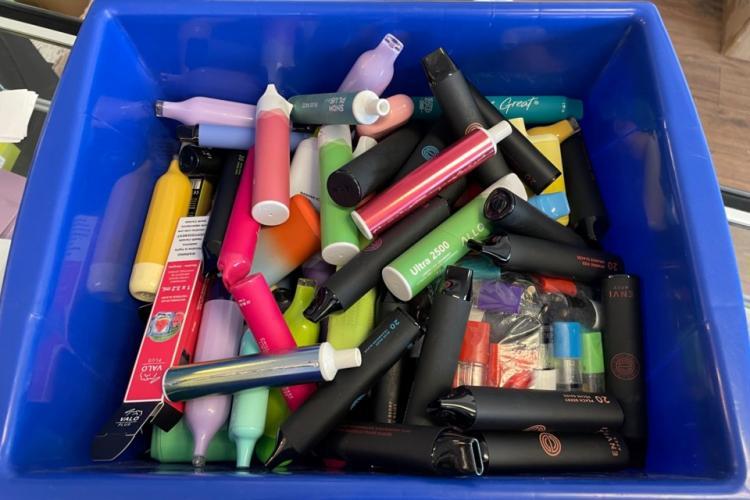
As the electronic cigarette industry continues to thrive, people are becoming increasingly concerned about how to properly dispose of these products. Given that e-cigarette manufacturing companies do not openly promote or share information on how to properly dispose of e-cigarettes and pods, where can people find guidance on where to dispose of used disposable e-cigarettes?
A survey by the Initiative for Truth revealed that "over half (51%) of young e-cigarette users reported disposing of used e-cigarettes or empty disposable products in the trash can." Additionally, "nearly half (49.1%) of young people did not know how to properly dispose of used e-cigarettes and disposable devices.
In this situation, what may be overlooked is the impact of e-cigarette disposal on the environment, especially considering the cultural phenomenon of e-cigarettes in recent years.
Since the early 2010s, the use of electronic cigarettes has been a booming market in Canada. According to statistics, sales revenue for electronic cigarettes in Canada has nearly doubled since 2014. As of 2022, revenue for electronic cigarettes in Canada has reached $1.26 billion, making it the third-largest source of revenue in the global electronic cigarette market.
Despite restrictions on the sale of nicotine-containing e-cigarettes in Canada, a study conducted by the Public Health Systems Institute at the University of Waterloo in Ontario in 2012 found that the proportion of non-smokers trying e-cigarettes has almost doubled.
As the consumption of e-cigarettes intensifies, millions of disposable e-cigarettes end up being buried in landfills despite containing metals such as lithium commonly used in batteries. E-cigarette devices are typically made with lithium-ion batteries, also used in mobile phone and electric car batteries. When they are thrown away as disposable or non-reusable items, they become waste that could have been recycled back into mobile phone or electric car batteries.
Handling e-cigarette products without recycling is not only wasteful, but also harmful to the environment.
A study by environmental philosopher Yogi Hendlin has revealed that high concentrations of nicotine and electronic waste residue pose a biological hazard. Hard plastics, lithium-ion batteries, and electronic circuit boards require dismantling, sorting, and further recovery and disposal. When improperly discarded or littered, broken devices may release heavy metals, including mercury, lead, and bromine, battery acid, and nicotine into local environments and urban landscapes, affecting both humans and other organisms.
The Truth Initiative recommends in its report that electronic cigarette companies bear responsibility and establish standardized processes for e-cigarette devices, additives, and e-liquids.
A vape shop in Suddbury has launched an initiative to collect and encourage the recycling of disposable e-cigarettes in the city.
Greg Steele, manager of an e-cigarette store, stated, "The main motivation behind this initiative was my frustration with seeing disposable items being treated as new cigarette butts thrown in parking lots. We came up with a plan where customers can bring their disposable items and dispose of them in a recycling bin. We have labels available so they can write down their name and phone number.
From there, individuals carrying second-hand disposable electronic cigarettes go to the electronic cigarette store every week to participate in a lottery for a chance to win some items.
Steele stated, "We provide them with refillable equipment that is more environmentally friendly compared to disposables like t-shirts and hats." The store then sends these items to a battery recycling facility or hazardous waste management department in Saddlebury where they will be properly and safely dismantled and recycled.
What I really want to do is change the behavior of people who just throw disposable e-cigarettes on the ground. I want to encourage them to bring them back to the store," said Stiel in English.
To ensure proper recycling and disposal of e-cigarettes, they can be brought to a store, but there are also other safe methods for recycling e-cigarettes. They may be recycled through the City Household Hazardous Waste Depot located at 1853 Froby She Street. The city has confirmed via email that they are adding e-cigarettes to the Waste Wise app, which aims to inform people on how to properly dispose of various types of waste.
If done correctly and safely, batteries can also be handled at home. Battery disassembly can be very dangerous, and Sudbury.com urges viewers to wear appropriate safety gear and be cautious.
Statement
This article is compiled from third-party information and is intended solely for industry exchange and learning purposes.
This article does not represent the views of 2FIRSTS and 2FIRSTS cannot confirm the truthfulness and accuracy of the content. The compilation of this article is solely intended for industry exchange and research purposes.
Due to limitations in the translator's ability, the translated article may not fully reflect the original text. Please refer to the original text for accuracy.
In all domestic, Hong Kong, Macau, Taiwan and foreign matters, 2FIRSTS maintains complete alignment with the Chinese government.
The copyright of the compiled information belongs to the original media and author. If there is any copyright infringement, please contact us for deletion.
Disclaimer
This article is provided solely for professional research, industry discussion, and informational purposes. Any references to brands, companies, products, technologies, or policies are made for factual reporting and analytical purposes only, and do not constitute endorsement, recommendation, promotion, or advertising by 2Firsts.
Nicotine-containing products, including but not limited to cigarettes, e-cigarettes, heated tobacco products, and nicotine pouches, carry significant health risks. Readers are responsible for complying with all applicable laws and regulations in their respective jurisdictions, including age restrictions and access limitations.
The information contained in this article should not be regarded as investment, legal, medical, regulatory, or commercial advice. While 2Firsts strives to ensure the accuracy and reliability of its content, it does not assume liability for any direct or indirect loss arising from errors, omissions, inaccuracies, or reliance on the information contained herein.
This article is not intended for individuals below the legal age for accessing tobacco or nicotine-related information in their jurisdiction.
Copyright Notice
This article is either original content produced by 2Firsts or content reproduced, translated, summarized, or adapted from third-party sources with attribution where applicable. The intellectual property rights of the original content remain with 2Firsts or the respective original rights holders.
No individual or organization may copy, reproduce, distribute, republish, modify, translate, or otherwise use this content without prior authorization. Any unauthorized use may result in legal action.
For copyright-related inquiries, corrections, or removal requests, please contact: info@2firsts.com.
AI-Assisted Translation and Editing Notice
Portions of this article may have been translated, edited, or reviewed with the assistance of artificial intelligence tools to improve efficiency and readability. Due to the limitations of AI-assisted translation and editing, discrepancies, omissions, or inaccuracies may exist when compared with the original source.
Where applicable, readers are advised to refer to the original source for the most complete and accurate information. If you identify any errors or believe that any content infringes upon your rights, please contact us at info@2firsts.com, and we will review and address the matter promptly.