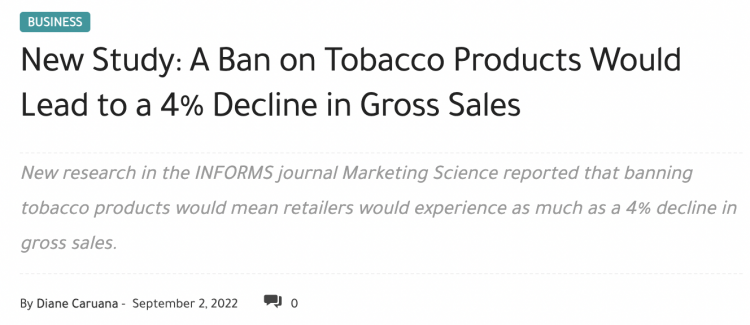
A study titled "What Happens When Retailers Abandon Product Categories?" published in the marketing science journal INFORMS, has found that tobacco products play a significant role in driving foot traffic to physical retail stores. The research also highlights the negative microeconomic effects that bans on tobacco can have, whether voluntary or mandated.
On one hand, ceasing the sale of electronic cigarette products could potentially lower foot traffic from that customer base and trickle down to other categories of sales. On the other hand, a store's voluntary decision to end tobacco sales could attract more non-smokers to their establishment and offset any losses from discontinuing that category of sales, the researchers stated. "However, in regards to tobacco specifically, our results suggest that the short-term gains retailers receive from prohibiting tobacco sales do not appear to outweigh the economic losses associated with these actions.
A recent study focused exclusively on early adopters of electronic cigarette shops found that these shops play a crucial role in supporting smokers in transitioning to safer alternative products. Researchers interviewed 22 customers recruited from electronic cigarette shops in the East Midlands region of England by telephone, exploring the participants' smoking history, reasons for using electronic cigarettes, the role of electronic cigarette shops in electronic cigarette use, and whether quitting smoking was discussed in the electronic cigarette shops.
According to the survey, respondents view e-cigarettes as a smoking cessation tool and reported very positive experiences with vaping. Participants found e-cigarette shops to be crucial to their positive experiences as they provided access to information and recommendations for various high-quality and reliable products.
Store employees have generated a sense of loyalty among customers and, along with other electronic cigarette users, have created a network that supports the use of e-cigarettes. While e-cigarette shops are not typically seen as places that offer smoking cessation advice, many consider them a potential source of support in quitting smoking.
The study concludes that electronic cigarette stores play an important role in reducing tobacco harm, and that their potential could increase if their service model could expand to help smokers quit smoking.
Disclaimer: 1. This article's content is compiled from third-party information and is only intended for industry exchange and learning purposes. 2. This article does not represent the opinion of 2FIRSTS, and 2FIRSTS is unable to confirm the truthfulness or accuracy of the article's content. The article's compilation is only used for industry exchange and research. 3. Due to the limited level of compilation, the compiled article may not fully express the original article's message, so please refer to the original article. 4. Regarding any domestic, Hong Kong, Macao, Taiwan or foreign expressions and stances, 2FIRSTS fully aligns with the Chinese government. 5. The copyright of the compiled information belongs to the original media and author. If there is any infringement, please contact us for removal.
Disclaimer
This article is provided solely for professional research, industry discussion, and informational purposes. Any references to brands, companies, products, technologies, or policies are made for factual reporting and analytical purposes only, and do not constitute endorsement, recommendation, promotion, or advertising by 2Firsts.
Nicotine-containing products, including but not limited to cigarettes, e-cigarettes, heated tobacco products, and nicotine pouches, carry significant health risks. Readers are responsible for complying with all applicable laws and regulations in their respective jurisdictions, including age restrictions and access limitations.
The information contained in this article should not be regarded as investment, legal, medical, regulatory, or commercial advice. While 2Firsts strives to ensure the accuracy and reliability of its content, it does not assume liability for any direct or indirect loss arising from errors, omissions, inaccuracies, or reliance on the information contained herein.
This article is not intended for individuals below the legal age for accessing tobacco or nicotine-related information in their jurisdiction.
Copyright Notice
This article is either original content produced by 2Firsts or content reproduced, translated, summarized, or adapted from third-party sources with attribution where applicable. The intellectual property rights of the original content remain with 2Firsts or the respective original rights holders.
No individual or organization may copy, reproduce, distribute, republish, modify, translate, or otherwise use this content without prior authorization. Any unauthorized use may result in legal action.
For copyright-related inquiries, corrections, or removal requests, please contact: info@2firsts.com.
AI-Assisted Translation and Editing Notice
Portions of this article may have been translated, edited, or reviewed with the assistance of artificial intelligence tools to improve efficiency and readability. Due to the limitations of AI-assisted translation and editing, discrepancies, omissions, or inaccuracies may exist when compared with the original source.
Where applicable, readers are advised to refer to the original source for the most complete and accurate information. If you identify any errors or believe that any content infringes upon your rights, please contact us at info@2firsts.com, and we will review and address the matter promptly.