The Surge in Synthetic Nicotine Products in E-cigarette Market

Mar.11.2025
The Surge in Synthetic Nicotine Products in E-cigarette Market
E-cigarette sales surge by 25% in Korea, with synthetic nicotine dominating market amid calls for regulations.

Key points:


1. E-cigarette sales surged by 25% over the past year, with synthetic nicotine products accounting for 97% of the e-cigarette market.


2. Imports of synthetic nicotine surged by 80%, with experts urging swift legislation to address the market shift.


3. Earlier, the South Korean parliament planned to regulate synthetic nicotine, but the proposal was put on hold due to industry concerns over the reliability of research.


According to N.News, a report submitted by South Korea’s Ministry of Health and Welfare on the 10th, titled "Domestic Tobacco Product Market Survey and In-Depth Analysis of Smoking Behavior," showed that e-cigarettes stood out in market performance.


E-cigarette sales reached 19.9 billion South Korean won (approximately $14 million) in the third quarter of 2024, a 24.6% increase from the same period in 2023. During the same period, sales of heated tobacco grew by 2%, while cigarette sales fell by 3.4%.


The report also found that in 2023, synthetic nicotine products accounted for 97.2% of the e-cigarette market, while natural nicotine made up 2.8%. Imports of natural nicotine increased slightly from 554 tons in 2022 to 555 tons in 2023, a growth of less than 1%. 


In contrast, imports of synthetic nicotine surged by 80%, rising from 121 tons in 2022 to 216 tons in 2023. While natural nicotine imports remain higher in volume, synthetic nicotine has quickly dominated the market due to its more efficient production capabilities.


As of June 2024, South Korea's synthetic nicotine imports reached 162 tons, accounting for three-quarters of the previous year's total imports in just six months.


The research team noted in the report that...

Before the discussion on regulating synthetic nicotine has even begun, the e-cigarette industry has already led the market with the introduction of products with no nicotine or low nicotine. The emergence of these nicotine analogs has made market changes even more complex, making it difficult even for experts to keep up with them quickly.


The South Korean parliament planned to discuss the possibility of including synthetic nicotine in tobacco regulations last month, but the proposal is currently on hold due to concerns raised by the e-cigarette industry about the reliability of the research and emphasizing the right to survival.


We welcome news tips, article submissions, interview requests, or comments on this piece.

Please contact us at info@2firsts.com, or reach out to Alan Zhao, CEO of 2Firsts, on LinkedIn


Notice

1.  This article is intended solely for professional research purposes related to industry, technology, and policy. Any references to brands or products are made purely for objective description and do not constitute any form of endorsement, recommendation, or promotion by 2Firsts.

2.  The use of nicotine-containing products — including, but not limited to, cigarettes, e-cigarettes, nicotine pouchand heated tobacco products — carries significant health risks. Users are responsible for complying with all applicable laws and regulations in their respective jurisdictions.

3.  This article is not intended to serve as the basis for any investment decisions or financial advice. 2Firsts assumes no direct or indirect liability for any inaccuracies or errors in the content.

4.  Access to this article is strictly prohibited for individuals below the legal age in their jurisdiction.


Copyright


This article is either an original work created by 2Firsts or a reproduction from third-party sources with proper attribution. All copyrights and usage rights belong to 2Firsts or the original content provider. Unauthorized reproduction, distribution, or any other form of unauthorized use by any individual or organization is strictly prohibited. Violators will be held legally accountable.

For copyright-related inquiries, please contact: info@2firsts.com


AI Assistance Disclaimer


This article may have been enhanced using AI tools to improve translation and editorial efficiency. However, due to technical limitations, inaccuracies may occur. Readers are encouraged to refer to the cited sources for the most accurate information.

We welcome any corrections or feedback. Please contact us at: info@2firsts.com

Pennsylvania Vape Directory Law Survives Court Challenge From Nova Distro and Others Amid Similar Rulings Across States
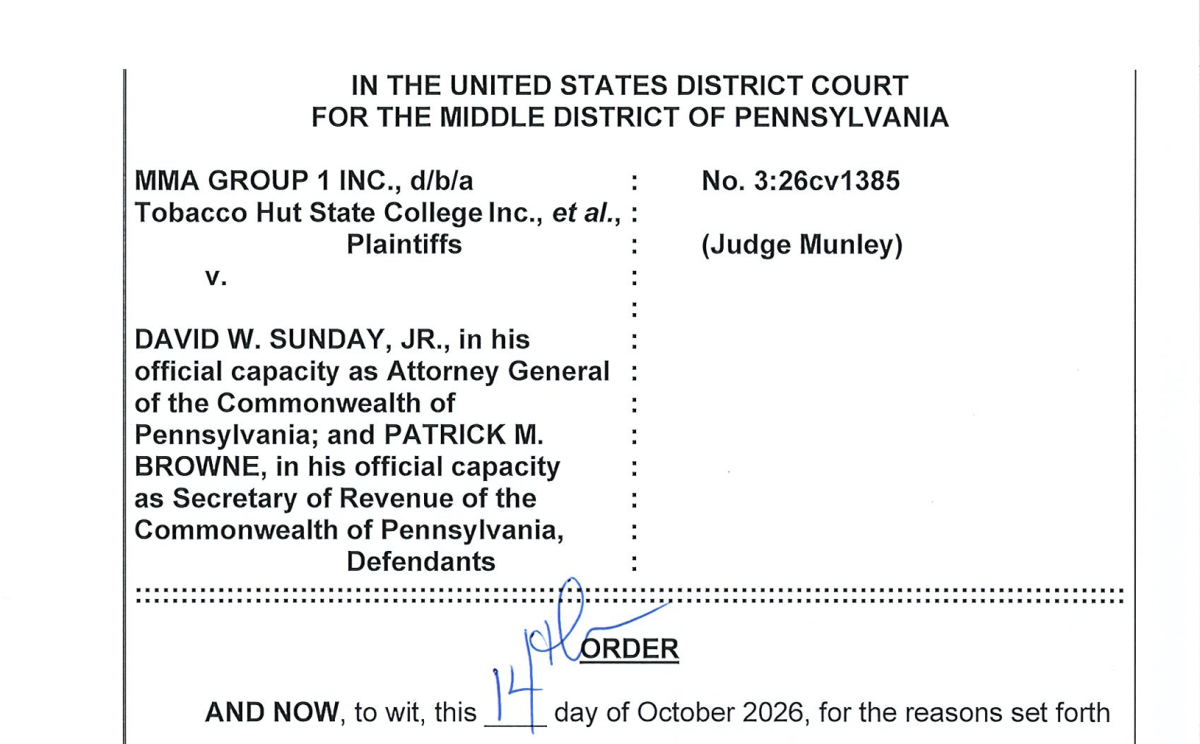
A U.S. federal court upheld Pennsylvania's vape directory law on October 14, rejecting a challenge brought by Nova Distro, 101 Distributors and companies operating Tobacco Hut retail stores. Court records show that vaping accounts for about 60% of Tobacco Hut's profits and that the chain held approximately $2 million in inventory potentially subject to seizure under the law as of June 2. Pennsylvania began enforcement on October 19. The ruling follows similar appellate decisions in other states, even as new research shows that unlisted vaping products continue to account for substantial sales in states with established directories.
Regulations
Oct.22
Pennsylvania Vape Directory Enforcement Starts Oct. 19, Barring Retail Sales of Unlisted Products
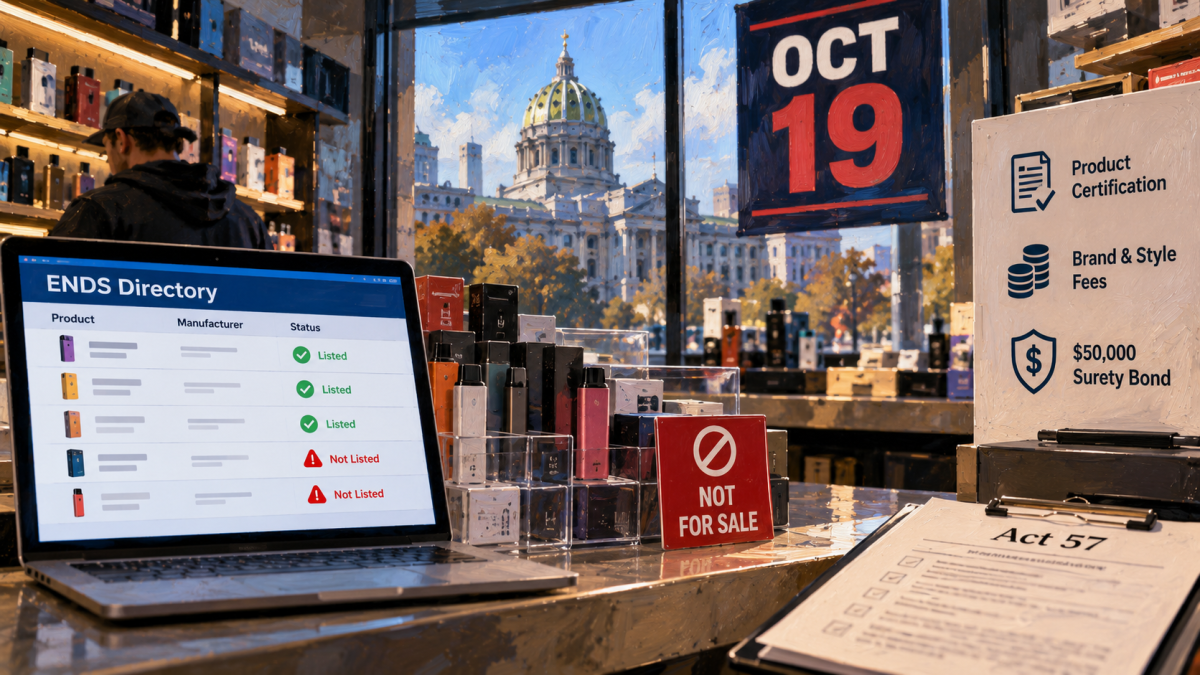
Pennsylvania's Act 57 vape directory regime will reach the end of its 120-day inventory transition period on Oct. 19. Nicotine-containing e-cigarettes intended for retail sale in the state that are not listed on the Attorney General's ENDS directory will then be barred from retail sale and treated as contraband subject to seizure, forfeiture and destruction. Manufacturers face annual product certification, brand- and style-based fees and a minimum $50,000 surety bond, while retailers and wholesalers must source through licensed channels and monitor the directory.
Regulations
Oct.08
Reynolds Puts Nearly 183,000 U.S. Contracted Outlets Under Age-Verification Rules, Covering 94% of Volume — Can It Shift an Unauthorized Vape Market?
Reynolds American says nearly 183,000 U.S. retail outlets are under contract, with its Retail Marketing Plan Contract covering about 94% of company volume and requiring point-of-sale age verification. The company combines those contracts with We Card, TruAge, NACS-linked infrastructure and POS integration, while enhanced Vuse Pro retail rules add ID scanning, purchase limits and stronger underage-sales accountability. The initial Vuse Pro rollout targets about 50,000 stores. The system is taking shape as unauthorized vapor products remain dominant in parts of the U.S. market: a 2026 study estimated they accounted for 69.4% of tracked brick-and-mortar e-cigarette dollar sales in December 2025.
Special Report
Oct.15
PMI's IQOS Extends ZAMNA Electronic-Music Partnership to Spain as Vogue España Publishes Branded Content
Philip Morris International's IQOS has extended its partnership with electronic-music event brand ZAMNA to Spain, setting up a House of IQOS at ZAMNA Madrid. Vogue España and Time Out Madrid subsequently published branded content clearly labeled as collaborations with IQOS. PMI has also expanded its company-owned IQOS boutique network in Spain to seven cities this year. The company says IQOS's adjusted heated-tobacco market share in Europe reached 12.6% in the first quarter of 2026, with Spain among its stronger-performing European markets.
Sep.20
FDA Revises Import Alert 98-07 Rules, Bringing May Enforcement Priorities Into Unauthorized ENDS Detentions
The U.S. Food and Drug Administration has revised the rules under Import Alert 98-07 to incorporate its May 2026 enforcement-priority policy for certain electronic nicotine delivery systems marketed without premarket authorization. The alert continues to allow detention without physical examination, or DWPE, for ENDS lacking required marketing authorization, while directing field divisions to apply the May risk-based framework. When necessary, detention or refusal decisions must also undergo review by the FDA's Center for Tobacco Products. Products including PACHA and Vuse Pro have already emerged as industry examples of the May policy, although enforcement discretion does not constitute FDA marketing authorization.
News
Sep.28 by 2Firsts Perspectives
Spain Cigarette Volumes Fall 5.2% in August, BAT Drops 14.5%, JTI Gains Share; France Down 8.3% on Adjusted Basis
Spain's cigarette volumes declined 5.2% year over year in August 2026, according to government data cited by UBS and reported by Investing.com on October 7. British American Tobacco's volumes fell 14.5%, followed by Imperial Brands at 8.8%, Philip Morris International at 6.6% and Japan Tobacco at 4.6%. JTI was the only one of the four companies to gain cigarette market share, rising six basis points to 26.7%. In France, official customs data showed an unadjusted 3.7% decline in cigarette deliveries. Adjusting for the difference in delivery days produces a decline of approximately 8.3%, consistent with the UBS figure. The bank also estimated the earnings exposure of major tobacco companies to both markets.
Market
Oct.13