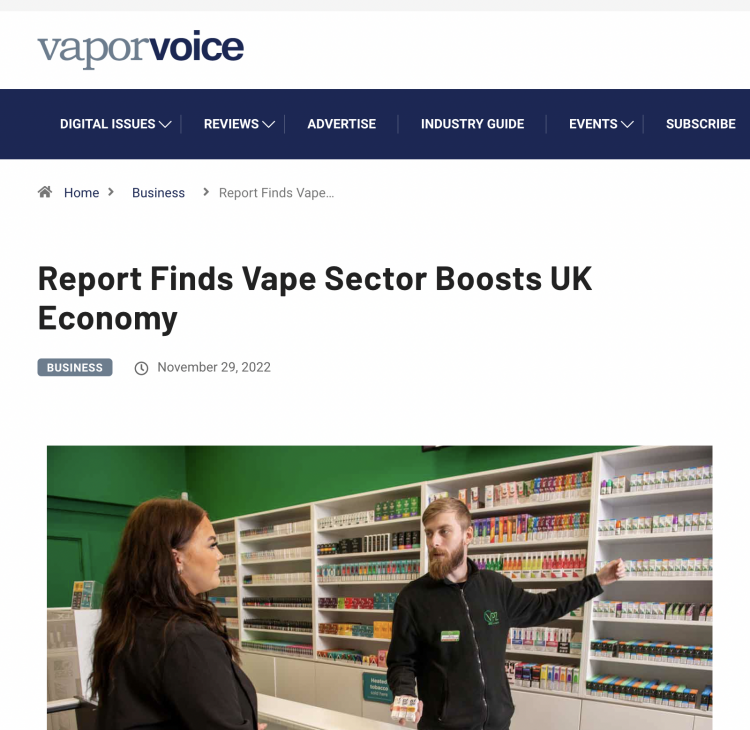
According to a new report compiled by the Centre for Economics and Business Research (CEBR) on behalf of the UK Vaping Industry Association (UKVIA), the e-cigarette industry has had a significant positive impact on the UK economy.
By 2021, the UK's electronic cigarette industry was worth £2.8 billion ($3.36 billion) and supported nearly 18,000 full-time jobs throughout retail, manufacturing, and the supply chain, according to a report. Additionally, the report highlights that in just 2019, smokers switching to less harmful e-cigarettes saved the National Health Service (NHS) over £300 million.
Despite many companies suffering in recent years, electronic cigarette retailers are bucking the trend and becoming one of the fastest growing industries since the first decade of the 21st century.
From 2017 to 2021, the electronic cigarette industry in the UK saw a revenue growth of 23.4%, reaching £1.33 billion in just the past year alone. When indirect economic benefits such as supply chain support and the spending power of workers in the e-cigarette sector are taken into account, the economic impact more than doubles.
In 2021, the electronic cigarette industry paid £310 million in taxes to the UK government.
According to research conducted by CEBR, the e-cigarette industry saved the UK approximately £322 million in healthcare costs related to smoking in 2019. The study estimates that if 50% of smokers switch to e-cigarettes, potential healthcare savings could reach £698 million by 2020.
Meanwhile, in 2019, the economic benefit related to smokers switching to electronic cigarettes was estimated to be £1.3 billion. According to this research, if 50% of remaining smokers in the UK switched to electronic cigarettes, this would increase to £3.33 billion.
Owen Good, head of economic consultancy CEBR, stated that the results of the first ever economic impact report on the e-cigarette industry show that it has achieved huge success as a rapidly growing disruptive industry.
Although many high street retailers have suffered losses in recent years, the electronic cigarette industry has defied the trend with significant growth both in brick-and-mortar stores and online. Even the impact of the pandemic has not significantly hindered the industry's growth.
The growth of this industry is highly beneficial to the UK economy, both for companies and employees directly involved, as well as those operating within the wider supply chain. As more and more smokers switch to e-cigarettes to quit their habit, the NHS is seeing significant cost savings.
John Dunne, the Director General of UKVIA, stated in a press release that "In just over a decade, electronic cigarettes have evolved from a very 'cottage industry' in the UK to not only a retail industry but also one of the fastest-growing sectors in the entire economy.
The number of people using e-cigarettes has surpassed any previous levels, marking a true success story in the UK. This trend has created employment opportunities and generated wealth, while also providing valuable income for the government through taxes. In addition, the transition from smoking tobacco to e-cigarettes has saved the NHS over £300 million annually.
2FIRSTS will continue to follow and report on this topic, with updates available on the 2FIRSTS app. Scan the QR code below to download the app.
Disclaimer
This article is provided solely for professional research, industry discussion, and informational purposes. Any references to brands, companies, products, technologies, or policies are made for factual reporting and analytical purposes only, and do not constitute endorsement, recommendation, promotion, or advertising by 2Firsts.
Nicotine-containing products, including but not limited to cigarettes, e-cigarettes, heated tobacco products, and nicotine pouches, carry significant health risks. Readers are responsible for complying with all applicable laws and regulations in their respective jurisdictions, including age restrictions and access limitations.
The information contained in this article should not be regarded as investment, legal, medical, regulatory, or commercial advice. While 2Firsts strives to ensure the accuracy and reliability of its content, it does not assume liability for any direct or indirect loss arising from errors, omissions, inaccuracies, or reliance on the information contained herein.
This article is not intended for individuals below the legal age for accessing tobacco or nicotine-related information in their jurisdiction.
Copyright Notice
This article is either original content produced by 2Firsts or content reproduced, translated, summarized, or adapted from third-party sources with attribution where applicable. The intellectual property rights of the original content remain with 2Firsts or the respective original rights holders.
No individual or organization may copy, reproduce, distribute, republish, modify, translate, or otherwise use this content without prior authorization. Any unauthorized use may result in legal action.
For copyright-related inquiries, corrections, or removal requests, please contact: info@2firsts.com.
AI-Assisted Translation and Editing Notice
Portions of this article may have been translated, edited, or reviewed with the assistance of artificial intelligence tools to improve efficiency and readability. Due to the limitations of AI-assisted translation and editing, discrepancies, omissions, or inaccuracies may exist when compared with the original source.
Where applicable, readers are advised to refer to the original source for the most complete and accurate information. If you identify any errors or believe that any content infringes upon your rights, please contact us at info@2firsts.com, and we will review and address the matter promptly.