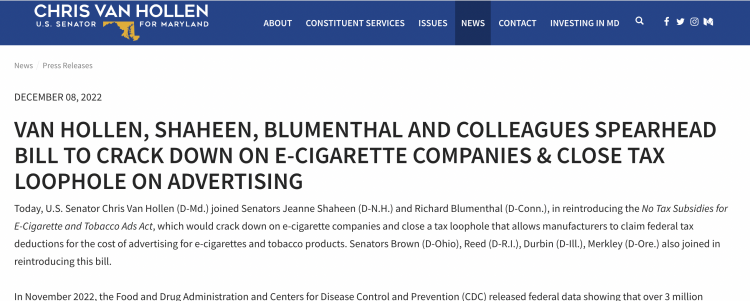
US Senators Chris Van Hollen (D-Md.), Jeanne Shaheen (D-N.H.), and Richard Blumenthal (D-Conn.) have reintroduced a bill aimed at eliminating tax credits for electronic cigarette and tobacco advertisements. The bill would target e-cigarette companies and close tax loopholes that allow manufacturers to claim federal tax breaks for advertising e-cigarettes and tobacco products. Senators Brown (D-Ohio), Reed (D-R.I.), Durbin (D-Ill.), and Merkley (D-Ore.) have also joined in reintroducing the bill. Federal data from November 2022, released by the FDA and the CDC, showed that more than three million middle and high school students used tobacco products in the past 30 days. More than 2.5 million middle and high school students, or over a quarter, used e-cigarettes daily. This is because the number of teenage e-cigarette users increased 1,800% from 2011 to 2019. More than 30% of teenagers who start using e-cigarettes switch to traditional tobacco products within six months. Currently, more than a quarter of teenage e-cigarette users use the product daily, with over 85% using fruit-flavored e-cigarettes. Among surveyed students who use social media, 73.5% have seen e-cigarette-related content. While federal law bans television and radio advertising for traditional tobacco products and the 1998 Tobacco Master Settlement Agreement limits some other forms of cigarette advertising, these restrictions do not apply to e-cigarettes. Although some television networks have started pulling e-cigarette ads from the air in response to the ongoing youth e-cigarette crisis, other networks continue to air them. To ensure e-cigarettes are treated equally to traditional tobacco, the Shaheen and Blumenthal bill also prohibits tax credits for advertising costs related to tobacco cigarettes, cigars, snuff, chewing tobacco, pipe tobacco, and roll-your-own tobacco.
2FIRSTS will continue to provide coverage on this topic, with future updates available on the '2FIRSTSAPP'. Scan the QR code below to download the app.
Disclaimer
This article is provided solely for professional research, industry discussion, and informational purposes. Any references to brands, companies, products, technologies, or policies are made for factual reporting and analytical purposes only, and do not constitute endorsement, recommendation, promotion, or advertising by 2Firsts.
Nicotine-containing products, including but not limited to cigarettes, e-cigarettes, heated tobacco products, and nicotine pouches, carry significant health risks. Readers are responsible for complying with all applicable laws and regulations in their respective jurisdictions, including age restrictions and access limitations.
The information contained in this article should not be regarded as investment, legal, medical, regulatory, or commercial advice. While 2Firsts strives to ensure the accuracy and reliability of its content, it does not assume liability for any direct or indirect loss arising from errors, omissions, inaccuracies, or reliance on the information contained herein.
This article is not intended for individuals below the legal age for accessing tobacco or nicotine-related information in their jurisdiction.
Copyright Notice
This article is either original content produced by 2Firsts or content reproduced, translated, summarized, or adapted from third-party sources with attribution where applicable. The intellectual property rights of the original content remain with 2Firsts or the respective original rights holders.
No individual or organization may copy, reproduce, distribute, republish, modify, translate, or otherwise use this content without prior authorization. Any unauthorized use may result in legal action.
For copyright-related inquiries, corrections, or removal requests, please contact: info@2firsts.com.
AI-Assisted Translation and Editing Notice
Portions of this article may have been translated, edited, or reviewed with the assistance of artificial intelligence tools to improve efficiency and readability. Due to the limitations of AI-assisted translation and editing, discrepancies, omissions, or inaccuracies may exist when compared with the original source.
Where applicable, readers are advised to refer to the original source for the most complete and accurate information. If you identify any errors or believe that any content infringes upon your rights, please contact us at info@2firsts.com, and we will review and address the matter promptly.