Vietnamese Police Seize 2219 Illegally-Sourced E-cigarette Products

Regulations by 2FIRSTS.ai
Jan.08.2024
Vietnamese Police Seize 2219 Illegally-Sourced E-cigarette Products
Vietnamese police seize over 2,200 unidentified e-cigarette and e-liquid products in a surprise inspection in Lang Son City.

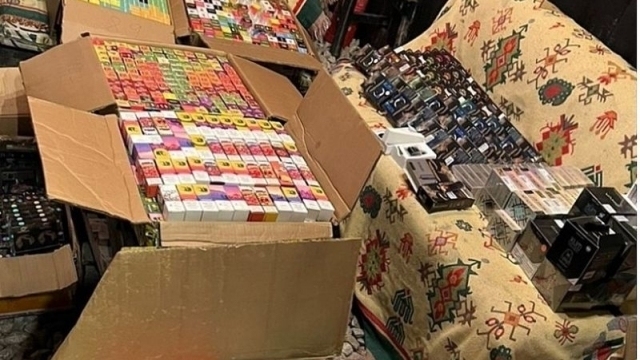
According to the local Vietnamese media outlet thuonghieucongluan, on January 5th, the police in Lang Son City, Vietnam, seized 2219 unidentified e-cigarette and e-cigarette liquid products during a surprise inspection operation.


The police in Luoshan City recently conducted surprise inspections on shops located within its jurisdiction. During the inspection process, law enforcement agencies discovered a significant quantity of e-cigarettes and e-liquid being sold at the inspected premises, including 755 bottles of e-cigarette e-liquid, 870 e-cigarette heads, and 594 pod systems in various colors. In total, 2219 pieces of e-cigarette products were found.


During the inspection, the shop owner was unable to provide invoices and documents proving the origin of all the goods. They claimed to have easily purchased these items on social media platforms in order to resell them for profit.


In response, law enforcement authorities have documented and temporarily detained all non-compliant products, in order to initiate an investigation and proceed with legal proceedings as prescribed by the law.


We welcome news tips, article submissions, interview requests, or comments on this piece.

Please contact us at info@2firsts.com, or reach out to Alan Zhao, CEO of 2Firsts, on LinkedIn


Notice

1.  This article is intended solely for professional research purposes related to industry, technology, and policy. Any references to brands or products are made purely for objective description and do not constitute any form of endorsement, recommendation, or promotion by 2Firsts.

2.  The use of nicotine-containing products — including, but not limited to, cigarettes, e-cigarettes, nicotine pouchand heated tobacco products — carries significant health risks. Users are responsible for complying with all applicable laws and regulations in their respective jurisdictions.

3.  This article is not intended to serve as the basis for any investment decisions or financial advice. 2Firsts assumes no direct or indirect liability for any inaccuracies or errors in the content.

4.  Access to this article is strictly prohibited for individuals below the legal age in their jurisdiction.


Copyright


This article is either an original work created by 2Firsts or a reproduction from third-party sources with proper attribution. All copyrights and usage rights belong to 2Firsts or the original content provider. Unauthorized reproduction, distribution, or any other form of unauthorized use by any individual or organization is strictly prohibited. Violators will be held legally accountable.

For copyright-related inquiries, please contact: info@2firsts.com


AI Assistance Disclaimer


This article may have been enhanced using AI tools to improve translation and editorial efficiency. However, due to technical limitations, inaccuracies may occur. Readers are encouraged to refer to the cited sources for the most accurate information.

We welcome any corrections or feedback. Please contact us at: info@2firsts.com

Bringing Tax and Insurance Into Nicotine Regulation: Insights From a Tobacco Harm-Reduction Report
A smoke-free nicotine policy report argues that tobacco harm reduction should move beyond product bans and health warnings into tax policy, insurance pricing and risk-based regulation. While some projections remain open to debate, the report highlights a wider challenge: nicotine products, technologies and consumer behavior have changed sharply over the past decade, and regulatory systems may need new tools to better align tobacco control with harm-reduction goals.
Jun.08
Global Tobacco Control Faces Regional Adaptation Test as Nicotine Markets Evolve, Asian Specialist Says
As e-cigarettes, heated tobacco products and nicotine pouches expand across global markets, a central question is gaining urgency: can tobacco control rely on a universal policy model? In an interview with 2Firsts, Asian public health and addiction medicine specialist Dr. Rashidi Mohamed bin Pakri Mohamed says Western experience remains relevant, but policies must be adapted to local culture, healthcare systems, enforcement capacity, illicit markets and clinical evidence.
Jul.08
One Nation Proposes 50% Tobacco Excise Cut as Australia’s Illicit Market Expands
Australian One Nation leader Pauline Hanson has proposed cutting tobacco excise by 50% and freezing indexation until June 30, 2028, in a bid to lower legal cigarette prices and reduce the price advantage of the illicit tobacco market.
Jun.18
South Korea’s Cigarette Smoking Rate Falls to 17.9%, E-Cigarette Use Continues to Rise
Data released by the Korea Disease Control and Prevention Agency (KDCA) showed South Korea’s conventional cigarette smoking rate fell to 17.9% in 2025, while heated tobacco and liquid e-cigarette use continued to rise, particularly among young adults and women.
Jun.01
2Firsts Interview | InterTabac 2026 Adapts to a More Complex Tobacco and Nicotine Market
As InterTabac 2026 approaches, Sabine Loos, Managing Director of Westfalenhallen Unternehmensgruppe, tells 2Firsts that global tobacco trade fairs are evolving beyond product display. With new nicotine categories, shifting regulation and more complex supply chains reshaping the industry, InterTabac is positioning itself as a platform for market insight, regulatory discussion and global business connection.
Special Report
Jul.02
South Korea Rejects 16 Trillion Won Tax-Evasion Claim Over Chinese Synthetic Nicotine
The South Korean government rejected allegations that Chinese synthetic-nicotine e-liquids were linked to about 16 trillion won in tobacco tax evasion, saying China does not ban synthetic nicotine exports and the estimate is difficult to verify, while acknowledging that pre-law synthetic-nicotine inventory is effectively difficult to tax.
Market
Jun.25