By Alan Zhao
Co-founder & CEO, 2Firsts
This article reflects the author’s personal views only.
Key Points
● China’s State Council–level crackdown signals a rare shift to intensified, full-chain enforcement against illicit tobacco and vaping.
● Multi-agency coordination and closer links to criminal justice are set to significantly raise compliance risks.
● As the core hub of the global novel tobacco supply chain, China’s enforcement actions will ripple across international markets.
● Stronger enforcement in China may curb illicit trade at the source and support deeper international cooperation.
● Compliance is emerging as a decisive factor shaping industry outcomes heading into 2026.
On December 18, 2025, China’s State Council General Office issued the Opinion on Cracking Down on Tobacco-Related Illegal Activities Across the Entire Chain. The document can be seen as the formal implementation plan following policy directions set out earlier this month.
On December 5, Chinese Premier Li Qiang chaired a State Council executive meeting, during which he explicitly called for a full-chain crackdown on illicit tobacco-related activities. The meeting and its key messages were subsequently broadcast by Xinwen Lianbo, China’s most authoritative national television news program.
Viewed through the lens of China’s administrative system, this sequence of actions carries clear significance. It represents not merely a departmental enforcement initiative, but a coordinated and explicit statement at the highest level of the Chinese central government regarding illicit tobacco and novel tobacco products. Such a high-level and clearly articulated enforcement signal has been relatively uncommon in past regulatory practice.
It is therefore reasonable to expect that China is entering a phase of intensified regulation and concentrated enforcement targeting illicit tobacco and vaping-related activities.
I. Immediate Implications of the Enforcement Action
1. A Significant Escalation in Enforcement Intensity
The campaign is being coordinated at the State Council level, with enforcement resources and scope that go well beyond previous actions led by individual regulatory agencies.
In addition to the State Tobacco Monopoly Administration, enforcement may involve public security authorities, customs, market regulators, and postal services. The Opinion explicitly states that:
“All regions and relevant departments must attach great importance to cracking down on tobacco-related illegal activities and fully fulfill their territorial and regulatory responsibilities.”
This language underscores an institutional push for stronger inter-agency coordination and clearer accountability at the local level, aimed at improving consistency and effectiveness in enforcement.
The Opinion also calls for “strengthening the linkage between tobacco administrative enforcement and criminal justice.” As a result, certain violations may no longer be addressed solely through administrative penalties but could be transferred to judicial authorities in accordance with the law, significantly raising compliance risks.
2. Concentrated Handling of Major and Representative Cases
In China’s regulatory practice, high-level enforcement directives are often followed by several months of focused enforcement activity, accompanied by the investigation and public disclosure of representative cases to establish deterrence.
With an emphasis on “full-chain enforcement,” the current campaign is expected to cover multiple stages of the supply chain, including raw materials, manufacturing, warehousing, logistics, and sales. Relevant authorities are therefore likely to investigate and publicly disclose a number of high-profile cases in the coming months.
3. Stronger International Enforcement Cooperation
Notably, the Opinion opens with a call to “intensify efforts to combat overseas manufacturing of counterfeit tobacco products and their smuggling into China.” This signals that cross-border illicit trade in tobacco and vaping products will be a key enforcement focus.
Against this backdrop, further strengthening of enforcement communication and cooperation between China and other countries has a solid practical basis.
II. Global Implications: Far Beyond China
China’s intensified enforcement at the end of 2025 may be seen as an early signal ahead of a pivotal period in global tobacco and novel tobacco regulation in 2026.
While many countries advanced tobacco and vaping legislation throughout 2025, 2026 is widely viewed as a critical year—whether in the United States with PMTA enforcement, or in Europe with the evolution of TPD 3.0.
As the world’s largest tobacco manufacturing base, a major consumer market, and the central hub of the global vaping supply chain, China’s enforcement posture will inevitably have far-reaching international consequences.
1. Addressing Illicit Trade at Its Source
The enforcement campaign is expected to directly impact:
- Unlicensed e-cigarette and nicotine pouch manufacturers
- Producers of counterfeit or substandard products
- Manufacturers of non-compliant products
- Logistics and distribution channels facilitating illicit trade
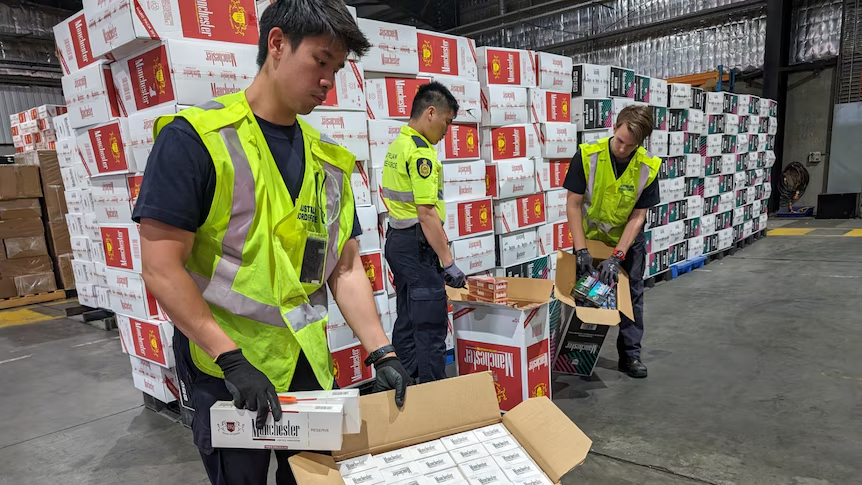
2Firsts has previously reported cases in which Chinese customs authorities seized counterfeit nicotine pouch products bearing well-known international brands. Similar conduct is likely to face closer scrutiny, with certain cases potentially handled through judicial channels.
From a global perspective, this represents a positive step in curbing illicit trade in novel tobacco products at the source.
2. Strengthening International Cooperation Against Illicit Trade
Illicit tobacco and vaping trade is increasingly characterized by cross-border regulatory arbitrage, exploiting inconsistencies in national regulatory frameworks and information asymmetries.
This challenge cannot be effectively addressed by any single country acting alone.
As previously written by 2Firsts co-founder Echo Guo:
"Addressing illicit vape trade cannot be achieved by any one party acting alone. Instead, it requires stronger international cooperation—including between China and the United States—particularly in areas such as information sharing, coordinated enforcement, and regulatory alignment, to narrow opportunities for regulatory arbitrage and improve the overall effectiveness of cross-border oversight."
China’s enforcement push provides a practical foundation for advancing such cooperation.
3. Supply Chain Upgrading and Global Restructuring
The campaign will further compress the space available to illicit and gray-market vaping supply chains in China, accelerating industry consolidation.
This may produce dual effects. On one hand, non-compliant operators will be forced out, while compliant enterprises gain greater room for development and supply chain integration accelerates. On the other hand, some high-risk operators may relocate production abroad, contributing to the further internationalization of the global vaping supply chain.
At the same time, there is a risk that illicit manufacturers may shift operations to jurisdictions with weaker regulatory capacity, increasing enforcement challenges and further complicating global illicit trade dynamics.
III. Implications for Industry and Regulators
The impact of this enforcement campaign extends beyond the purification of China’s domestic tobacco market and the protection of state interests and consumer safety. For the global market, its effects are set to be both profound and long-lasting.
For regulators worldwide, strengthening communication and cooperation with the Chinese government and relevant regulatory authorities will be increasingly important. Measures such as information sharing, intelligence exchange, and coordinated enforcement can play a critical role in addressing cross-border illicit trade in tobacco and novel tobacco products, thereby improving the overall effectiveness of global regulatory oversight.
For international brands and traders, close attention to developments within China’s supply chain is essential. Companies should promptly engage with their manufacturers and partners to verify compliance status and prevent upstream regulatory risks from cascading downstream. In supplier selection, procurement models that have historically prioritized cost efficiency will need to evolve, with compliance becoming a non-negotiable prerequisite for building safer and more sustainable supply chains.
For Chinese supply chain enterprises, an immediate reassessment of compliance is necessary. Companies facing potential compliance uncertainties should adopt risk-control measures without delay and proactively communicate with relevant regulators. Continuing to rely on legacy gray-market practices may expose firms to heightened risks during periods of concentrated enforcement.
Looking Ahead to 2026
The year 2026 will present the global novel tobacco industry with both significant opportunities and substantial regulatory risks. Compliance, however, remains one of the most tangible and realistic dividends available to the industry.
From this point forward, regulatory adjustments, enforcement actions, and the resulting market restructuring across key jurisdictions—including China, the United States, Europe, Russia, and India—are likely to unfold in parallel.
These developments represent not only a challenge, but a fundamental reshaping of the global industry landscape.
2026 will not be business as usual.
相关文章: