England's 'smoke-free' goal at risk of delay until 2039, Cancer Research UK urges legislative action

Nov.04.2024
England's 'smoke-free' goal at risk of delay until 2039, Cancer Research UK urges legislative action
England's "smoke-free" goal may be postponed until 2039, leading Cancer Research UK (CRUK) to urge the government to expedite the Tobacco and Vapes Bill for faster smoking control.

An analysis has found that England may not achieve its "smoke-free" goal until 2039, as reported by The Guardian on November 4.


In 2019, the UK government announced a target for the country to become "smoke-free" by 2030, meaning that the proportion of smoking adults would not exceed 5%. However, according to the latest analysis by Cancer Research UK (CRUK), even with a continued decline in smoking rates over the next few years, the timeline for reaching this "smoke-free" goal will still be pushed back to 2039.


Currently, about 6 million adults in the UK smoke, the lowest percentage in history, having dropped from 20.2% in 2011 to 11.9%. In England, the smoking rate is 11.6% (approximately 4.9 million), while Scotland has the highest rate at 13.5%. 


Although the overall number of smokers is expected to continue declining, CRUK's projections indicate that this trend will not sufficiently reduce the so-called "poverty gap." For example, the wealthiest 10% of the population is expected to reach the 5% smoking rate target by 2025, while the poorest 10% may not come close to this level until 2050.


Even if the "smoke-free" goal is achieved by 2039, the number of tobacco users in the poorest groups will still be nearly four times that of the wealthiest. It is estimated that about 459,000 people in the poorest areas will still be smoking, compared to around 119,000 in the wealthiest regions.


CRUK's CEO, Michelle Mitchell, urged the government to promptly publish the long-promised Tobacco and Vapes Bill. "About 160 people in the UK are diagnosed with cancer each day due to smoking, and the government must prioritize national health by implementing the Tobacco and Vapes Bill as soon as possible," She said. "Any further delays could hinder the progress toward a smoke-free future."


We welcome news tips, article submissions, interview requests, or comments on this piece.

Please contact us at info@2firsts.com, or reach out to Alan Zhao, CEO of 2Firsts, on LinkedIn


Notice

1.  This article is intended solely for professional research purposes related to industry, technology, and policy. Any references to brands or products are made purely for objective description and do not constitute any form of endorsement, recommendation, or promotion by 2Firsts.

2.  The use of nicotine-containing products — including, but not limited to, cigarettes, e-cigarettes, nicotine pouchand heated tobacco products — carries significant health risks. Users are responsible for complying with all applicable laws and regulations in their respective jurisdictions.

3.  This article is not intended to serve as the basis for any investment decisions or financial advice. 2Firsts assumes no direct or indirect liability for any inaccuracies or errors in the content.

4.  Access to this article is strictly prohibited for individuals below the legal age in their jurisdiction.


Copyright


This article is either an original work created by 2Firsts or a reproduction from third-party sources with proper attribution. All copyrights and usage rights belong to 2Firsts or the original content provider. Unauthorized reproduction, distribution, or any other form of unauthorized use by any individual or organization is strictly prohibited. Violators will be held legally accountable.

For copyright-related inquiries, please contact: info@2firsts.com


AI Assistance Disclaimer


This article may have been enhanced using AI tools to improve translation and editorial efficiency. However, due to technical limitations, inaccuracies may occur. Readers are encouraged to refer to the cited sources for the most accurate information.

We welcome any corrections or feedback. Please contact us at: info@2firsts.com

Spain Cigarette Volumes Fall 5.2% in August, BAT Drops 14.5%, JTI Gains Share; France Down 8.3% on Adjusted Basis
Spain's cigarette volumes declined 5.2% year over year in August 2026, according to government data cited by UBS and reported by Investing.com on October 7. British American Tobacco's volumes fell 14.5%, followed by Imperial Brands at 8.8%, Philip Morris International at 6.6% and Japan Tobacco at 4.6%. JTI was the only one of the four companies to gain cigarette market share, rising six basis points to 26.7%. In France, official customs data showed an unadjusted 3.7% decline in cigarette deliveries. Adjusting for the difference in delivery days produces a decline of approximately 8.3%, consistent with the UBS figure. The bank also estimated the earnings exposure of major tobacco companies to both markets.
Market
Oct.13
UK ONS Data: Vaping Rate Among Women Aged 25–34 Reaches 18.3%, Compared With 14.4% for Men
The vaping rate among women aged 25 to 34 in Great Britain reached 18.3% in 2025, up from 13.7% in 2024 and 8.3% in 2020, according to data from the Office for National Statistics (ONS). The figure was the highest for this group since records began in 2014 and exceeded the 14.4% recorded among men of the same age. Adults aged 25 to 34 also overtook those aged 16 to 24 as the age group with the highest vaping prevalence. Overall, about 5.4 million adults in Great Britain used e-cigarettes in 2025, broadly unchanged from the previous year.
DATA
Oct.13
NAS 2026 | Former FDA Tobacco Chief Mitch Zeller Calls for Shift From “End Game” to “End State”
At the 2026 New Approaches Summit in New York, former FDA Center for Tobacco Products Director Mitch Zeller called for the tobacco harm reduction debate to shift from the traditional “end game” toward defining a desired “end state.” He also highlighted unresolved concerns around dual use, argued that biomarkers of exposure may be more meaningful than cigarettes-per-day in assessing risk reduction, and said nicotine misperceptions remain a major barrier to public health progress.
Sep.25
Latest UK ONS Data: Vaping Rate Edges Down to 9.9% in 2025, a Year After Overtaking Cigarette Smoking
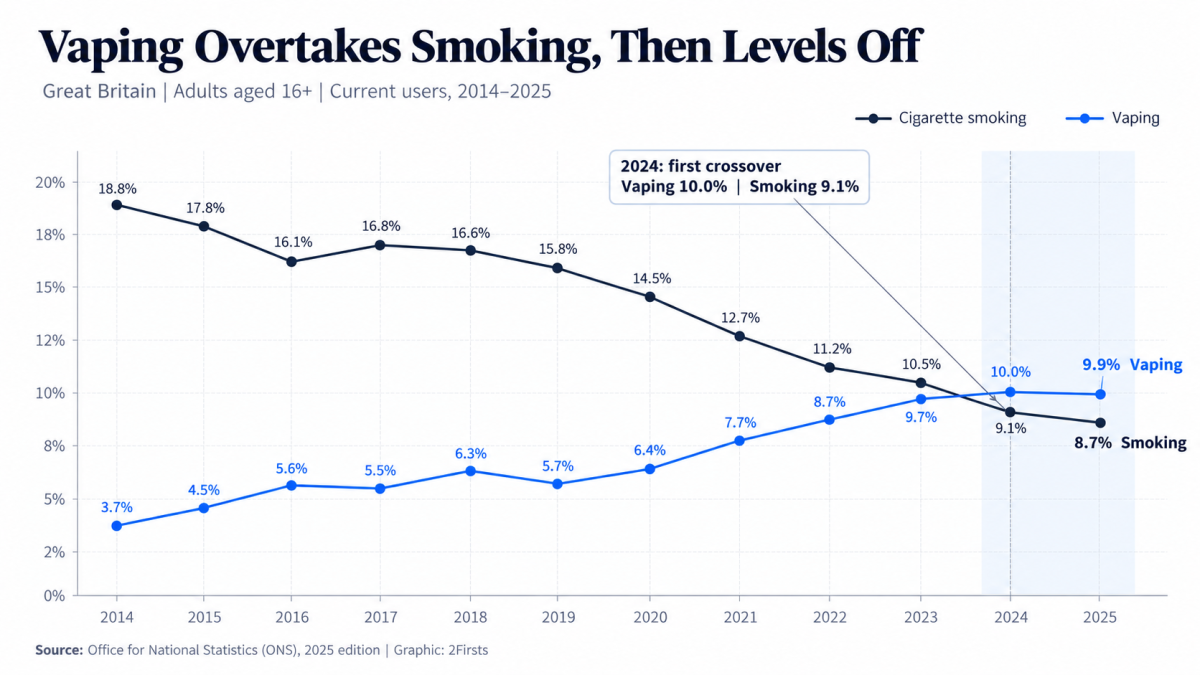
Vaping prevalence in Great Britain edged down to 9.9% in 2025 from 10.0% in 2024, with the number of adult users holding at approximately 5.4 million for a second consecutive year, according to the Office for National Statistics (ONS). E-cigarette use had risen from 6.4% in 2020 to 10.0% in 2024, when it exceeded cigarette smoking prevalence for the first time. Cigarette smoking continued to decline to 8.7% in 2025, widening the gap to 1.2 percentage points. Daily vaping declined slightly, while usage among adults aged 25–34 increased despite falling rates in other age groups.
DATA
Oct.14
EU Commission Clarifies Vaping, Smokeless Nicotine Use in Proposed Cardiovascular Checks
The European Commission has clarified to 2Firsts that its proposed cardiovascular health checks would assess smoking, vaping and the use of smokeless nicotine products as part of patients’ medical histories. The Commission also said Member States may organise additional checks within their healthcare systems. In the same response, it pointed to JRC research on e-cigarettes, heated tobacco products and nicotine pouches that has fed into the evaluation of EU tobacco legislation.
Nov.09
India Duty-Free Nicotine Pouch Sales Face Regulatory Test as ZYN, FOX Classification Remains Open
The Bombay High Court has ruled that airport duty-free shops are not exempt from India's domestic regulatory laws merely because they operate beyond the customs barrier, leaving in place a sales halt covering ZYN and FOX nicotine pouches at Mumbai's international airport. The court, however, did not determine that the products necessarily qualify as "drugs" under India's Drugs and Cosmetics Act. The retailers have four weeks to submit product information to the appropriate authorities, including CDSCO, which must complete its review within 30 days of receiving the submissions.
Sep.24