PMI Q3: Smokeless products account for 38% of net sales, says The Times

Oct.28.2024
PMI Q3: Smokeless products account for 38% of net sales, says The Times
PMI's third-quarter financial report revealed $9.91 billion in revenue, up 8.4% year-on-year, with smoke-free products driving growth.

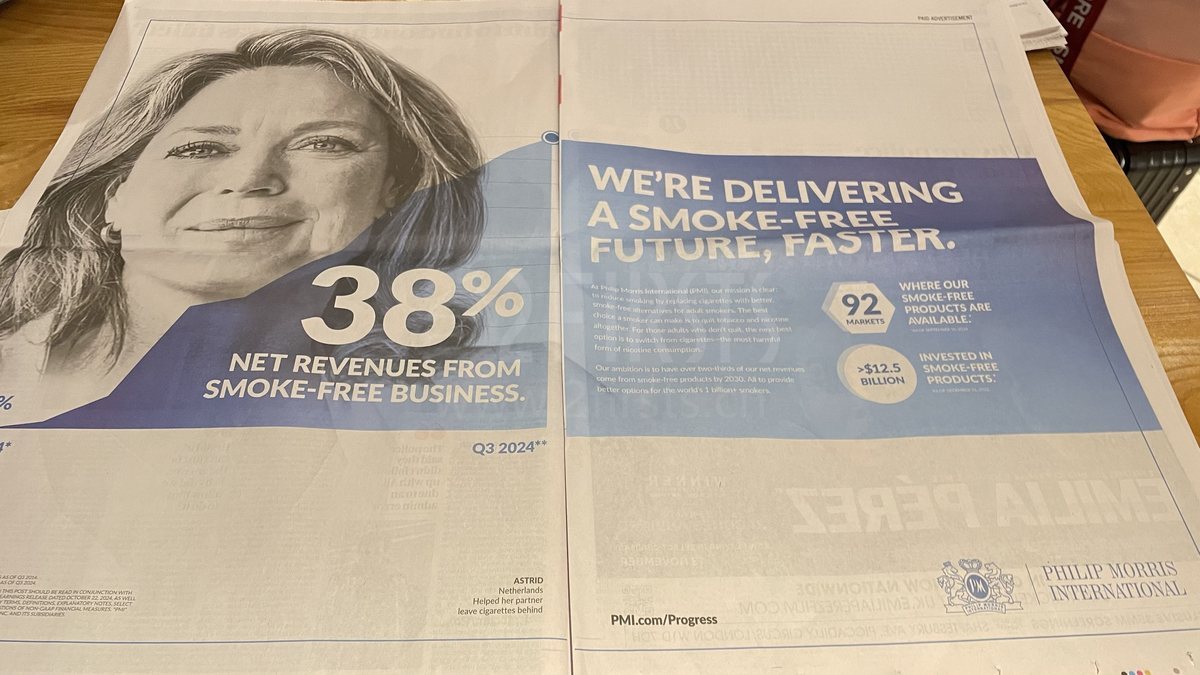
On October 27th, 2Firsts noticed that the British newspaper "The Times" published an advertisement for the third quarter financial report of Philip Morris International (PMI).


PMI Q3: Smokeless products account for 38% of net sales, says The Times
The PMI financial report published in The Times | Image source: 2Firsts


Previously, PMI released its financial report for the third quarter of 2024 on October 22. The report showed that the third quarter revenue was $9.91 billion, an increase of 8.4% year-over-year. In this quarter, the smoke-free business accounted for 38% of PMI's total net income and 40% of gross profit, increasing by 1.9% and 2.2% compared to the third quarter of last year, respectively. The quarterly shipments of smoke-free products reached nearly 40 billion units in 92 markets globally, with a total of 36.5 million users.


We welcome news tips, article submissions, interview requests, or comments on this piece.

Please contact us at info@2firsts.com, or reach out to Alan Zhao, CEO of 2Firsts, on LinkedIn


Notice

1.  This article is intended solely for professional research purposes related to industry, technology, and policy. Any references to brands or products are made purely for objective description and do not constitute any form of endorsement, recommendation, or promotion by 2Firsts.

2.  The use of nicotine-containing products — including, but not limited to, cigarettes, e-cigarettes, nicotine pouchand heated tobacco products — carries significant health risks. Users are responsible for complying with all applicable laws and regulations in their respective jurisdictions.

3.  This article is not intended to serve as the basis for any investment decisions or financial advice. 2Firsts assumes no direct or indirect liability for any inaccuracies or errors in the content.

4.  Access to this article is strictly prohibited for individuals below the legal age in their jurisdiction.


Copyright


This article is either an original work created by 2Firsts or a reproduction from third-party sources with proper attribution. All copyrights and usage rights belong to 2Firsts or the original content provider. Unauthorized reproduction, distribution, or any other form of unauthorized use by any individual or organization is strictly prohibited. Violators will be held legally accountable.

For copyright-related inquiries, please contact: info@2firsts.com


AI Assistance Disclaimer


This article may have been enhanced using AI tools to improve translation and editorial efficiency. However, due to technical limitations, inaccuracies may occur. Readers are encouraged to refer to the cited sources for the most accurate information.

We welcome any corrections or feedback. Please contact us at: info@2firsts.com

Ireland Vape Bill Passes Dáil, Setting Limits on Flavours, Packaging and Retail Display
Ireland’s Public Health (Tobacco Products and Nicotine Inhaling Products) (Amendment) Bill 2026 has passed final stage in the Dáil and will move to the Seanad, with measures to limit vape flavours to tobacco or unflavoured products and tighten rules on packaging colours, retail advertising, in-store displays and sales of nicotine pouches to minors.
News
Jun.26 by 2Firsts Perspectives
Global Tobacco Control Faces Regional Adaptation Test as Nicotine Markets Evolve, Asian Specialist Says
As e-cigarettes, heated tobacco products and nicotine pouches expand across global markets, a central question is gaining urgency: can tobacco control rely on a universal policy model? In an interview with 2Firsts, Asian public health and addiction medicine specialist Dr. Rashidi Mohamed bin Pakri Mohamed says Western experience remains relevant, but policies must be adapted to local culture, healthcare systems, enforcement capacity, illicit markets and clinical evidence.
Jul.08
Haypp Report: Women Emerge as a Key Growth Driver in the UK Nicotine Pouch Market
According to Haypp’s 2026 UK Nicotine Report, women are a key growth driver in the UK nicotine pouch market. Overall sales for Haypp and Northerner rose 60% year‑on‑year in 2025, but purchases by women surged 202%, versus 25% for men. Women’s share of consumers jumped from 22% to 40%. The report attributes this to discretion, perceived health benefits, and more gender‑neutral product positioning, suggesting future growth will come from a broader range of adult nicotine users.
Jul.01
BAT Restructuring to Affect 9,000 Roles as Tobacco Group Pushes Cost Cuts and AI
British American Tobacco (BAT) plans to cut about 5,500 jobs globally and shift around 3,500 roles to strategic partners by the end of 2026, affecting about 9,000 roles in total, as the company seeks to simplify operations, strengthen technology capabilities and deliver £600 million in annual savings by 2028.
BAT
Jun.29
U.S. Convenience Stores Rebalance Backbar as Nicotine Pouches Outpace Cigarettes
As cigarette volumes continue to decline, U.S. convenience-store operators are reconfiguring backbar space to accommodate modern oral nicotine products such as nicotine pouches. Industry data show nicotine pouches have become one of the fastest-growing nicotine categories while generating higher margins for retailers.
Jun.12
Special Report | China’s Tobacco Tax Debate Shifts Toward Tax Design as Policy Trade-offs Come Into Focus
China’s tobacco tax debate is moving from whether to raise prices to how the tax system should be designed. At a Beijing forum on World No Tobacco Day, experts discussed higher specific excise taxes, minimum tax burdens and dynamic adjustments linked to income and inflation. The issue also connects to China’s broader consumption tax reform, health financing and chronic disease costs. Public reports did not mention e-cigarettes, heated tobacco, nicotine pouches or other new nicotine products.
Jun.11