Evgeny Nikolsky Appointed as JTI Romania, Moldova, Bulgaria GM

News by 2FIRSTS.ai
Feb.22.2024
Evgeny Nikolsky Appointed as JTI Romania, Moldova, Bulgaria GM
Evgeny Nikolsky appointed as new general manager of JTI in Romania, Moldova, and Bulgaria, following successful career progression.

Recently, according to a statement released by Japan Tobacco International (JTI), Evgeny Nikolsky has been appointed as the new General Manager of JTI in Romania, Moldova, and Bulgaria.


Nikolsky joined JTI in 2001 and has since advanced his career and professional skills in brand and trade marketing. In 2009, he became the country sales director. In 2014, he managed city distributors in Russia before becoming the sales director for JTI Russia. In 2016, he returned to Kazakhstan and since 2018, he has also been coordinating JTI's activities in Central Asia and Mongolia.


Niculescu expressed his excitement for the appointment, stating, "I am pleased to have the opportunity to live and work in Romania. JTI has been operating in this country for 30 years, holding over 28% market share and introducing the e-cigarette product Logic Compact in recent years.


Former CEO Mark Rock will continue to lead JTI Germany.


We welcome news tips, article submissions, interview requests, or comments on this piece.

Please contact us at info@2firsts.com, or reach out to Alan Zhao, CEO of 2Firsts, on LinkedIn


Notice

1.  This article is intended solely for professional research purposes related to industry, technology, and policy. Any references to brands or products are made purely for objective description and do not constitute any form of endorsement, recommendation, or promotion by 2Firsts.

2.  The use of nicotine-containing products — including, but not limited to, cigarettes, e-cigarettes, nicotine pouchand heated tobacco products — carries significant health risks. Users are responsible for complying with all applicable laws and regulations in their respective jurisdictions.

3.  This article is not intended to serve as the basis for any investment decisions or financial advice. 2Firsts assumes no direct or indirect liability for any inaccuracies or errors in the content.

4.  Access to this article is strictly prohibited for individuals below the legal age in their jurisdiction.


Copyright


This article is either an original work created by 2Firsts or a reproduction from third-party sources with proper attribution. All copyrights and usage rights belong to 2Firsts or the original content provider. Unauthorized reproduction, distribution, or any other form of unauthorized use by any individual or organization is strictly prohibited. Violators will be held legally accountable.

For copyright-related inquiries, please contact: info@2firsts.com


AI Assistance Disclaimer


This article may have been enhanced using AI tools to improve translation and editorial efficiency. However, due to technical limitations, inaccuracies may occur. Readers are encouraged to refer to the cited sources for the most accurate information.

We welcome any corrections or feedback. Please contact us at: info@2firsts.com

South Korea Extends Vape Rules to Unmanned Stores After Bringing Synthetic Nicotine Under Tobacco Law
South Korea's Ministry of Gender Equality and Family said on September 14 that it plans to designate unmanned e-cigarette stores as businesses where minors are prohibited from entering or working. Operators would be required to verify customers' ages and display notices restricting access by minors. The proposal is open for public comment through October 6. The move follows an April expansion of South Korea's statutory tobacco definition that brought products made with natural or synthetic nicotine under the Tobacco Business Act. Nicotine-free liquids and products using nicotine analogues such as 6-methylnicotine, however, remain an emerging regulatory issue.
Sep.21
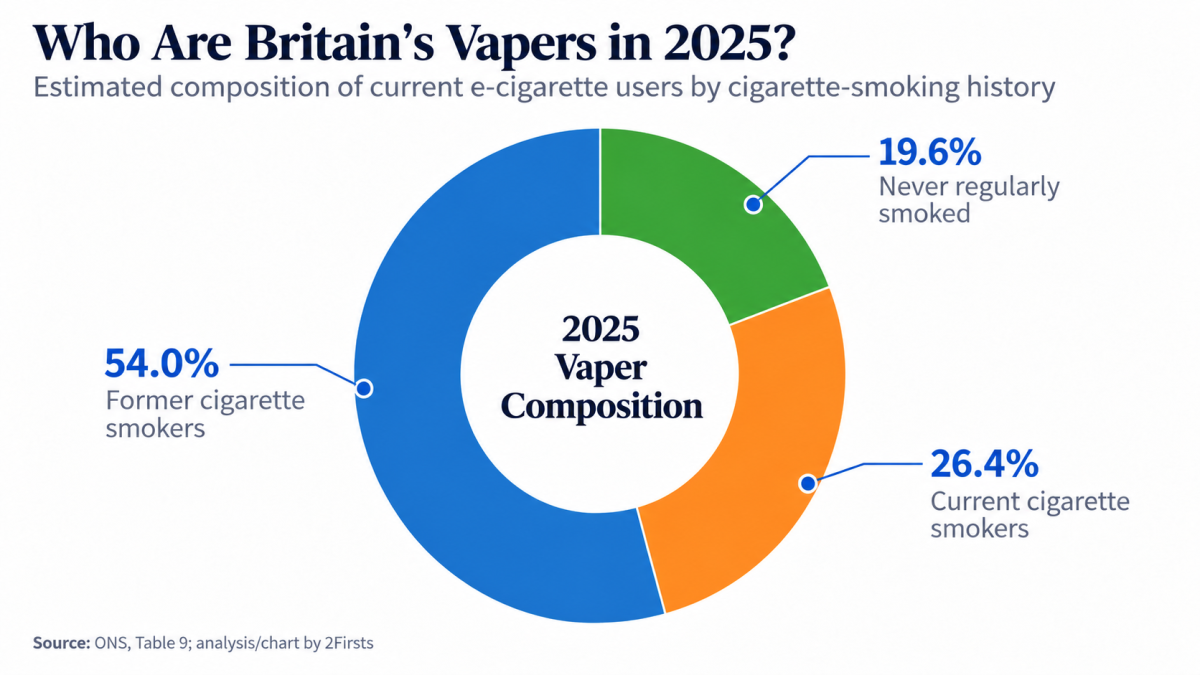
Latest UK ONS Data: 54% of Vapers Are Former Cigarette Smokers, 26% Also Smoke and 20% Never Smoked Regularly
Former cigarette smokers accounted for an estimated 54% of current e-cigarette users in Great Britain in 2025, while 26% also smoked cigarettes and 20% had never regularly smoked, according to a 2Firsts analysis of Office for National Statistics (ONS) data. Among former cigarette smokers who currently vape, approximately 81% used e-cigarettes daily, compared with about 50% of dual users. The ONS found that 33.8% of current cigarette smokers also vaped in 2025, up from 10.6% in 2014. Approximately 1.1 million adults who had never regularly smoked cigarettes used e-cigarettes, representing 2.9% of that population, compared with 0.2% in 2014. The figures highlight differences in the composition, frequency of use and long-term trends across Britain's vaping population.
DATA
Oct.14
Special Report | Vape bans and tougher rules: the South Caucasus takes different paths
Azerbaijan's sweeping e-cigarette ban has raised concerns over enforcement errors and the emergence of illicit sales, while neighboring Armenia is tightening technical rules and preparing higher excise taxes. Georgia, meanwhile, has resisted calls for broader vape restrictions and introduced preferential taxes for some domestically produced cigarettes. The divergent approaches across the South Caucasus highlight a regional policy dilemma: how to curb nicotine use and protect public health without encouraging black markets or creating unintended economic consequences for businesses and consumers.
Nov.03
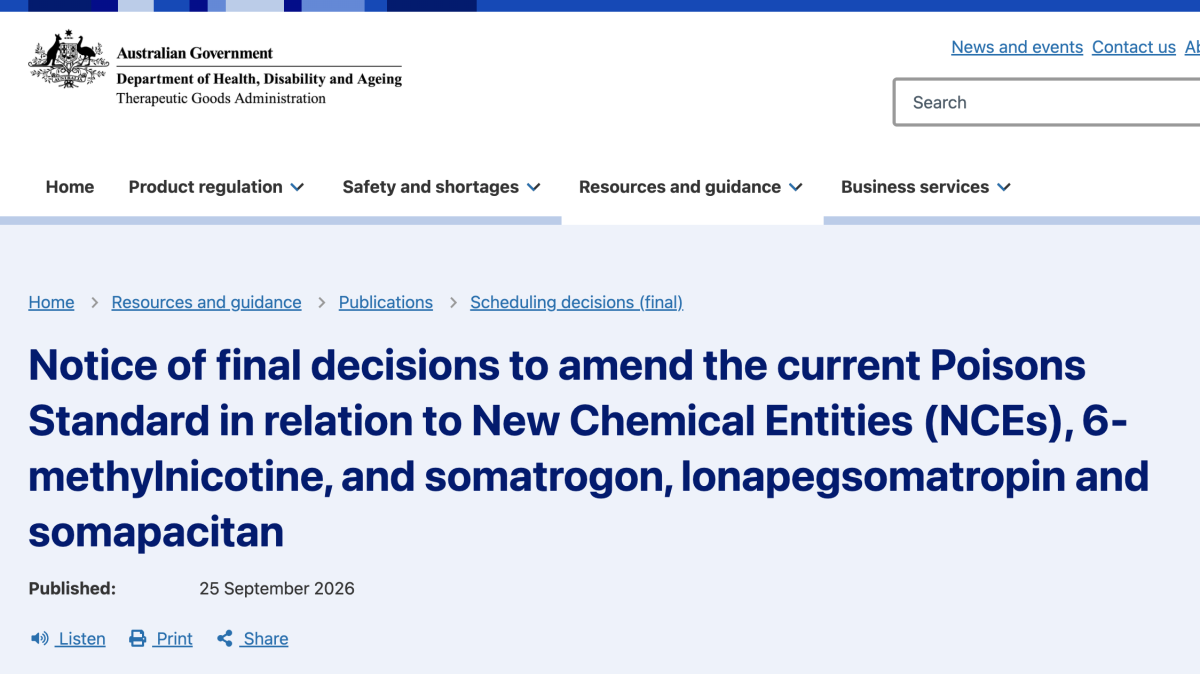
Australia Adds 6-Methylnicotine to Schedule 9 Prohibited Substances, Effective October 1
Australia's Therapeutic Goods Administration published a final decision on September 25 to classify 6-methylnicotine as a Schedule 9 prohibited substance under the Poisons Standard, effective October 1, 2026. TGA said the chemical has been reported in e-cigarette liquids sold in Australia and marketed as nicotine-free or nicotine alternatives, while evidence also indicates its use in preparations such as oral pouches. The government originally proposed a Schedule 7 classification but ultimately adopted the stricter Schedule 9 designation, citing acute toxicity, dependence risk, use in unapproved consumer products and misleading marketing.
News
Sep.29 by 2Firsts Perspectives
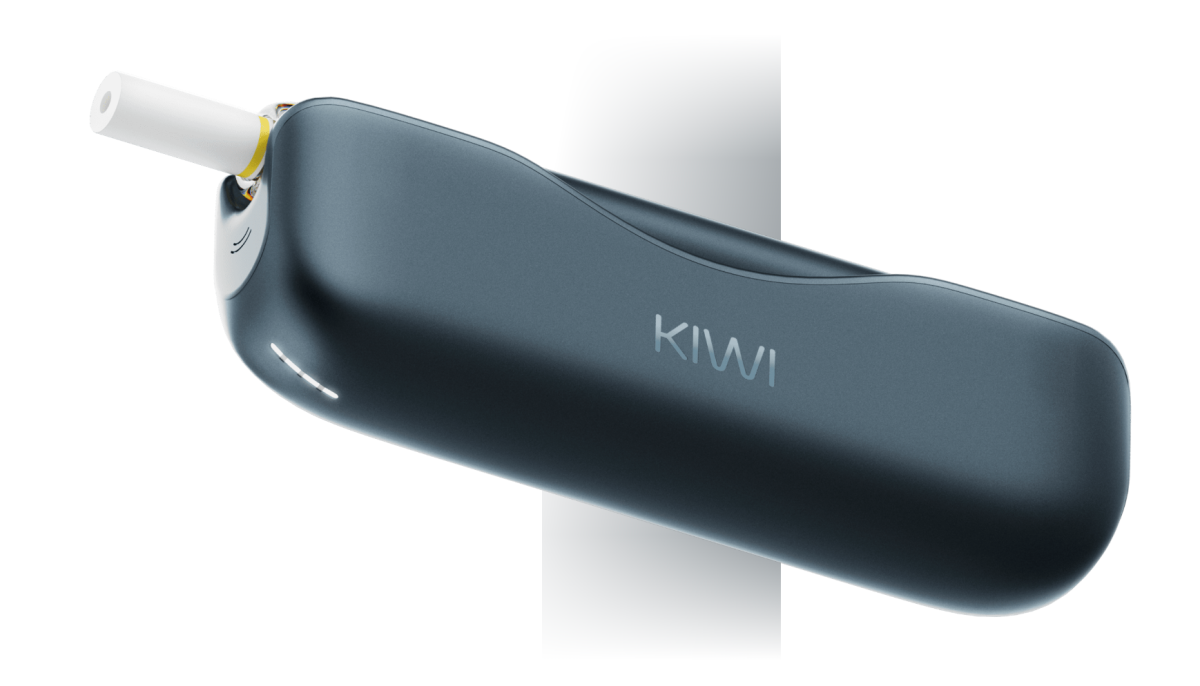
Product | KIWI Launches Spark 2 and Spark 2 Pro in Germany, Two Hardware Tiers Share Backward-Compatible 2ml Pods
KIWI has launched the Spark 2 and Spark 2 Pro refillable pod systems in Germany at official prices of €18 and €29, respectively. Spark 2 uses an 800mAh removable lithium-ion battery in a pen-style body, while Spark 2 Pro features a 1,400mAh removable battery, a box-shaped design and vibration feedback every 20 puffs. Both devices use the same 2ml Spark V2 pods in 0.8Ω and 1.2Ω versions, with AirSync airflow adjustment and a choice between Cotton Tips and conventional Drip Tips. The new pods also remain compatible with the original KIWI Spark.
News
Sep.29 by 2Firsts Perspectives
Smoke-Free Business Hits 42% of Q2 Net Revenue as PMI’s First TNFD Report Covers Single-Use Electronics, Critical Raw Materials and IQOS Repairs
Philip Morris International has published its first report aligned with the Taskforce on Nature-related Financial Disclosures, bringing its electronics supply chain and the use and end-of-life stages of smoke-free devices and consumables into its nature-related assessment. PMI said its smoke-free business accounted for about 42% of total net revenues in the second quarter of 2026. The report says non-circular electronic products, particularly single-use items, can increase consumption of limited natural resources and also details an IQOS repair pilot. A 2040 circularity scenario tests assumptions including a 50% reduction in product waste-related costs, 10% raw-material savings and a 25% substitution rate for refurbished products versus new products.
Sep.23