Key Points
- FDA officials outlined a five-tier carcinogenicity classification system and the calculation of Excess Lifetime Cancer Risk (ELCR) as part of toxicological review under the “Appropriate for the Protection of Public Health” (APPH) standard.
- Tier 1–3 constituents reflect established or probable carcinogens; Tier 4 captures varying levels of experimental evidence, including in vivo findings and positive Ames assay results; Tier 5 constituents, meeting defined negative criteria, are excluded from ELCR calculations.
- ELCR is calculated using daily exposure assumptions and inhalation unit risk (IUR) values, or a Threshold of Toxicological Concern (TTC) of 1.5 μg/day when IUR data are unavailable.
- Cumulative ELCR assumes additive effects among carcinogenic constituents and does not account for potential synergistic or antagonistic interactions.
- FDA officials stated there is no fixed numeric ELCR threshold that determines marketing authorization.
- Small manufacturers requested greater transparency regarding internal dose-response databases and calculation tools, and questioned how ELCR guidance applies to older pending applications.
2Firsts, February 11, 2026
During Panel V of the U.S. Food and Drug Administration’s (FDA) February 10 PMTA roundtable on electronic nicotine delivery systems (ENDS), agency toxicology officials described in detail how carcinogenicity tiering and Excess Lifetime Cancer Risk (ELCR) calculations are used in premarket application review, while industry representatives pressed for clearer benchmarks and greater predictability in the process.

The session, titled “Toxicological Profile,” was moderated by Todd L. Cecil, Ph.D., Deputy Director of Regulatory Management in the FDA’s Office of Science. Presentations were delivered by Hans Rosenfeldt, Ph.D., Director of the Division of Nonclinical Science, and Mary Irwin, Ph.D., Supervisory Pharmacologist. Industry participants included Steven Haddad, J.D.; Willie J. McKinney, Ph.D., D.A.B.T.; Manoj Misra, Ph.D.; and Char Owen.
Toxicology Within the APPH Framework
Rosenfeldt opened by situating toxicological review within the statutory standard of “Appropriate for the Protection of Public Health” (APPH). He stated that toxicological risk is one component of a broader population-level risk-benefit analysis that also considers switching, cessation, abuse liability, and device-related risks.
“Toxicological risk does not in itself determine whether a product is APPH,” he said, noting that the evaluation is conducted alongside other scientific disciplines.
He emphasized that, unlike traditional combustible tobacco products, ENDS are engineered consumer devices whose toxicological profile is heavily influenced by formulation and manufacturing design. This creates variability across products, but also allows manufacturers to reduce risk through material and ingredient choices.
Hazard Identification and the Five-Tier System
Irwin described the agency’s carcinogenicity tiering framework, which classifies constituents into five levels based on weight of evidence.
Tier 1 through Tier 3 include constituents identified by agencies such as EPA or IARC as known or probable carcinogens. Tier 4 captures constituents with experimental evidence suggestive of carcinogenic potential but lacking definitive regulatory classification. Within Tier 4, evidentiary strength varies, including positive in vivo findings, positive Ames assay results, or other in vitro genotoxicity signals. Computational (in silico) predictions may also inform classification, but are evaluated within the broader evidentiary context.
Tier 5 denotes constituents considered unlikely to contribute to carcinogenic risk, based on negative findings across multiple lines of evidence. Tier 5 constituents are excluded from ELCR calculations.
Irwin stated that classification decisions rely on totality-of-evidence assessment and are not determined by a single positive or negative study.
Exposure Assumptions and ELCR Calculation
Following hazard identification, reviewers conduct exposure assessment and calculate ELCR values.
Irwin explained that when applicant-specific heavy-use data are unavailable, toxicologists may apply a default exposure assumption reflecting high-end nicotine consumption. Individual constituent ELCRs are calculated by multiplying estimated daily exposure by an inhalation unit risk (IUR) value. When no adjusted IUR is available, a Threshold of Toxicological Concern (TTC) value of 1.5 micrograms per day is used as a reference point.
Cumulative ELCR represents the sum of individual ELCR values for Tier 1 through Tier 4 carcinogens. The framework assumes additive effects among constituents and does not account for potential synergistic or antagonistic interactions.
Irwin noted that ELCR is an estimate derived from modeling assumptions and toxicological data, and that the robustness of the estimate depends on the strength of hazard identification and exposure information.
She added that cumulative ELCR values may be compared within product categories to provide context for decision-making, but no fixed numeric cutoff was described as determinative for authorization.
“Is There a Standard?”
During the discussion period, industry representatives questioned whether there is a defined risk threshold that applicants must meet.
One participant asked whether specific numeric limits exist for Harmful and Potentially Harmful Constituents (HPHCs), noting that certain aldehydes appear in nearly all ENDS products.
FDA officials responded that there is no predefined ELCR limit or numeric benchmark that automatically satisfies or fails the APPH standard. Instead, toxicological findings are evaluated within the broader population-level assessment of risks and potential benefits.
Officials clarified that comparisons to marketplace categories or reference cigarettes provide contextual risk descriptors but do not function as regulatory “safe harbor” thresholds.
Database Transparency and Modeling Data
Several industry representatives requested greater transparency regarding the dose-response data underlying ELCR modeling. One participant referenced a database of hundreds of carcinogenic chemicals used to inform risk modeling and asked whether those data could be made publicly available to assist manufacturers in product design.
FDA officials responded that elements of the approach are described in publicly available scientific policy memoranda and rely on published inhalation unit risk values and toxicological literature. However, they noted that certain aspects of internal processes and data handling may involve proprietary considerations or procedural constraints.
Officials suggested that industry collaboration through standards organizations could help develop shared toxicological resources.
Application Timing and Retroactivity
Industry representatives also raised concerns about how ELCR-related memoranda apply to older PMTA submissions that remain under review.
FDA officials responded that the ELCR framework reflects established risk assessment principles rather than a newly created methodology. Applications already in process would be evaluated individually, particularly where deficiency letters had previously been issued.
Route of Exposure and Bridging Limitations
Rosenfeldt emphasized that route of administration is central to toxicological interpretation. Oral toxicology findings cannot automatically be extrapolated to inhalation exposure without scientific justification, as inhalation bypasses first-pass metabolism.
He also stated that Ames assay and other in vitro genotoxicity findings are treated as hazard identification tools and are incorporated into risk assessment modeling rather than disregarded.
Product Design and Risk Reduction
Irwin illustrated how product design decisions can materially influence cumulative ELCR outcomes. She described a comparative example in which two products with similar baseline HPHC emission levels yielded markedly different ELCR profiles due to differences in materials and ingredient selection.
In the example, a product using higher-quality materials with fewer hazardous leachables and flavor constituents classified as Tier 5 generated substantially lower cumulative ELCR than a product incorporating lower-grade plastics and Tier 1–4 carcinogenic constituents in flavor formulations.
The example underscored that manufacturing and formulation choices can significantly affect toxicological risk profiles, even when core emission levels appear similar.
Case-by-Case Determination
As the session concluded, FDA officials reiterated that ELCR and carcinogenicity tiering provide a structured framework for toxicological consistency but do not independently determine marketing authorization.
Final determinations are made through integrated review across scientific disciplines under the APPH standard, with toxicological risk evaluated alongside other components of population-level impact.
The discussion highlighted industry calls for clearer predictive benchmarks, while FDA maintained its case-by-case approach grounded in scientific assessment.
2Firsts will continue to follow the roundtable discussions and report further developments.
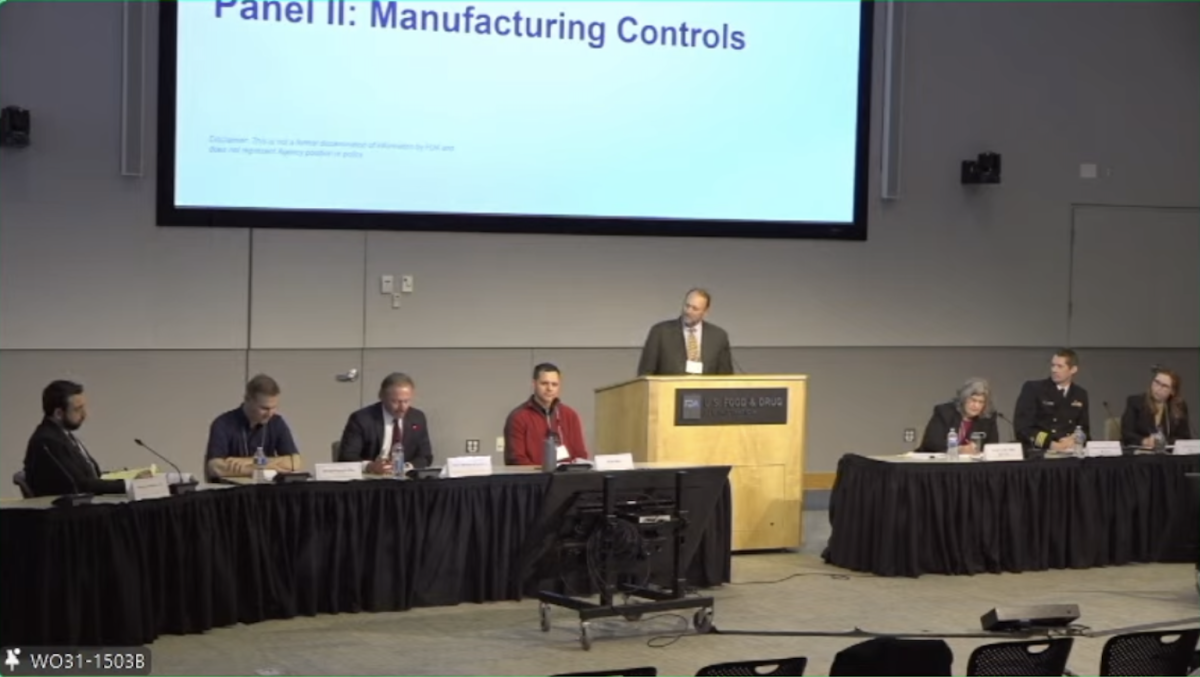
(The cover image is a screenshot from the FDA’s livestream of the PMTA roundtable.)

Click here to read the full coverage


Disclaimer
This article is provided solely for professional research, industry discussion, and informational purposes. Any references to brands, companies, products, technologies, or policies are made for factual reporting and analytical purposes only, and do not constitute endorsement, recommendation, promotion, or advertising by 2Firsts.
Nicotine-containing products, including but not limited to cigarettes, e-cigarettes, heated tobacco products, and nicotine pouches, carry significant health risks. Readers are responsible for complying with all applicable laws and regulations in their respective jurisdictions, including age restrictions and access limitations.
The information contained in this article should not be regarded as investment, legal, medical, regulatory, or commercial advice. While 2Firsts strives to ensure the accuracy and reliability of its content, it does not assume liability for any direct or indirect loss arising from errors, omissions, inaccuracies, or reliance on the information contained herein.
This article is not intended for individuals below the legal age for accessing tobacco or nicotine-related information in their jurisdiction.
Copyright Notice
This article is either original content produced by 2Firsts or content reproduced, translated, summarized, or adapted from third-party sources with attribution where applicable. The intellectual property rights of the original content remain with 2Firsts or the respective original rights holders.
No individual or organization may copy, reproduce, distribute, republish, modify, translate, or otherwise use this content without prior authorization. Any unauthorized use may result in legal action.
For copyright-related inquiries, corrections, or removal requests, please contact: info@2firsts.com.
AI-Assisted Translation and Editing Notice
Portions of this article may have been translated, edited, or reviewed with the assistance of artificial intelligence tools to improve efficiency and readability. Due to the limitations of AI-assisted translation and editing, discrepancies, omissions, or inaccuracies may exist when compared with the original source.
Where applicable, readers are advised to refer to the original source for the most complete and accurate information. If you identify any errors or believe that any content infringes upon your rights, please contact us at info@2firsts.com, and we will review and address the matter promptly.