FDA Releases Guidance on Tobacco Product Warning Labels and Ads

Regulations by 2FIRSTS.ai
Sep.13.2024
FDA Releases Guidance on Tobacco Product Warning Labels and Ads
FDA issues new guidance on tobacco warning labels, following court challenges, with plans for enforcement in 2025.

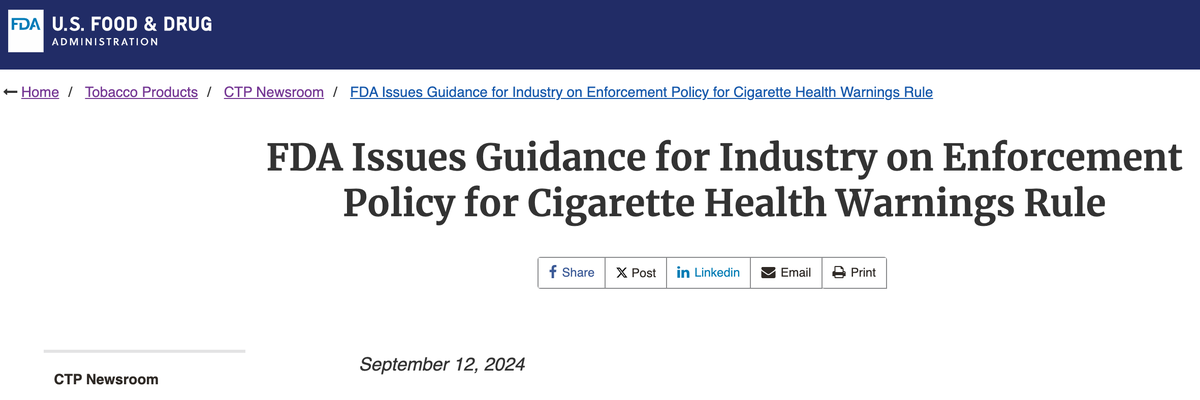
On September 12th, the U.S. Food and Drug Administration (FDA) website announced that they are providing guidance on the final rule regarding "Tobacco Products; Required Warnings for Cigarette Packages and Advertisements." The rule aims to promote greater public understanding of the negative health effects of smoking by adding new health warnings to cigarette packaging and advertisements.


The final rule was published in March 2020 and faced a challenge in the Eastern District Court of Texas. In December 2022, the district court overturned the rule. However, the government appealed this decision, and in May 2024, the United States Fifth Circuit Court of Appeals overturned the district court's ruling, reinstating the final rule, which is now officially in effect. The plaintiffs are now waiting for review by the Supreme Court.


In the newly released guidance document, the FDA plans to exercise enforcement discretion for 15 months or until December 12, 2025, generally not enforcing the requirements of final rules. For products manufactured before December 12, 2025, the FDA will also provide an additional 30-day grace period, or until January 12, 2026. The FDA has chosen a 15-month orderly transition period, consistent with the initially envisioned 15-month compliance period of the Family Smoking Prevention and Tobacco Control Act, but impacted by litigation proceedings.


The final rule also requires the industry to submit plans and obtain FDA approval to ensure that warning labels on cigarette packaging are displayed and distributed randomly and evenly, while rotating warning labels on cigarette advertisements quarterly. Therefore, entities with cigarette health warning plans that have not yet been approved are advised to submit such plans as soon as possible, but must do so within five months or by February 10, 2025. Entities that had previously submitted cigarette plans to the FDA do not need to resubmit their plans unless they wish to make changes.


We welcome news tips, article submissions, interview requests, or comments on this piece.

Please contact us at info@2firsts.com, or reach out to Alan Zhao, CEO of 2Firsts, on LinkedIn


Notice

1.  This article is intended solely for professional research purposes related to industry, technology, and policy. Any references to brands or products are made purely for objective description and do not constitute any form of endorsement, recommendation, or promotion by 2Firsts.

2.  The use of nicotine-containing products — including, but not limited to, cigarettes, e-cigarettes, nicotine pouchand heated tobacco products — carries significant health risks. Users are responsible for complying with all applicable laws and regulations in their respective jurisdictions.

3.  This article is not intended to serve as the basis for any investment decisions or financial advice. 2Firsts assumes no direct or indirect liability for any inaccuracies or errors in the content.

4.  Access to this article is strictly prohibited for individuals below the legal age in their jurisdiction.


Copyright


This article is either an original work created by 2Firsts or a reproduction from third-party sources with proper attribution. All copyrights and usage rights belong to 2Firsts or the original content provider. Unauthorized reproduction, distribution, or any other form of unauthorized use by any individual or organization is strictly prohibited. Violators will be held legally accountable.

For copyright-related inquiries, please contact: info@2firsts.com


AI Assistance Disclaimer


This article may have been enhanced using AI tools to improve translation and editorial efficiency. However, due to technical limitations, inaccuracies may occur. Readers are encouraged to refer to the cited sources for the most accurate information.

We welcome any corrections or feedback. Please contact us at: info@2firsts.com

UK Councils Seize More Than 1.3 Million Non-Compliant Vapes One Year After Disposable Ban
One year after the UK disposable vape ban came into force, local authorities continue to seize illegal and non-compliant vaping products. FOI data compiled by nicotine retailer Northerner shows more than 1.3 million products were seized between June 2025 and May 2026, with Bolton recording the highest number of seizures and Swansea reporting the highest estimated value.
Jul.21
Former ATF Official’s Claims on Chinese Vape Companies and 6-Methyl Nicotine Fuel US Regulatory Debate
Former ATF Deputy Director Edgar Domenech has warned that some Chinese vape companies may be using 6-methyl nicotine, a nicotine analogue, raising new questions over how US regulators should classify emerging nicotine compounds.
Jul.13
FDA 2025 NYTS: Youth E-Cigarette Use Declines but Unauthorized Disposables Remain Prominent; Nicotine Pouch Use Stays Low
The U.S. Food and Drug Administration (FDA) released its 2025 National Youth Tobacco Survey analysis, saying about 2.01 million U.S. middle and high school students currently used any tobacco product; among current youth e-cigarette users, unauthorized disposable brands including Geek Bar, Elf Bar, Lost Mary and Raz had high reported shares, potentially making them a focus for future enforcement.
Jun.24
Australia’s TGA Places Nicotine Pouches Under Therapeutic Goods Rules From July 24, Blocking Imports of Unapproved Products
Australia is strengthening controls on nicotine pouches under its existing therapeutic goods regulatory framework. According to the Therapeutic Goods Administration (TGA), nicotine pouch products must meet regulatory requirements, and unapproved products cannot be legally imported. The move follows Australia’s broader approach of maintaining strict oversight of nicotine products, including nicotine-containing vapes. As nicotine pouches expand globally, Australia’s regulatory approach highlights growing differences in how countries manage emerging smoke-free nicotine products.
Regulations
Jul.27
KT&G’s Lil Strengthens Market Lead in Korea as Heated Tobacco Share Reaches 47.4%
According to South Korea’s UpKorea, KT&G’s heated tobacco brand Lil reached a 47.4% share of Korea’s heated tobacco stick market in the first quarter of 2026. The company is expanding its next-generation products (NGP) business through product development, technology investment and overseas growth. KT&G reported NGP sales of 890.1 billion won (approximately US$650 million) in 2025, up significantly from 279.3 billion won in 2020. Lil products are now available in 34 markets, while KT&G continues building its technology portfolio through patents and multiple product platforms.
Jul.23
Science | International Experts Propose a New Smoking Cessation Pathway, Citing Higher Quit Rates With E-Cigarettes Than Nicotine Replacement Therapy
A new expert paper in JAMA urges U.S. clinicians to include nicotine e-cigarettes in smoking-cessation discussions, citing higher quit rates than nicotine replacement therapy. It also stresses that products must deliver enough nicotine to replace cigarettes, dual use should be brief, and complete switching is the goal. 2Firsts argues the recommendations matter beyond clinics: public-health professionals should reassess relative risk, regulators should preserve sufficient product appeal for adult smokers, and manufacturers should focus on helping users quit cigarettes more sustainably.
SCIENCE
Aug.03 by 2Firsts Perspectives