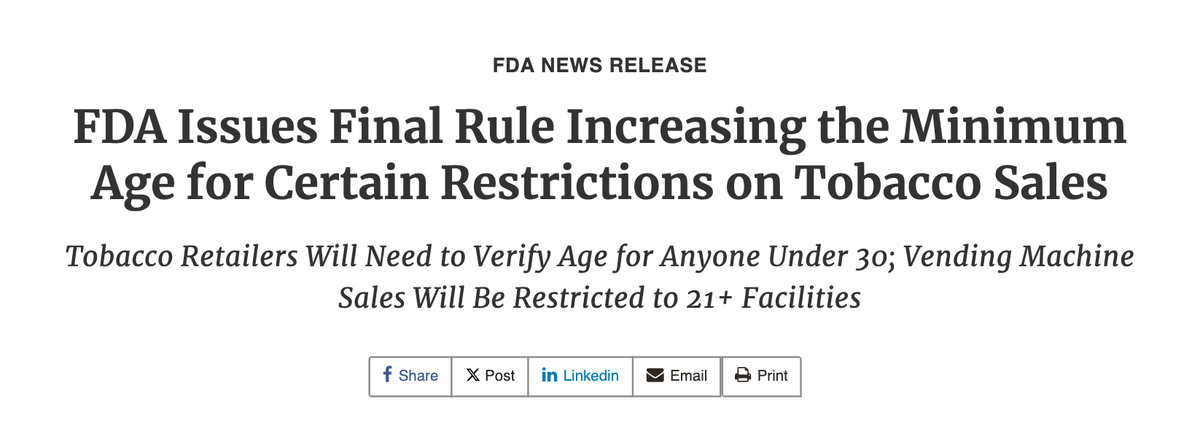
On August 29, the U.S. Food and Drug Administration (FDA) announced a new regulation increasing the minimum age for the sale of tobacco products. Starting on September 30, individuals under the age of 30 must present a photo ID when purchasing tobacco products (including e-cigarettes), previously this requirement applied to those under 27. Also starting on September 30, retailers are prohibited from selling tobacco products through vending machines in establishments where individuals under the age of 21 are allowed, as previously this ban applied to establishments allowing those under 18 to enter.
The final rule changes are aimed at maximizing the public health impact of the legislation that was passed in December 2019.
According to reports, legislation signed in December 2019 will raise the minimum age for the sale of tobacco products federally in the United States from 18 to 21. Once implemented, this regulation is expected to help reduce underage tobacco sales.
Dr. Brian King, Director of the FDA Center for Tobacco Products, expressed:
Today's regulation is a crucial step in protecting the health of our country's youth from the risks associated with tobacco products. Decades of scientific research have shown that preventing youth from accessing tobacco products is vital in reducing the number of individuals who eventually become addicted and suffer from tobacco-related diseases and deaths.
The FDA stated that this action is part of the federal government's ongoing efforts to protect young people from accessing tobacco products. Over 95% of American adults who smoke daily tried their first cigarette before the age of 21. Therefore, the FDA continues to actively enforce the federal minimum age limit for tobacco product sales, including raising the minimum age to 21. To date, the FDA has conducted over 1.5 million compliance inspections of tobacco retailers to ensure compliance with federal age restrictions. These inspections have resulted in 134,000 warning letters, over 33,000 civil fines, and 230 sales prohibitions.
The FDA continues to provide resources to retailers to enhance compliance with tobacco laws and regulations (including sales age restrictions). For example, the FDA has developed a voluntary education program called "This is Our Watch," which offers free resources to help retailers verify customer ages, including digital age verification calendars and age calculator applications. Retailers can also access information on tobacco products legally sold in the United States through a searchable tobacco product database.
We welcome news tips, article submissions, interview requests, or comments on this piece.
Please contact us at info@2firsts.com, or reach out to Alan Zhao, CEO of 2Firsts, on LinkedIn
Notice
1. This article is intended solely for professional research purposes related to industry, technology, and policy. Any references to brands or products are made purely for objective description and do not constitute any form of endorsement, recommendation, or promotion by 2Firsts.
2. The use of nicotine-containing products — including, but not limited to, cigarettes, e-cigarettes, nicotine pouchand heated tobacco products — carries significant health risks. Users are responsible for complying with all applicable laws and regulations in their respective jurisdictions.
3. This article is not intended to serve as the basis for any investment decisions or financial advice. 2Firsts assumes no direct or indirect liability for any inaccuracies or errors in the content.
4. Access to this article is strictly prohibited for individuals below the legal age in their jurisdiction.
Copyright
This article is either an original work created by 2Firsts or a reproduction from third-party sources with proper attribution. All copyrights and usage rights belong to 2Firsts or the original content provider. Unauthorized reproduction, distribution, or any other form of unauthorized use by any individual or organization is strictly prohibited. Violators will be held legally accountable.
For copyright-related inquiries, please contact: info@2firsts.com
AI Assistance Disclaimer
This article may have been enhanced using AI tools to improve translation and editorial efficiency. However, due to technical limitations, inaccuracies may occur. Readers are encouraged to refer to the cited sources for the most accurate information.
We welcome any corrections or feedback. Please contact us at: info@2firsts.com