Editor's note: On June 6, local time, the US FDA announced the voluntary withdrawal of the Marketing Denial Order (MDO) for JUUL, allowing the application to return to pending status. This is reportedly the first time the FDA has voluntarily withdrawn a Marketing Denial Order (MDO).
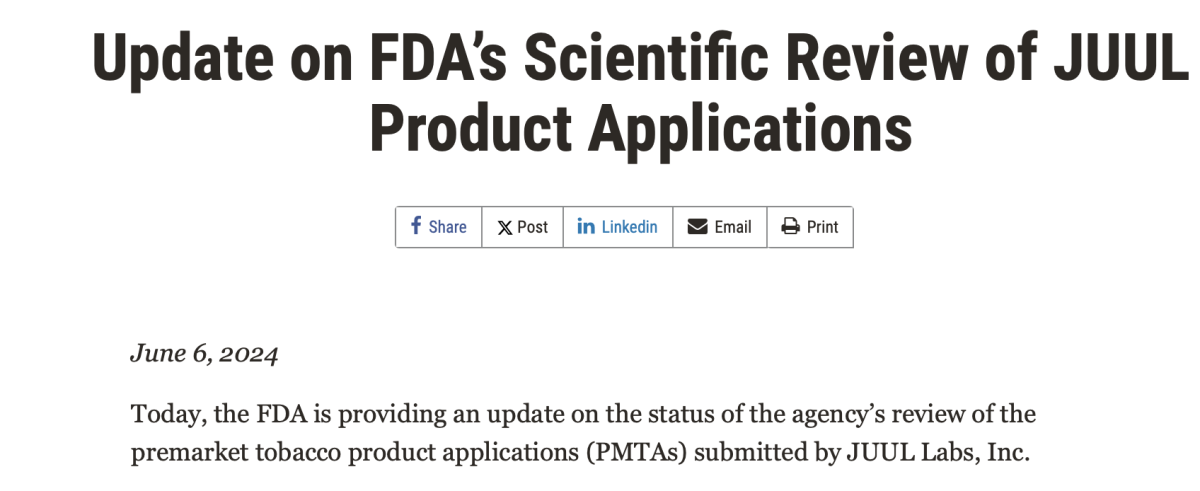
On June 6th, the Food and Drug Administration (FDA) of the United States released a press release announcing updates on its review of the Premarket Tobacco Product Applications (PMTAs) submitted by JUUL Labs, Inc.
On June 23, 2022, the FDA issued Marketing Denial Orders (MDOs) for all products of JUUL Labs, Inc. that were being sold in the United States at the time. The FDA determined that these applications lacked sufficient evidence regarding the toxic characteristics of the products, and failed to demonstrate that the marketing of the products met the public health standards required by law. When announcing the issuance of the MDOs, the FDA stated that insufficient and conflicting data on genotoxicity and potential harmful chemicals leaching from the company's proprietary pods prevented the agency from completing a comprehensive toxicological review of the products.
On July 5, 2022, the FDA administratively suspended MDOs (medical device orders) after determining that certain scientific issues required additional review. Since then, the FDA has conducted additional reviews and substantial reviews in multiple areas, including toxicology, engineering, social sciences, and clinical pharmacology.
Meanwhile, since the administrative pause of MDOs in 2022, the FDA has gained more experience in various scientific issues related to e-cigarette products and has seen new litigation outcomes in MDOs cases involving other manufacturers' e-cigarette products. Some of these court rulings have established new precedents and provided information for the FDA's product review methods to uphold its commitment to making appropriate final decisions based on science and law.
Today, on June 6th, the FDA revoked the MDOs issued to JUUL Labs, Inc. in June 2022. This action was partly due to new legal precedents and FDA's review of information provided by the applicant. Revoking the MDOs is neither an authorization nor a denial, and does not indicate whether the application is likely to be authorized or denied. Revoking the MDOs returns the application to a pending status for substantive review by the FDA. FDA regulations severely limit the information the agency can disclose about pending applications.
Once accepted and filed by the FDA, applications under review will ultimately receive either a sale permit or a sale rejection order. Additional steps may be taken temporarily during any application review, as stated on the FDA website.
The FDA's ongoing review does not change the fact that, according to the law, all e-cigarette products, including those made by JUUL, must obtain FDA authorization to legally market them.
We welcome news tips, article submissions, interview requests, or comments on this piece.
Please contact us at info@2firsts.com, or reach out to Alan Zhao, CEO of 2Firsts, on LinkedIn
Notice
1. This article is intended solely for professional research purposes related to industry, technology, and policy. Any references to brands or products are made purely for objective description and do not constitute any form of endorsement, recommendation, or promotion by 2Firsts.
2. The use of nicotine-containing products — including, but not limited to, cigarettes, e-cigarettes, nicotine pouchand heated tobacco products — carries significant health risks. Users are responsible for complying with all applicable laws and regulations in their respective jurisdictions.
3. This article is not intended to serve as the basis for any investment decisions or financial advice. 2Firsts assumes no direct or indirect liability for any inaccuracies or errors in the content.
4. Access to this article is strictly prohibited for individuals below the legal age in their jurisdiction.
Copyright
This article is either an original work created by 2Firsts or a reproduction from third-party sources with proper attribution. All copyrights and usage rights belong to 2Firsts or the original content provider. Unauthorized reproduction, distribution, or any other form of unauthorized use by any individual or organization is strictly prohibited. Violators will be held legally accountable.
For copyright-related inquiries, please contact: info@2firsts.com
AI Assistance Disclaimer
This article may have been enhanced using AI tools to improve translation and editorial efficiency. However, due to technical limitations, inaccuracies may occur. Readers are encouraged to refer to the cited sources for the most accurate information.
We welcome any corrections or feedback. Please contact us at: info@2firsts.com