JUUL Receives FDA Approval to Resume Product Sales

Regulations by 2FIRSTS.ai
Jun.07.2024
JUUL Receives FDA Approval to Resume Product Sales
Juul, US e-cigarette brand, welcomed FDA's decision to revoke sales refusal order and initiate scientific review process on June 6.

On June 6th, the American e-cigarette brand JUUL issued a statement announcing that the U.S. FDA has rescinded its Marketing Denial Orders (MDOs) for JUUL products scheduled for June 2022, and will reevaluate JUUL's application through the scientific review process. (See news article: American FDA revokes 2022 Marketing Denial Orders for JUUL products, restarts review process)
JUUL Receives FDA Approval to Resume Product Sales
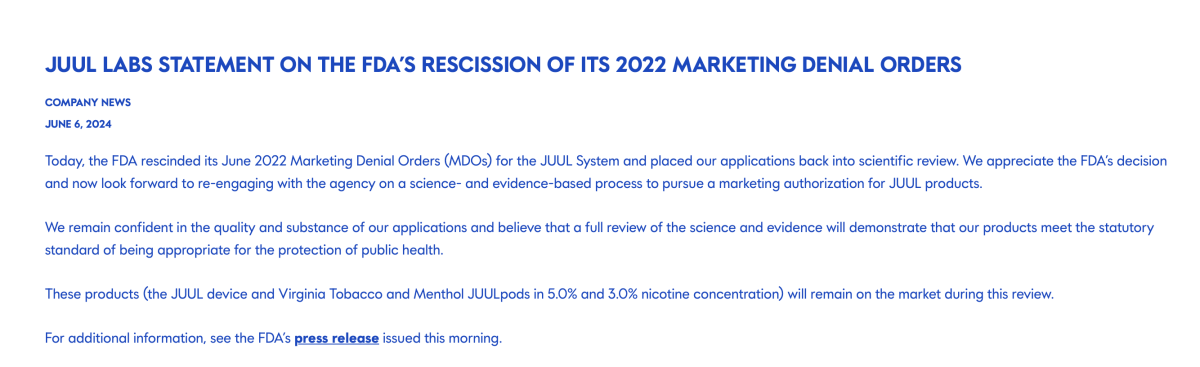
Translation: JUUL Statement | Image source: JUUL Official Website


JUUL expressed the following viewpoints in their statement:


JUUL appreciates the FDA's decision and looks forward to re-establishing contact with the agency to seek market approval for JUUL products through a scientific and evidence-based process. 

JUUL is confident in the quality and substance of their application, believing that a comprehensive review of the science and evidence will demonstrate that JUUL products meet the safety standards required to protect public health. 

During this review period, JUUL devices and Virginia Tobacco and Mint JUULpods with 5.0% and 3.0% nicotine concentration will continue to be sold on the market.


We welcome news tips, article submissions, interview requests, or comments on this piece.

Please contact us at info@2firsts.com, or reach out to Alan Zhao, CEO of 2Firsts, on LinkedIn


Notice

1.  This article is intended solely for professional research purposes related to industry, technology, and policy. Any references to brands or products are made purely for objective description and do not constitute any form of endorsement, recommendation, or promotion by 2Firsts.

2.  The use of nicotine-containing products — including, but not limited to, cigarettes, e-cigarettes, nicotine pouchand heated tobacco products — carries significant health risks. Users are responsible for complying with all applicable laws and regulations in their respective jurisdictions.

3.  This article is not intended to serve as the basis for any investment decisions or financial advice. 2Firsts assumes no direct or indirect liability for any inaccuracies or errors in the content.

4.  Access to this article is strictly prohibited for individuals below the legal age in their jurisdiction.


Copyright


This article is either an original work created by 2Firsts or a reproduction from third-party sources with proper attribution. All copyrights and usage rights belong to 2Firsts or the original content provider. Unauthorized reproduction, distribution, or any other form of unauthorized use by any individual or organization is strictly prohibited. Violators will be held legally accountable.

For copyright-related inquiries, please contact: info@2firsts.com


AI Assistance Disclaimer


This article may have been enhanced using AI tools to improve translation and editorial efficiency. However, due to technical limitations, inaccuracies may occur. Readers are encouraged to refer to the cited sources for the most accurate information.

We welcome any corrections or feedback. Please contact us at: info@2firsts.com

Uzbekistan to impose full ban on nicotine delivery devices from March 1,2026
Uzbekistan will enforce a total ban on the circulation of electronic nicotine delivery systems from March 1, covering legal sales, storage and imports. Consumers are offered a legal option to avoid criminal liability by voluntarily handing prohibited devices to law enforcement. The report says imports had already effectively stalled in early 2025, leaving sellers to clear remaining stock.
Feb.27 by 2FIRSTS.ai
Bangladesh High Court rule targets vape-ban clause; fines up to about $1,635 cited
Bangladesh’s High Court issued a rule asking why Section 6(G) of the Smoking and Tobacco Products Usage (Control) Act, 2005 — which bans the import, supply and sale of vapes and e-cigarettes — should not be declared unconstitutional and illegal.
Mar.02 by 2FIRSTS.ai
Illinois HB 4652 Targets Discarded Vapes, Would Require Manufacturer-Funded Disposal Programs
Illinois House Bill 4652 proposes e-cigarette companies establish and fund safe disposal programs to combat environmental risks.
Mar.09 by 2FIRSTS.ai
Pennsylvania Lawmaker Seeks to Keep Vape Shops Away From Schools
A Pennsylvania lawmaker is seeking legislation that would require newly licensed vape shops to be located at least 1,000 feet away from K-12 schools in the state. The proposal was put forward by State Representative Chris Pielli.
Mar.11 by 2FIRSTS.ai
Kazakhstan: Over 131,000 vapes seized in Almaty and Pavlodar case; about $1.422 million cited
Kazakhstan’s financial monitoring authorities said a group is suspected of illicitly distributing vaping devices in Almaty and Pavlodar Region, using Telegram as a sales channel with courier delivery. During searches, investigators seized more than 131,000 vapes valued at 711 million tenge (about $1.422 million, using 1 tenge = $0.0020).
Mar.04 by 2FIRSTS.ai
PMTA Manufacturing Panel Sees Small Firms Warn “Unknown Is Death” as FDA Defends Review Boundaries
During FDA’s Feb 10 PMTA roundtable (manufacturing controls panel), small ENDS manufacturers warned that uncertainty in manufacturing expectations creates existential financial risk. FDA officials reiterated review flexibility is constrained by statutory and scientific boundaries. The panel debated testing standards, documentation requirements, open-system responsibility, supply chain changes, and software updates—highlighting unresolved PMTA challenges for small manufacturers.
Feb.11