Inventor Turns Disposable E-cigarettes into Portable Power Bank

Sep.09.2024
Inventor Turns Disposable E-cigarettes into Portable Power Bank
British inventor Kris Doyle repurposes 35 disposable e-cigarette batteries to create a functional power bank, highlighting potential waste reduction.

According to a report from Ixbt on September 8th, British inventor Kris Doyle created a power bank using 35 disposable e-cigarettes.
Inventor Turns Disposable E-cigarettes into Portable Power Bank
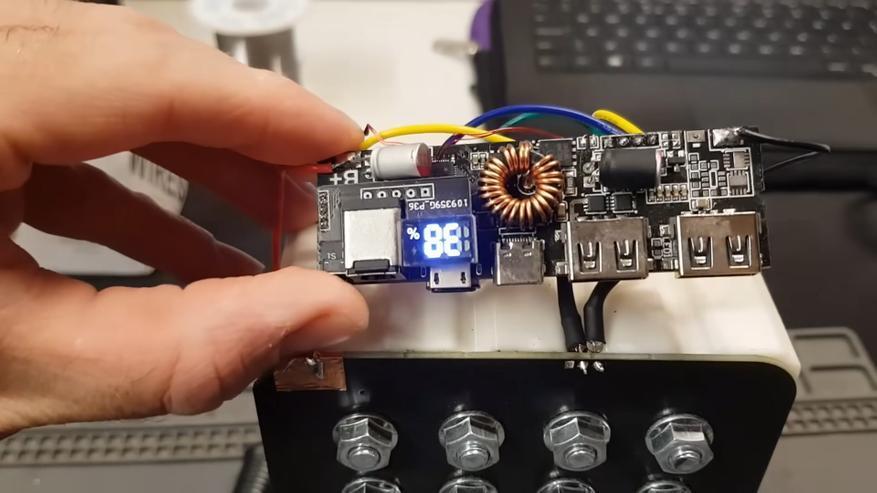
Chris Doyle made a power bank out of 35 disposable e-cigarettes. | Image source: youtu.be


In order to demonstrate the potential value of these devices, the enthusiast collected over 200 discarded e-cigarettes from the streets and music festivals.


It is estimated that around 5 million of such devices are discarded every week in the UK alone, reaching a total of 260 million per year. This amount is enough to produce batteries for 5000 electric cars or 1.3 million electric bicycles.


Furthermore, according to data from the Discovery Research Group, in 2023 Russia sold a total of 40.8 million e-cigarettes, with at least a quarter of them being disposable. This means that millions of lithium-ion batteries are being disposed of each year.


In order to raise awareness of the issue, this British inventor created a functional power bank made from discarded e-cigarette batteries. In his project, he used 35 batteries from disposable e-cigarette ELF BAR.


The production process involves several steps:


The battery is removed from the e-cigarette casing and installed in a 3D-printed holder; a custom circuit board is developed and installed to connect the battery components; another custom circuit board is used to balance the voltage between the batteries; a fast charging module with a USB port is connected; the casing is made using a 3D printer. The result is that Chris has created a power bank with approximately 20,000 milliampere-hours, supporting up to 100 watts of fast charging technology and equipped with multiple different types of ports for quickly charging smartphones and even powering laptops.


Chris emphasized that his project simply showcases the potential reuse value of discarded e-cigarettes.


Every time we dispose of five e-cigarettes, we are actually throwing away a nearly brand new iPhone 15 battery.


Currently, Chris is developing a new version of power bank, aiming to accommodate all components with a more compact design. In addition, he also plans to use approximately 100 larger capacity batteries to manufacture batteries for electric bicycles.


We welcome news tips, article submissions, interview requests, or comments on this piece.

Please contact us at info@2firsts.com, or reach out to Alan Zhao, CEO of 2Firsts, on LinkedIn


Notice

1.  This article is intended solely for professional research purposes related to industry, technology, and policy. Any references to brands or products are made purely for objective description and do not constitute any form of endorsement, recommendation, or promotion by 2Firsts.

2.  The use of nicotine-containing products — including, but not limited to, cigarettes, e-cigarettes, nicotine pouchand heated tobacco products — carries significant health risks. Users are responsible for complying with all applicable laws and regulations in their respective jurisdictions.

3.  This article is not intended to serve as the basis for any investment decisions or financial advice. 2Firsts assumes no direct or indirect liability for any inaccuracies or errors in the content.

4.  Access to this article is strictly prohibited for individuals below the legal age in their jurisdiction.


Copyright


This article is either an original work created by 2Firsts or a reproduction from third-party sources with proper attribution. All copyrights and usage rights belong to 2Firsts or the original content provider. Unauthorized reproduction, distribution, or any other form of unauthorized use by any individual or organization is strictly prohibited. Violators will be held legally accountable.

For copyright-related inquiries, please contact: info@2firsts.com


AI Assistance Disclaimer


This article may have been enhanced using AI tools to improve translation and editorial efficiency. However, due to technical limitations, inaccuracies may occur. Readers are encouraged to refer to the cited sources for the most accurate information.

We welcome any corrections or feedback. Please contact us at: info@2firsts.com

2Firsts Hosts U.S. Compliance Briefing on Building PMTA Support Capabilities Across the Nicotine Supply Chain
2Firsts held a U.S. compliance briefing in Shenzhen to help vaping, heated tobacco and nicotine pouch supply chain companies strengthen PMTA support capabilities. The event focused on supplier documentation, quality systems, traceability, TPMF/TPMP pathways, age verification and customer audit readiness as U.S. compliance expectations increasingly extend deeper into the nicotine supply chain.
Events
Jun.12
Australia Quantifies Black Market for First Time, Illicit Nicotine Products Account for About 80% of Consumption
The Australian Bureau of Statistics (ABS) has released its first estimate of the illicit nicotine market, finding that about 80% of cigarettes, vapes and other nicotine products consumed in 2025 came from illegal sources, reigniting debate over tobacco taxation and enforcement policies.
Jun.03
WIRED Investigation: Chinese-Made Vapes Turn to 6-Methyl-Nicotine and Other Analogs, Challenging U.S. Regulation
U.S. technology and investigative publication WIRED has examined how nicotine analogs are emerging as a new challenge for the country’s vape regulatory framework. The article argues that after the U.S. expanded federal oversight of nicotine products in 2022, some manufacturers began using nicotine-like compounds such as 6-methyl-nicotine that may fall outside existing definitions. Researchers cited by WIRED said some nicotine analogs could be more potent than traditional nicotine, although human health impacts remain unclear. U.S. policymakers are considering broader definitions of nicotine to bring these compounds under federal oversight.
Jul.27
Altria Smokeable Profit Rises 2.4% as Marlboro Share Falls and U.S. Discounts Gain
Altria’s second-quarter results show a U.S. nicotine market splitting across price, product and regulation. Smokeable profit rose 2.4% as Marlboro pricing offset lower volumes, while discount brand Basic gained share among value-conscious smokers. In oral nicotine, on! PLUS expanded distribution but faced intensifying competition from ZYN and Velo. NJOY remained off the market as patent and regulatory hurdles delayed its return. The broader lesson: U.S. growth increasingly depends on price-tier strategy, retail execution, authorisation and enforcement readiness across the industry.
Special Report
Jul.31
Spain Plans to Extend Smoking Ban to Terraces and Beaches, Bringing Vapes Under New Restrictions
Spain is advancing a new tobacco-control reform that would expand smoking restrictions to additional public spaces, including restaurant terraces and beaches, while bringing vaping and other nicotine products into the same regulatory framework. The proposed measures aim to reduce secondhand smoke exposure, protect young people and expand smoke-free environments. The proposal remains under legislative development, and final implementation details have not yet been confirmed.
Jul.23
Special Report | Russia, Ukraine and Belarus Launch Fresh Push to Rein in Vaping
Russia, Ukraine and Belarus are tightening vape regulation through different tools, from Ukraine’s stronger enforcement push and Belarus’s proposed advertising restrictions to Russia’s new GOST standard and regional sales-ban mechanism. As black-market concerns persist, some Russian experts argue that China’s tightly controlled but legalised model — built around licensing, traceability and taxation — may offer a more effective alternative to blanket prohibition.
Jul.15