Investigation Reveals Illegal E-cigarette Smuggling in Vietnam

Regulations by 2FIRSTS.ai
Nov.28.2023
Investigation Reveals Illegal E-cigarette Smuggling in Vietnam
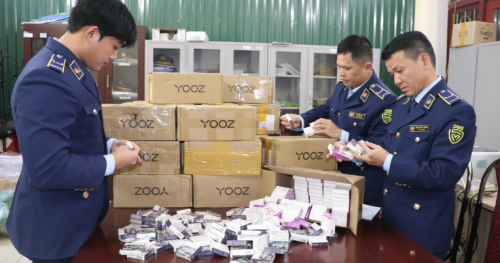
Vietnamese Market Management Team detains 2500 e-cigarettes without proof of origin during anti-smuggling operation in Gia Lai province.

According to a report by Vietq, the market management team in Gao Ping province, Vietnam, recently seized 2500 e-cigarettes. All the products were labeled with foreign languages, including the "Made in China" mark, but no invoice or documents proving their origin could be presented for the goods.


During the peak operation period of the anti-smuggling, commercial fraud, and counterfeit products campaign in late 2023, the market management team conducted an investigation and verification upon receiving information from the public. Upon confirming the illegal basis, they immediately proceeded to inspect the transportation trucks delivering goods in Gao Ping City.


According to data from the Ministry of Health, the usage rate of e-cigarettes among students has significantly increased in the past three years. In the age group of 13-17 years old, the usage rate of e-cigarettes was 2.6% in 2019, which is projected to increase to 3.5% by 2022. Among adults aged 15 and above, the use of e-cigarettes is predominantly concentrated in the age group of 15-24 years old, with a usage rate of 7.3%. The usage rate for the age groups of 25-44 years old and 45-64 years old is 3.2% each, while for the age group of 64 years and above, it is 1.4%.


We welcome news tips, article submissions, interview requests, or comments on this piece.

Please contact us at info@2firsts.com, or reach out to Alan Zhao, CEO of 2Firsts, on LinkedIn


Notice

1.  This article is intended solely for professional research purposes related to industry, technology, and policy. Any references to brands or products are made purely for objective description and do not constitute any form of endorsement, recommendation, or promotion by 2Firsts.

2.  The use of nicotine-containing products — including, but not limited to, cigarettes, e-cigarettes, nicotine pouchand heated tobacco products — carries significant health risks. Users are responsible for complying with all applicable laws and regulations in their respective jurisdictions.

3.  This article is not intended to serve as the basis for any investment decisions or financial advice. 2Firsts assumes no direct or indirect liability for any inaccuracies or errors in the content.

4.  Access to this article is strictly prohibited for individuals below the legal age in their jurisdiction.


Copyright


This article is either an original work created by 2Firsts or a reproduction from third-party sources with proper attribution. All copyrights and usage rights belong to 2Firsts or the original content provider. Unauthorized reproduction, distribution, or any other form of unauthorized use by any individual or organization is strictly prohibited. Violators will be held legally accountable.

For copyright-related inquiries, please contact: info@2firsts.com


AI Assistance Disclaimer


This article may have been enhanced using AI tools to improve translation and editorial efficiency. However, due to technical limitations, inaccuracies may occur. Readers are encouraged to refer to the cited sources for the most accurate information.

We welcome any corrections or feedback. Please contact us at: info@2firsts.com

China Tobacco Plans CNY 60 Billion Investment in ICBC, Agricultural Bank as Strategic Ties Extend Beyond Equity
China National Tobacco Corporation and several subsidiaries plan to invest a combined CNY 60 billion ($8.7 billion) in share placements by Industrial and Commercial Bank of China and Agricultural Bank of China as strategic investors. The agreements extend beyond equity investment to corporate governance, banking services and supply-chain finance. The filings also disclose 2025 data on China Tobacco’s tax and profit contributions and industry scale.
Sep.07
UAE Sets Dh1-Per-ml Minimum Excise Price for Vape Liquids From Sept. 1 While Keeping 100% Tax Rate
The UAE Ministry of Finance will introduce a minimum excise price for e-liquids used in vaping and electronic smoking devices from September 1, 2026. The minimum excise price will be set at AED 1 per millilitre. The existing 100% excise tax rate will continue to apply to tobacco and electronic smoking products. The measure changes the minimum taxable base rather than the tax rate, with the UAE government saying it aims to establish unified tax standards, improve market compliance and prevent pricing loopholes.
Regulations
Aug.07 by 2Firsts Perspectives
Australian Coalition Unveils Illicit Tobacco Plan With 80% Excise Cut and Legal, Taxed Vapes and Nicotine Pouches
Australia’s Coalition has unveiled a national illicit-tobacco policy that would cut tobacco excise by 80% and create legal, regulated and taxed adult markets for vaping products and nicotine pouches if it wins government. The plan proposes an excise of A$0.50 per millilitre of e-liquid and A$0.025 per milligram of nicotine in pouches, alongside A$200 million in additional enforcement and a A$60 million three-year public-awareness campaign. The Coalition says the package would narrow the price advantage of illicit products and undermine organised crime, while Labor and public-health groups warn that dramatically cheaper cigarettes could reverse long-term declines in smoking.
Sep.03
South Korea Extends Vape Rules to Unmanned Stores After Bringing Synthetic Nicotine Under Tobacco Law
South Korea's Ministry of Gender Equality and Family said on September 14 that it plans to designate unmanned e-cigarette stores as businesses where minors are prohibited from entering or working. Operators would be required to verify customers' ages and display notices restricting access by minors. The proposal is open for public comment through October 6. The move follows an April expansion of South Korea's statutory tobacco definition that brought products made with natural or synthetic nicotine under the Tobacco Business Act. Nicotine-free liquids and products using nicotine analogues such as 6-methylnicotine, however, remain an emerging regulatory issue.
Sep.21
Trump Names Darrell Scott as CDC Tobacco Health Adviser, Citing Tobacco Risks and Harm-Reduction Solutions
U.S. President Donald Trump has named Pastor Darrell Scott to serve as an adviser on tobacco health issues on the Centers for Disease Control and Prevention’s Advisory Committee to the Director. Trump said Scott would focus on the burden of tobacco-related disease and help examine ways to protect Americans from dangerous tobacco products while supporting solutions that reduce harm. Scott’s public career has largely centered on faith leadership, community advocacy and politics.
Sep.02
PMI Expands U.S. ZYN Portfolio With New 1.5 mg and 8 mg Strengths, Moves Toward a Unified 20-Pouch-Per-Can Format
Philip Morris International is expanding its U.S. ZYN nicotine pouch portfolio with new 1.5 mg and 8 mg strengths and plans to move its core 3 mg and 6 mg dry-pouch products from 15 to 20 pouches per can in the fourth quarter of 2026. ZYN ULTRA is also commercially available, with FDA authorization covering 10 products at 9 mg and one 11 mg Smooth product. PMI U.S. lists the new 1.5 mg and 8 mg strengths as commercially available, but as of September 10 they do not appear on the FDA’s public authorization list. Public materials do not identify which PMTA submissions cover the two new strengths or their current review status.
Sep.11