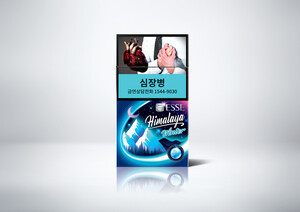
According to ENewsToday on May 27th, the new series "ESSE Himalaya Winter" stands out for its use of tobacco leaves from the Himalayas and Cold Locking Tech. In addition, the product enhances the reduction of tobacco smell in the mouth after smoking by utilizing advanced flavor-reducing technology.

The packaging design of this product incorporates a navy blue color with black and features an image of the Himalayan mountain range to emphasize the scent and image of "ESSE Himalaya Winter". The tar and nicotine content of "ESSE Himalaya Winter" are 1.0mg and 0.10mg respectively, and it is priced at 4500 Korean won (approximately $3.30) per pack.
"ESSE Himalaya Winter" is the first extension product of KT&G's "ESSE Himalaya" series to apply flavor reduction technology. Since its initial launch in South Korea in 2019, the series has rapidly gained popularity, with sales of approximately 10 million packs within four months of its release. This has paved the way for a new trend in reducing the smell of tobacco.
Song Seung-Cheol, head of the ESSE team at KT&G, stated, "ESSE Himalaya Winter not only enhances the natural aroma of tobacco leaves from clean regions such as the Himalayas, but also improves the effectiveness of reducing tobacco odor through KT&G's unique technology.
We welcome news tips, article submissions, interview requests, or comments on this piece.
Please contact us at info@2firsts.com, or reach out to Alan Zhao, CEO of 2Firsts, on LinkedIn
Notice
1. This article is intended solely for professional research purposes related to industry, technology, and policy. Any references to brands or products are made purely for objective description and do not constitute any form of endorsement, recommendation, or promotion by 2Firsts.
2. The use of nicotine-containing products — including, but not limited to, cigarettes, e-cigarettes, nicotine pouchand heated tobacco products — carries significant health risks. Users are responsible for complying with all applicable laws and regulations in their respective jurisdictions.
3. This article is not intended to serve as the basis for any investment decisions or financial advice. 2Firsts assumes no direct or indirect liability for any inaccuracies or errors in the content.
4. Access to this article is strictly prohibited for individuals below the legal age in their jurisdiction.
Copyright
This article is either an original work created by 2Firsts or a reproduction from third-party sources with proper attribution. All copyrights and usage rights belong to 2Firsts or the original content provider. Unauthorized reproduction, distribution, or any other form of unauthorized use by any individual or organization is strictly prohibited. Violators will be held legally accountable.
For copyright-related inquiries, please contact: info@2firsts.com
AI Assistance Disclaimer
This article may have been enhanced using AI tools to improve translation and editorial efficiency. However, due to technical limitations, inaccuracies may occur. Readers are encouraged to refer to the cited sources for the most accurate information.
We welcome any corrections or feedback. Please contact us at: info@2firsts.com