According to the Philippine government news site, the Philippine News Agency (PNA), on September 9th, the Bureau of Customs (BOC) recently seized a suspected smuggled shipment worth approximately 4.8 billion Philippine pesos (around 84.9 million US dollars) in a raid in Manila.
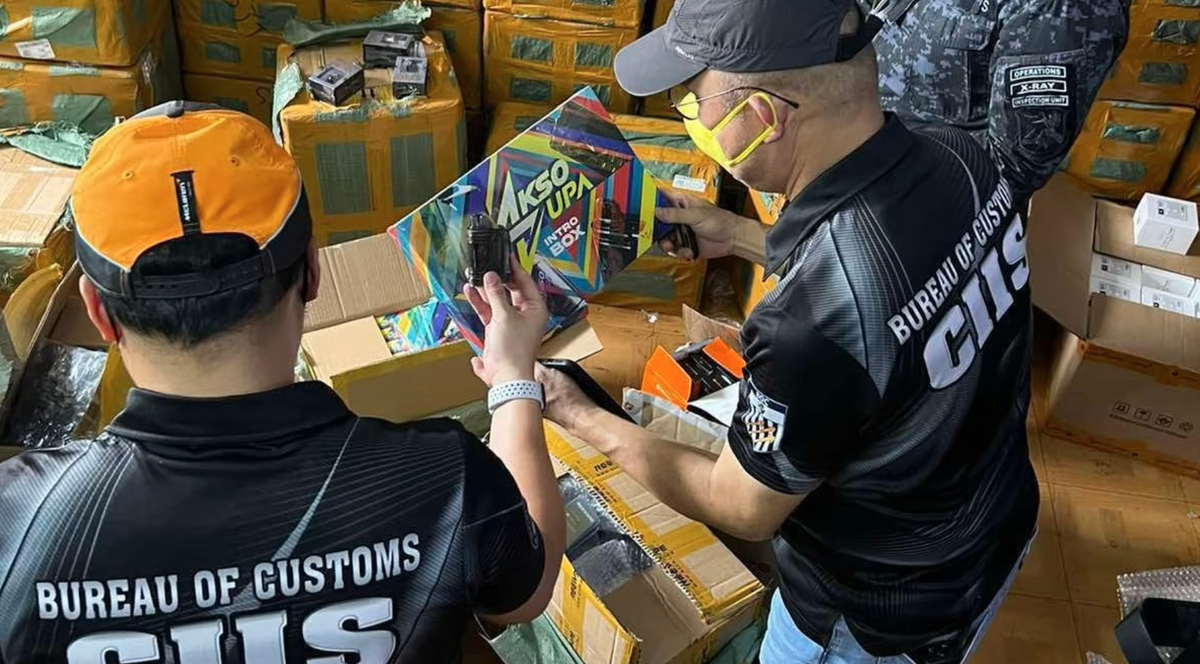
Bienvenido Rubio, Commissioner of the Bureau of Customs (BOC), announced during a press conference on Monday (9th) that the Customs Intelligence and Investigation Service of the Manila International Container Port (CIIS-MICP) conducted a raid on a warehouse in Binondo on September 6th. The raid resulted in the seizure of smuggled e-cigarettes, counterfeit branded goods, cosmetics, and household items, including e-cigarette products labeled with the brand "AKSO.
I am confident that this will be one of the biggest operations of the year for our customs bureau, with the items discovered being of significant value. In recent years, we have been monitoring multiple warehouses to prevent intellectual property infringement. As these groups and individuals become more brazen in their evasion of the law, our customs officers will spare no effort in tracking them down and prosecuting them from top to bottom.
BOC-CIIS supervisor Verne Enciso added that multiple counterfeit items with brand logos were found on several floors of the warehouse.
The customs bureau temporarily closed the warehouse storage area, waiting for designated customs inspectors to conduct a final inventory of the items. At the same time, the owners and operators of the warehouse received a notification, and within 15 days from the date of receipt of the letter, they are required to submit proof that these imported goods are legally imported and have paid the correct customs duties and taxes in accordance with the Customs Modernization and Tariff Act (CMTA) Section 224.
If the appropriate documents cannot be provided, the owners and operators of the warehouse may be held accountable for violating Section 117 (Regulated Imports and Exports) and Section 1400 (False Declaration of Goods) of the CMTA, as well as regulations related to Section 1113 (Seizure and Forfeiture of Property). Additionally, they may also face charges under the Philippine Intellectual Property Code (Republic Act No. 8293) and the Tax Reform Acceleration and Inclusion Act (Republic Act No. 10963).
In addition, the Philippine Bureau of Customs (MICP) and the Philippine Coast Guard (PCG) were also involved in this operation.
We welcome news tips, article submissions, interview requests, or comments on this piece.
Please contact us at info@2firsts.com, or reach out to Alan Zhao, CEO of 2Firsts, on LinkedIn
Notice
1. This article is intended solely for professional research purposes related to industry, technology, and policy. Any references to brands or products are made purely for objective description and do not constitute any form of endorsement, recommendation, or promotion by 2Firsts.
2. The use of nicotine-containing products — including, but not limited to, cigarettes, e-cigarettes, nicotine pouchand heated tobacco products — carries significant health risks. Users are responsible for complying with all applicable laws and regulations in their respective jurisdictions.
3. This article is not intended to serve as the basis for any investment decisions or financial advice. 2Firsts assumes no direct or indirect liability for any inaccuracies or errors in the content.
4. Access to this article is strictly prohibited for individuals below the legal age in their jurisdiction.
Copyright
This article is either an original work created by 2Firsts or a reproduction from third-party sources with proper attribution. All copyrights and usage rights belong to 2Firsts or the original content provider. Unauthorized reproduction, distribution, or any other form of unauthorized use by any individual or organization is strictly prohibited. Violators will be held legally accountable.
For copyright-related inquiries, please contact: info@2firsts.com
AI Assistance Disclaimer
This article may have been enhanced using AI tools to improve translation and editorial efficiency. However, due to technical limitations, inaccuracies may occur. Readers are encouraged to refer to the cited sources for the most accurate information.
We welcome any corrections or feedback. Please contact us at: info@2firsts.com