Meeting between State Tobacco Monopoly Administration and PMI

PMI by 2FIRSTS.ai
Jan.16.2024
Meeting between State Tobacco Monopoly Administration and PMI
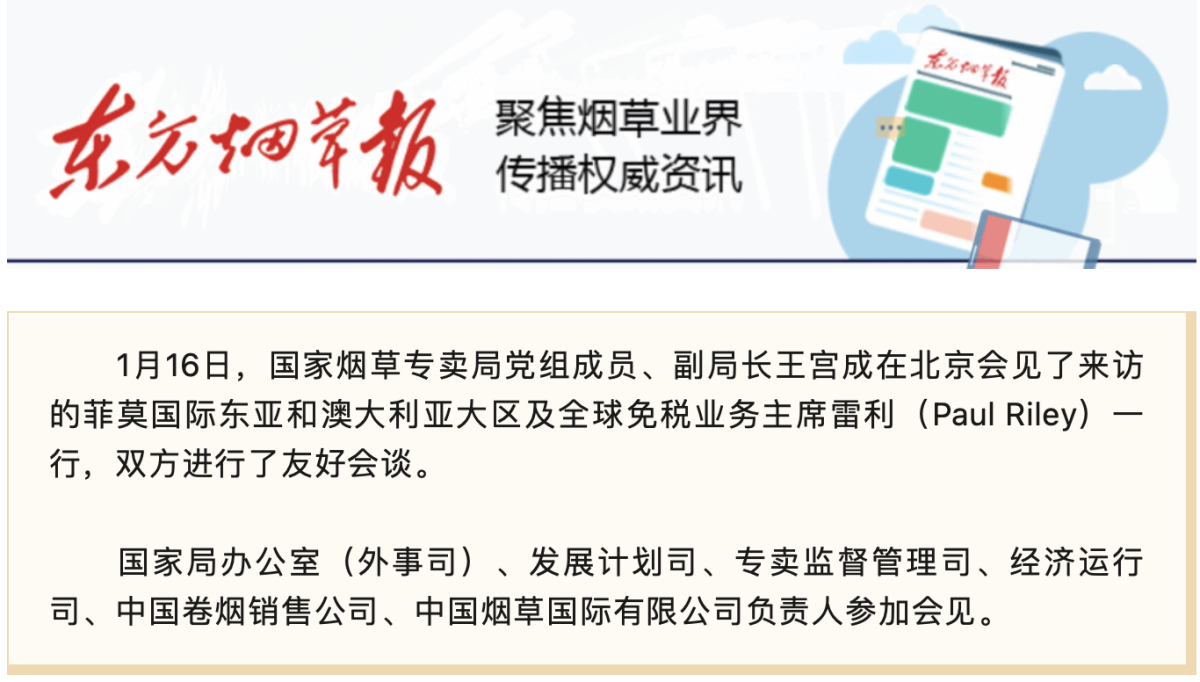
Head of State Tobacco Monopoly Administration, Wang Gongcheng, met with Philip Morris International executives in Beijing on January 16.

On January 16th, Wang Gongcheng, a member of the Communist Party group and Deputy Director of the State Tobacco Monopoly Administration, held a friendly meeting in Beijing with the visiting delegation of Paul Riley, President of East Asia and Australia Region, as well as global duty-free operations leader of Philip Morris International (PMI).


The heads of the External Affairs Division, Development Planning Division, Supervision and Administration Division for Monopolized Sales, Economic Operations Division, China National Tobacco Sales Corporation, and China Tobacco International Limited attended the meeting.


We welcome news tips, article submissions, interview requests, or comments on this piece.

Please contact us at info@2firsts.com, or reach out to Alan Zhao, CEO of 2Firsts, on LinkedIn


Notice

1.  This article is intended solely for professional research purposes related to industry, technology, and policy. Any references to brands or products are made purely for objective description and do not constitute any form of endorsement, recommendation, or promotion by 2Firsts.

2.  The use of nicotine-containing products — including, but not limited to, cigarettes, e-cigarettes, nicotine pouchand heated tobacco products — carries significant health risks. Users are responsible for complying with all applicable laws and regulations in their respective jurisdictions.

3.  This article is not intended to serve as the basis for any investment decisions or financial advice. 2Firsts assumes no direct or indirect liability for any inaccuracies or errors in the content.

4.  Access to this article is strictly prohibited for individuals below the legal age in their jurisdiction.


Copyright


This article is either an original work created by 2Firsts or a reproduction from third-party sources with proper attribution. All copyrights and usage rights belong to 2Firsts or the original content provider. Unauthorized reproduction, distribution, or any other form of unauthorized use by any individual or organization is strictly prohibited. Violators will be held legally accountable.

For copyright-related inquiries, please contact: info@2firsts.com


AI Assistance Disclaimer


This article may have been enhanced using AI tools to improve translation and editorial efficiency. However, due to technical limitations, inaccuracies may occur. Readers are encouraged to refer to the cited sources for the most accurate information.

We welcome any corrections or feedback. Please contact us at: info@2firsts.com

How AI Is Rewriting the Talent Playbook for the Nicotine Industry: JTI’s Case
AI is moving from a back-office tool to a core organizational capability in the nicotine industry. Based on JTI’s responses, this 2Firsts feature examines how AI is reshaping talent strategy, internal mobility, decision-making and human accountability as global tobacco companies compete in the shift toward new nicotine categories.
Jun.17
Product | PMI Introduces VEEV inPrime, Bringing an Induction Vaporization Platform to the Next Generation of the VEEV Portfolio
Philip Morris International (PMI) has introduced VEEV inPrime, the next-generation closed-system vape platform featuring the new AdvanceVape Induction System™. Alongside the new induction platform, PMI has redesigned the pods, e-liquid formulations and user interaction experience. According to PMI and official IQOS websites, VEEV inPrime began a phased European rollout between May and June 2026, with products now available in Greece, Estonia, the United Kingdom and Italy.
Jul.14
Italian Court Ends Six-Year Cigarette Excise Dispute, Rejecting Damages Claim
Italy’s Lazio Regional Administrative Court has dismissed an appeal by Italian Tobacco Manufacturing and Manifattura Italiana Tabacco over the cigarette excise calculation mechanism, upholding the minimum tax burden rules and excluding compensation for smaller tobacco operators.
News
Jun.26 by 2Firsts Perspectives
Indiana’s Foreign-Made Vape Ban Takes Effect, Forcing Brands and Retailers to Adjust Supply Chains
A new Indiana law restricting the sale of foreign-made vape products has taken effect, requiring retailers to adjust inventory and sourcing practices. According to The Sun, WDRB and other reports, some local vape shops are reviewing product origins and supplier information to comply with the new requirements. The measure represents a broader shift in U.S. vape regulation, with oversight expanding beyond product authorization and sales rules toward manufacturing origin and supply-chain management.
Jul.24
Minnesota Sues Loon as State Enforcement Targets U.S. Vape Brand Operators
Minnesota Attorney General Keith Ellison sued Maduro Distributors, Inc., doing business as Loon, on July 15, 2026, alleging that the company illegally manufactured, distributed and sold flavored vapes that appeal to minors.
Jul.16
Bringing Tax and Insurance Into Nicotine Regulation: Insights From a Tobacco Harm-Reduction Report
A smoke-free nicotine policy report argues that tobacco harm reduction should move beyond product bans and health warnings into tax policy, insurance pricing and risk-based regulation. While some projections remain open to debate, the report highlights a wider challenge: nicotine products, technologies and consumer behavior have changed sharply over the past decade, and regulatory systems may need new tools to better align tobacco control with harm-reduction goals.
Jun.08